
Indiana
Indiana Fireworks Laws (2026): Hours, Ages, Penalties
Independently fact-checked against primary sources (last audited September 24, 2026). · 14 primary sources cited on this page. How we verify our legal content
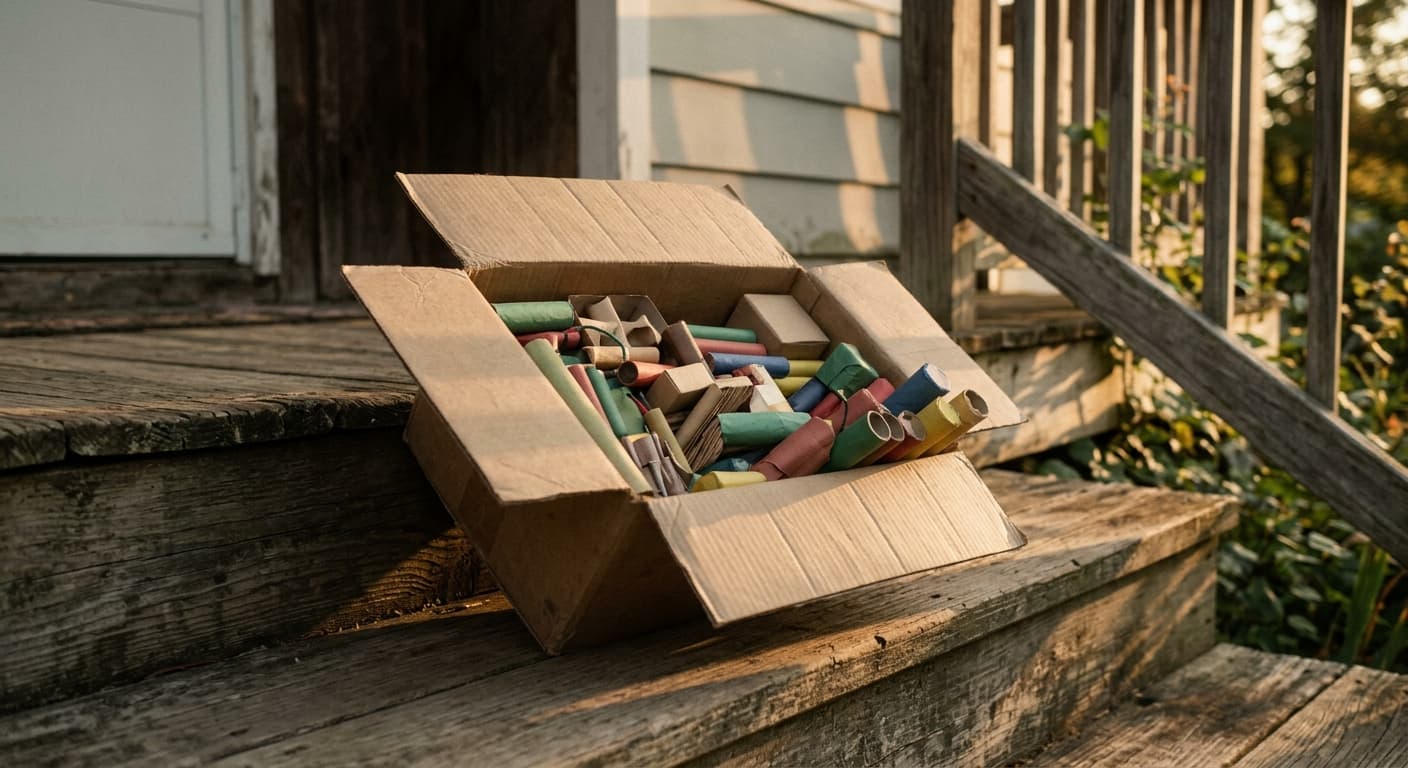
Indiana allows consumer fireworks to be sold at retail statewide through state-fire-marshal-registered retailers and wholesalers. A separate statutory list of lower-power novelty items, sparklers, fountains, snakes, and trick noisemakers among them, is likewise off-limits to a buyer under 18: the same section that sets the consumer-fireworks purchase age also bars selling or delivering any item on that list to someone under 18. Use is confined to three locations and a statewide default hours window, and a county or municipality may restrict further, but only down to a set of protected floors it cannot undercut, under Ind. Code § 22-11-14.
Jurisdiction scope: This article addresses Indiana's statewide consumer fireworks framework under Ind. Code ch. 22-11-14, including device caps, purchase age, use locations and hours, local-ordinance limits, and the penalty ladder. It does not address Indiana's separate manufacturer, distributor, and wholesaler permitting requirements under Ind. Code ch. 22-12-6 in detail.
What's Legal: Consumer Fireworks Statewide
Indiana defines "consumer firework" as "a small firework that is designed primarily to produce visible effects by combustion, and that is required to comply with the construction, chemical composition, and labeling regulations promulgated by the United States Consumer Product Safety Commission." That category is broadly legal for retail sale statewide through registered retailers and wholesalers, whether from a permanent store or a temporary stand permit.
A separate, higher-power category, "special fireworks," is not sold at a consumer retail counter. Indiana treats it as an interstate-wholesale category: its intrastate sale is limited to sales between interstate wholesalers of fireworks not approved for sale in Indiana, and each interstate wholesaler carries its own recordkeeping duty: "Each interstate wholesaler shall keep a record of each sale of special fireworks. This record must include: (1) the purchaser's name; (2) the purchaser's address; and (3) the date of the sale." The chapter also exempts from its restrictions the use of fireworks by railroads or transportation agencies for signal or illumination purposes, blank cartridges used for a show, theater, athletic, or military purpose, the possession, sale, or disposal of Class B fireworks incidental to a public display by an ATF-permitted person, and indoor pyrotechnic special-effects material used before a proximate audience.
Sparkler and Novelty Items: The Same Under-18 Sale Ban
Indiana Code 22-11-14-8 is titled "Sale of fireworks; sales to minors prohibited," and its opening subsection is a prohibition covering sparklers and novelties, not a permissive list separate from the age rule: "A person shall not sell at retail, offer for sale at retail, or deliver the following items to a person less than eighteen (18) years of age," followed by a ten-item list. The first item sets a specific composition cap: "Dipped sticks or wire sparklers. However, total pyrotechnic composition may not exceed one hundred (100) grams per item. Devices containing chlorate or perchlorate salts may not exceed five (5) grams in total composition per item." The remaining nine items, cylindrical and cone fountains, illuminating torches, wheels, ground spinners, flitter sparklers, snakes and glow worms, smoke devices, and six named trick noisemakers (party poppers, booby traps, snappers, trick matches, cigarette loads, and auto burglar alarms), carry no separate numeric weight cap in the statute beyond the general federal CPSC and DOT compliance requirement that applies to consumer fireworks generally, but every one of them is subject to the same under-18 sale prohibition as sparklers. In practice, this means the 18-and-older purchase rule described below covers sparklers and every item on this list exactly as it covers consumer fireworks, not just the higher-power category.
Purchase Age
A buyer must be at least 18 to be sold consumer fireworks: "A retailer or wholesaler of consumer fireworks may sell consumer fireworks to a person at least eighteen (18) years of age," under IC 22-11-14-8(b). The same section sets a separate age floor for the seller: "An individual who sells consumer fireworks must be at least eighteen (18) years of age," while "an individual who sells an item set forth in subsection (a)," meaning sparklers or any of the other novelty items described above, "must be at least sixteen (16) years of age," under IC 22-11-14-8(c) and (d). The fire prevention and building safety commission may adopt rules to ensure compliance with these age limits.
Where and When You Can Use Fireworks
Use is confined to three locations: a special discharge location sponsored under a permit from a municipal or township fire department chief, the user's own property, or another person's property with that owner's permission.
Indiana also sets its own statewide default hours, and violating them is a listed offense in its own right: "A person who ignites, discharges, or uses consumer fireworks: (1) after 11 p.m. except on a holiday (as defined in IC 1-1-9-1(a)) or December 31, on which dates consumer fireworks may not be ignited, discharged, or used after midnight; or (2) before 9 a.m.; commits a Class C infraction." So the statewide baseline is 9:00 a.m. to 11:00 p.m. on an ordinary day, extended to midnight on a statutory holiday or December 31, and using fireworks outside that window is itself a Class C infraction independent of any local ordinance.
Local Ordinances: A Floor Local Governments Cannot Undercut
A county or municipality may adopt its own ordinance narrowing the days and hours consumer fireworks may be used within its boundaries, on top of the statewide framework above. That local power has a hard limit built into the statute itself: "An ordinance adopted under this section: (1) may limit the use of consumer fireworks in the county or municipality; (2) may not be more lenient than a rule adopted by a state agency concerning the use of fireworks; and (3) may not limit the use of consumer fireworks: (A) between the hours of 5:00 p.m. and two (2) hours after sunset on June 29, June 30, July 1, July 2, July 3, July 5, July 6, July 7, July 8, and July 9; (B) between the hours of 10:00 a.m. and 12:00 midnight on July 4; and (C) between the hours of 10:00 a.m. on December 31 and 1:00 a.m. on January 1." A local government can shorten Indiana's default hours on an ordinary day, but it cannot touch those three protected windows around July 4 and New Year's.
Licensing and Fees
A retailer must file a location-specific application and obtain a certificate of compliance with the state fire marshal before selling consumer fireworks, and a temporary fireworks stand needs its own retail sales permit from the fire marshal. Public displays run through a separate permit track: the state fire prevention and building safety commission adopts rules "for the granting of permits for supervised public displays of fireworks by municipalities, fair associations, amusement parks, and other organizations or groups of individuals," and a permit must issue in writing before the display date. Manufacturers, distributors, wholesalers, and importers separately need a permit under IC 22-12-6, and purchasers pay a public safety fee on retail fireworks transactions.
Several sections in this chapter, and in the related manufacturer and wholesaler permit chapter, carry an already-enrolled amended version taking effect July 1, 2027: IC 22-11-14-2 (the definitions section), IC 22-11-14-4.5, IC 22-11-14-8 itself, the sales-to-minors section quoted throughout this page, IC 22-11-14-15, IC 22-12-6-1, IC 22-12-6-3, IC 22-12-6-6, IC 22-12-6-7, and IC 22-12-6-8. The version described on this page is the one currently in force; check the 2027 successor version of these sections closer to that date.
Penalties
Indiana runs a full penalty ladder rather than one flat classification. Violating specified administrative provisions of the chapter is a Class C infraction, escalating to a Class A misdemeanor if the person has an unrelated prior judgment or conviction within the preceding 5 years. Using consumer fireworks at a location other than a special discharge location, the user's own property, or another person's property with permission is a Class C infraction, escalating to a Class C misdemeanor on a repeat violation within 5 years, regardless of whether the earlier instance resulted in a judgment. A person under 18 who possesses or uses consumer fireworks without a responsible adult present commits a Class C infraction, escalating to a delinquent act under IC 31-37 on a repeat instance. Violating the statewide hours rule described above is a Class C infraction, escalating to a Class C misdemeanor on a repeat violation within 5 years.
Above that infraction tier, the chapter sets out harm-based felonies: "A person who recklessly, knowingly, or intentionally uses consumer fireworks and the violation causes harm to the property of a person commits a Class A misdemeanor. ... A person who recklessly, knowingly, or intentionally uses consumer fireworks and the violation results in serious bodily injury to a person commits a Level 6 felony. ... A person who recklessly, knowingly, or intentionally uses consumer fireworks and the violation results in the death of a person commits a Level 5 felony." Knowingly or intentionally failing to collect or remit the public safety fee described above is also a Level 6 felony.
Crossing State Lines
Federal law adds a layer on top of Indiana's own rules, and Indiana is a major source state for cross-border buying, so this cuts against Indiana buyers more than most. Under 18 U.S.C. § 836, it is a federal offense, punishable by a fine, up to one year in prison, or both, to transport fireworks into a state whose law specifically prohibits or regulates their use, or to deliver them for that transportation, knowing they will be delivered, possessed, stored, sold, or otherwise dealt with in a manner that state's law forbids; the statute excludes fireworks merely passing through a state in continuous interstate transportation, and it does not apply to common or contract carriers, to water carriers engaged in interstate commerce, or to transportation for the use of a federal agency. Separately, the U.S. Postal Service bans all fireworks from the mail entirely, for both international and domestic shipment (USPS Publication 52 § 341.22); federal consumer-product-safety rules set the device and packaging standards fireworks must meet to be sold anywhere in the country (16 C.F.R. § 1500.17 and Part 1507); and a federal explosives-licensing exemption (27 C.F.R. § 555.141(a)(7)) covers only the importation, distribution, and storage of consumer fireworks, not their manufacture. Since Indiana is already broadly permissive for consumer fireworks bought through a registered retailer, this matters most for special fireworks, or for an Indiana buyer driving a legally purchased device back into a neighboring state, such as Illinois, that bans it.
For a neighboring state that bans consumer fireworks outright, see Illinois fireworks laws. For the complete state-by-state picture, see the fireworks laws by state comparison. Indiana also maintains a separate open container law worth knowing if fireworks and holiday drinking overlap.
Disclaimer: This article provides general legal information about fireworks laws in the United States as of September 2026. It is not legal advice. Fireworks statutes, local ordinances, sale and use windows, and penalties change frequently and are often further restricted by county or city ordinance beyond what state law requires; verify the current rule for your specific city and county before buying, selling, or using fireworks, and consult a lawyer licensed in your state for advice about a specific situation.
Statutes cited reflect their in-force version as of 2026-09-17. Last updated: 2026-09-17.
Frequently Asked Questions
Are fireworks legal in Indiana?
Yes. Consumer fireworks are broadly legal for retail sale statewide through state-fire-marshal-registered retailers and wholesalers, under IC 22-11-14-1. A separate, higher-power "special fireworks" category is an interstate-wholesale category, not a consumer retail item; its intrastate sale is limited to sales between interstate wholesalers of fireworks not approved for sale in Indiana.
How old do you have to be to buy fireworks in Indiana?
18. "A retailer or wholesaler of consumer fireworks may sell consumer fireworks to a person at least eighteen (18) years of age," under IC 22-11-14-8(b). The same section bars selling sparklers, fountains, snakes, and the other listed novelty items to anyone under 18 too, so the 18-and-older rule is not limited to consumer fireworks. A seller of consumer fireworks must also be at least 18, and a seller of a novelty item must be at least 16.
What time can you legally use fireworks in Indiana?
9:00 a.m. to 11:00 p.m. by statewide default, extended to midnight on a statutory holiday or December 31, under IC 22-11-14-6(d). A local ordinance may narrow that further, but it cannot restrict use during three protected windows: the days flanking July 4, July 4 itself (10:00 a.m. to midnight), and New Year's Eve into New Year's Day (10:00 a.m. to 1:00 a.m.).
Where can you legally use fireworks in Indiana?
At a special discharge location sponsored under a fire department chief's permit, on your own property, or on someone else's property with that owner's permission, under IC 22-11-14-6.
What is the penalty for a fireworks violation in Indiana?
It scales with the violation. Using fireworks at an unauthorized location or outside legal hours is a Class C infraction, escalating to a Class C misdemeanor on a repeat violation within 5 years. Reckless, knowing, or intentional use causing property harm is a Class A misdemeanor, serious bodily injury is a Level 6 felony, and a death is a Level 5 felony, under IC 22-11-14-6.
Updates
Independently fact-checked against the cited primary sources
Independently fact-checked against the cited primary sources
The Law Behind This Article
This article rests on the statutory provisions below, held in our own legal record and retrieved from the official source. Tap a section to read the operative text.
Indiana Code, TITLE 22. LABOR AND SAFETY
§ 22-11-14-6Violations; offenses; time and dates of allowable usage of consumer fireworksIn force
Sec. 6. (a) A person who recklessly, knowingly, or intentionally violates section 2(f), 4.5, 5(c), 5(d), 7, 8(a), 8(c), 8(d), 10, or 11(c) of this chapter commits a Class C infraction. However, the offense is a Class A misdemeanor if the person has a prior unrelated judgment or conviction within the previous five (5) years. (b) A person who ignites, discharges, or uses consumer fireworks at a site other than: (1) a special discharge location; (2) the property of the person; or (3) the property of another who has given permission to use the consumer fireworks; commits a Class C infraction. However, if a person recklessly, knowingly, or intentionally takes an action described in this subsection within five (5) years after the person previously took an action described in this subsection, whether or not there has been a judgment that the person committed an infraction in taking the previous action, the person commits a Class C misdemeanor. (c) A person less than eighteen (18) years of age who possesses or uses a firework when an adult is not present and responsible at the location of the possession or use commits a Class C infraction.
Official text (excerpt) · last checked 2026-09-24 · Read the full text in our law library · Verify at iga.in.gov
§ 22-11-14-8Sale of fireworks; sales to minors prohibited; administrative rules concerning sales of fireworksIn force
Note: This version of section effective until 7-1-2027. See also following version of this section, effective 7-1-2027. Sec. 8. (a) A person shall not sell at retail, offer for sale at retail, or deliver the following items to a person less than eighteen (18) years of age: (1) Dipped sticks or wire sparklers. However, total pyrotechnic composition may not exceed one hundred (100) grams per item. Devices containing chlorate or perchlorate salts may not exceed five (5) grams in total composition per item. (2) Cylindrical fountains. (3) Cone fountains. (4) Illuminating torches. (5) Wheels. (6) Ground spinners. (7) Flitter sparklers. (8) Snakes or glow worms. (9) Smoke devices. (10) Trick noisemakers, which include: (A) Party poppers. (B) Booby traps. (C) Snappers. (D) Trick matches. (E) Cigarette loads. (F) Auto burglar alarms. (b) A retailer or wholesaler of consumer fireworks may sell consumer fireworks to a person at least eighteen (18) years of age. (c) An individual who sells consumer fireworks must be at least eighteen (18) years of age.
Official text (excerpt) · last checked 2026-07-29 · Read the full text in our law library · Verify at iga.in.gov
Cited in 4 court opinions in our collectionLatest citing opinion in our collection: 2005
Opinions citing this section in our collection:
- State v. Windy City Fireworks, Inc. (Indiana Court of Appeals 1992, 600 N.E.2d 555)“…the general public of fireworks other than those listed in I.C. 22-11-14-8. Windy City Fireworks, Inc. ("Windy C…”
- Johnson v. Celebration Fireworks, Inc. (Indiana Supreme Court 2005, 829 N.E.2d 979)“…al fireworks”) may be sold at retail to the general public. Ind. Code § 22-11-14-8 (2004). All fireworks not designated by…”
- Hill v. State (Indiana Supreme Court 1986, 488 N.E.2d 709)“…guilty by the trial court of selling fireworks illegally, Ind. Code § 22-11-14-8 and § 22-11-14-6, a Class A misdemeano…”
Identified automatically from the court opinions citing this section — not a ranking of which case controls.
§ 22-11-14-1DefinitionsIn force
Sec. 1. As used in this chapter and IC 22-11-14.5: "Auto burglar alarm" means a tube that contains pyrotechnic composition that produces a loud whistle or smoke when ignited. A small quantity of explosive, not exceeding fifty (50) milligrams, may also be used to produce a small report. A squib is used to ignite the device. "Booby trap" means a small tube with string protruding from both ends, similar to a party popper in design. The ends of the string are pulled to ignite the friction sensitive composition, producing a small report. "Chaser" means a device, containing fifty (50) milligrams or less of explosive composition, that consists of a small paper or cardboard tube that travels along the ground upon ignition. A whistling effect is often produced, and a small noise may be produced. "Cigarette load" means a small wooden peg that has been coated with a small quantity of explosive composition. Upon ignition of a cigarette containing one (1) of the pegs, a small report is produced.
Official text (excerpt) · last checked 2026-07-29 · Read the full text in our law library · Verify at iga.in.gov
Cited in 1 court opinions in our collectionLatest citing opinion in our collection: 1982
Opinions citing this section in our collection:
- City of Hammond, Lake County v. NID CORP. (Indiana Court of Appeals 1982, 435 N.E.2d 42)“…s. FACTS At all times pertinent to this case, Ind. Code 22-11-14-1 has read in part as follows: “Se…”
Identified automatically from the court opinions citing this section — not a ranking of which case controls.
§ 22-11-14-10.5"Use" defined; adoption of ordinance by county or municipality concerning use of consumer fireworksIn force
Sec. 10.5. (a) As used in this section, the term "use" means the ability of a county or municipality to regulate the days and hours when consumer fireworks may be used, ignited, or discharged. (b) Notwithstanding any other provision of this chapter: (1) a county may adopt an ordinance concerning the use of consumer fireworks in the unincorporated areas of the county; and (2) a municipality may adopt an ordinance concerning the use of consumer fireworks within the corporate limits of the municipality. (c) An ordinance adopted under this section: (1) may limit the use of consumer fireworks in the county or municipality; (2) may not be more lenient than a rule adopted by a state agency concerning the use of fireworks; and (3) may not limit the use of consumer fireworks: (A) between the hours of 5:00 p.m. and two (2) hours after sunset on June 29, June 30, July 1, July 2, July 3, July 5, July 6, July 7, July 8, and July 9; (B) between the hours of 10:00 a.m. and 12:00 midnight on July 4; and (C) between the hours of 10:00 a.m. on December 31 and 1:00 a.m. on January 1.
Official text (excerpt) · last checked 2026-07-29 · Read the full text in our law library · Verify at iga.in.gov
§ 22-11-14-10Interstate wholesalers; sales of special fireworksIn force
Sec. 10. Each interstate wholesaler shall keep a record of each sale of special fireworks. This record must include: (1) the purchaser's name; (2) the purchaser's address; and (3) the date of the sale. These records shall be kept for three (3) years and be available for inspection by the fire marshal.
Official text (excerpt) · last checked 2026-07-29 · Read the full text in our law library · Verify at iga.in.gov
Cited in 2 court opinions in our collectionLatest citing opinion in our collection: 2005
Opinions citing this section in our collection:
- Johnson v. Celebration Fireworks, Inc. (Indiana Supreme Court 2005, 829 N.E.2d 979)“…eworks out of Indiana within five days of the date of sale. Ind. Code § 22-11-14-10 (2004). The Indiana State Fire…”
- State v. Windy City Fireworks, Inc. (Indiana Court of Appeals 1992, 600 N.E.2d 555)“…was erroneous in that: (1) it incorporated the language of I.C. 22-11-14-10(b) and (2) stated that "Indiana law doe…”
Identified automatically from the court opinions citing this section — not a ranking of which case controls.
§ 22-11-14-4Wholesale sales; consumer fireworks usage; signal or ceremonial purposes; pyrotechnics special effects materialIn force
Sec. 4. (a) Nothing in this chapter shall be construed to prohibit: (1) any resident wholesaler, manufacturer, importer, or distributor from selling: (A) at wholesale fireworks not prohibited by this chapter; or (B) consumer fireworks if they are to be used: (i) on the property of the purchaser; (ii) on the property of another who has given permission to use the consumer fireworks; or (iii) at a special discharge location as set forth in section 3.5 of this chapter; (2) the use of fireworks by railroads or other transportation agencies for signal purposes or illumination; (3) the sale or use of blank cartridges for: (A) a show or theater; (B) signal or ceremonial purposes in athletics or sports; or (C) use by military organizations; (4) the intrastate sale of fireworks not approved for sale in Indiana between interstate wholesalers; (5) the possession, sale, or disposal of fireworks, incidental to the public display of Class B fireworks, by wholesalers or other persons who possess a permit to possess, store, and sell Class B explosives from the Bureau of Alcohol, Tobacco, Firearms and Explosives of the United States Department of Justice; or (6) the use of indoor…
Official text (excerpt) · last checked 2026-07-29 · Read the full text in our law library · Verify at iga.in.gov
Cited in 2 court opinions in our collectionLatest citing opinion in our collection: 1992
Opinions citing this section in our collection:
- State v. Windy City Fireworks, Inc. (Indiana Court of Appeals 1992, 600 N.E.2d 555)“…ether Final Instruction 9 was erroneous. We conclude that I.C. 22-11-14-4 does not permit retail sales to members…”
- Hill v. State (Indiana Supreme Court 1986, 488 N.E.2d 709)“…By a divided vote, the Court of Appeals concluded that Ind. Code § 22-11-14-4 permitted the sale and reversed the co…”
Identified automatically from the court opinions citing this section — not a ranking of which case controls.
§ 22-11-14-4.5Sale of consumer fireworksIn force
Note: This version of section effective until 7-1-2027. See also following version of this section, effective 7-1-2027. Sec. 4.5. (a) A retailer may sell consumer fireworks and items referenced in section 8(a) of this chapter from a tent under the following conditions: (1) The tent may not be larger than one thousand five hundred (1,500) square feet. (2) There may be only one (1) tent for each registration granted under section 11(a) of this chapter. (3) The tent may not be located closer than one hundred (100) feet from a permanent structure. (4) A vehicle may not be parked closer than twenty (20) feet from the edge of the tent. (5) The tent must be fire retardant. (6) The sales site must comply with all applicable local zoning and land use rules. (7) Sales of fireworks may be made from the tent for not more than forty-five (45) days in a year. (8) The weight of consumer fireworks in a tent may not exceed three thousand (3,000) gross pounds of consumer fireworks. (9) A retailer that legally operated a tent with a registration in 2005 may continue operation in a tent in 2006 and the following years.
Official text (excerpt) · last checked 2026-07-29 · Read the full text in our law library · Verify at iga.in.gov
§ 22-11-14-2Public displays; permits; fees; qualified operations; denial of permit; violationsIn force
Note: This version of section effective until 7-1-2027. See also following version of this section, effective 7-1-2027. Sec. 2. (a) The fire prevention and building safety commission shall: (1) adopt rules under IC 4-22-2 for the granting of permits for supervised public displays of fireworks by municipalities, fair associations, amusement parks, and other organizations or groups of individuals; and (2) establish by rule the fee for the permit, which shall be paid into the fire and building services fund created under IC 22-12-6-1. (b) The application for a permit required under subsection (a) must: (1) name a competent operator who is to officiate at the display; (2) set forth a brief resume of the operator's experience; (3) be made in writing or an electronic format; and (4) be received with the applicable fee by the department of homeland security at least five (5) business days before the display. No operator who has a prior conviction for violating this chapter may operate any display for one (1) year after the conviction.
Official text (excerpt) · last checked 2026-07-29 · Read the full text in our law library · Verify at iga.in.gov
Cited in 1 court opinions in our collectionLatest citing opinion in our collection: 1982
Opinions citing this section in our collection:
- City of Hammond, Lake County v. NID CORP. (Indiana Court of Appeals 1982, 435 N.E.2d 42)“…isdemeanor, or a felony for a third violation of section 2 (IC 22-11-14-2) provisions. A 1978 amendment made viol…”
Identified automatically from the court opinions citing this section — not a ranking of which case controls.
§ 22-11-14-15Fire prevention and building safety commission; department of state revenue; rules concerning fireworks salesIn force
Note: This version of section effective until 7-1-2027. See also following version of this section, effective 7-1-2027. Sec. 15. The fire prevention and building safety commission and the department of state revenue shall adopt rules under IC 4-22-2 to carry out this chapter.
Official text (excerpt) · last checked 2026-07-29 · Read the full text in our law library · Verify at iga.in.gov
§ 22-12-6-6Fee schedules; fire prevention and building safety commissionIn force
Note: This version of section effective until 7-1-2027. See also following version of this section, effective 7-1-2027. Sec. 6. (a) The commission may adopt rules under IC 4-22-2 setting a fee schedule for the following: (1) Fireworks display permits issued under IC 22-11-14-2. (2) Explosives magazine permits issued under IC 35-47.5-4. (3) Design releases issued under IC 22-15-3 and IC 22-15-3.2. (4) Certification of industrialized building systems and mobile structures under IC 22-15-4. (5) Inspection of regulated amusement devices under IC 22-15-7. (6) Application fees for variance requests under IC 22-13-2-11 and inspection fees for exemptions under IC 22-13-4-5. (7) Except as provided in section 6.5 of this chapter, permitting and inspection of regulated lifting devices under IC 22-15-5. (8) Permitting and inspection of regulated boiler and pressure vessels under IC 22-15-6. (9) Licensing of boiler and pressure vessel inspectors under IC 22-15-6-5. (10) Licensing of elevator contractors, elevator inspectors, and elevator mechanics under IC 22-15-5-6 through IC 22-15-5-16.
Official text (excerpt) · last checked 2026-07-29 · Read the full text in our law library · Verify at iga.in.gov
Cited in 1 court opinions in our collectionLatest citing opinion in our collection: 2016
Opinions citing this section in our collection:
- L.M. Zeller, Individually, and D/B/A Zeller Elevator Company, LEO Mark Zeller, Louis M. Zeller III, Andrew M. Boeglin, and Matthew Boeglin v. Indiana Fire Prevention (mem. dec.) (Indiana Court of Appeals 2016)“…ontransferable license fee established under IC 22-12-6-6. Court of Appeals of Indiana…”
Identified automatically from the court opinions citing this section — not a ranking of which case controls.
§ 22-12-6-8Application fees; fireworks manufacturer, distributor, wholesaler, or importer permit; fireworks retail stand permitIn force
Note: This version of section effective until 7-1-2027. See also following version of this section, effective 7-1-2027. Sec. 8. (a) The application fee for a fireworks manufacturer, distributor, wholesaler, or importer permit issued under IC 22-11-14-5 shall be set by rules adopted by the commission under IC 4-22-2. (b) The application fee for a fireworks retail stand permit issued under IC 22-11-14-7 shall be set by rules adopted by the commission under IC 4-22-2. The rules must exempt a nonprofit corporation incorporated under IC 23-7-1.1 (before its repeal on August 1, 1991) or IC 23-17 from the fee. (c) The fees set for applications under this section must be sufficient to pay all the direct and indirect costs of processing an application for which the fee is set. In setting the fees, the commission may consider differences in the degree or complexity of the activity being performed for each fee.
Official text (excerpt) · last checked 2026-07-29 · Read the full text in our law library · Verify at iga.in.gov
§ 22-12-6-1Fire and building services fundIn force
Note: This version of section effective until 7-1-2027. See also following version of this section, effective 7-1-2027. Sec. 1. (a) The fire and building services fund is established for the purpose of defraying the personal services, other operating expense, and capital outlay of the following: (1) The department. (2) The education board. (3) The commission. (b) The fund shall be administered by the department. Money collected for deposit in the fund shall be deposited at least monthly with the treasurer of state. (c) The treasurer of state shall deposit the following collected amounts in the fund: (1) Fire insurance policy premium taxes assessed under section 5 of this chapter. (2) Except as provided in section 6(d) of this chapter, all fees collected under this chapter. (3) Any money not otherwise described in this subsection but collected by the department, commission, or education board and designated for distribution to the fund by statute or the executive director of the department. (4) A fee collected by the education board for the issuance of a certification under IC 22-14-2-7.
Official text (excerpt) · last checked 2026-07-29 · Read the full text in our law library · Verify at iga.in.gov
Cited in 1 court opinions in our collectionLatest citing opinion in our collection: 2007
Opinions citing this section in our collection:
- Johnson v. Patriotic Fireworks, Inc. (Indiana Court of Appeals 2007, 871 N.E.2d 989)“…ited in the fire and building services fund as set forth in I.C. § 22-12-6-1(c). I.C. § 22-11-14-5. Subsequ…”
Identified automatically from the court opinions citing this section — not a ranking of which case controls.
§ 22-12-6-3Statewide fire and building safety education fundIn force
Note: This version of section effective until 7-1-2027. See also following version of this section, effective 7-1-2027. Sec. 3. (a) The statewide fire and building safety education fund is established to provide money to: (1) local fire and building inspection departments for enrollment in education and training programs approved by the department; and (2) the department for: (A) enrollment in education and training programs approved by the department; and (B) the sponsoring of training conferences. (b) The department shall administer the fund. The department shall distribute money from the fund in accordance with the rules adopted under IC 4-22-2 by the commission. (c) The fund consists of: (1) money allocated under section 6(d) of this chapter; and (2) fees collected under subsection (e). (d) Money in the fund at the end of a fiscal year does not revert to the state general fund. (e) The department may charge a fee for a person's participation in a training conference. The department shall deposit the fees collected under this subsection in the fund. The department shall pay all expenses associated with training conferences out of the fund.
Official text (excerpt) · last checked 2026-07-29 · Read the full text in our law library · Verify at iga.in.gov
Indiana Code, TITLE 1. GENERAL PROVISIONS
§ 1-1-9-1List; observanceIn force
Sec. 1. (a) The following are legal holidays within the state of Indiana for all purposes: New Year's Day, January 1. Martin Luther King, Jr.'s Birthday, the third Monday in January. Abraham Lincoln's Birthday, February 12. George Washington's Birthday, the third Monday in February. Good Friday, a movable feast day. Memorial Day, the last Monday in May. Independence Day, July 4. Labor Day, the first Monday in September. Columbus Day, the second Monday in October. Election Day, the day of any general, municipal, or primary election. Veterans Day, November 11. Thanksgiving Day, the fourth Thursday in November. Christmas Day, December 25. Sunday, the first day of the week. (b) When any of these holidays, other than Sunday, comes on Sunday, the following Monday shall be the legal holiday. When any of these holidays comes on Saturday, the preceding Friday shall be the legal holiday. (c) This section does not affect any action taken by the state, the general assembly while in session, or a political subdivision (as defined in IC 36-1-2-13).
Official text (excerpt) · last checked 2026-07-29 · Read the full text in our law library · Verify at iga.in.gov
Cited in 3 court opinions in our collectionLatest citing opinion in our collection: 2017
Opinions citing this section in our collection:
- Richardson v. Hansrote (Indiana Court of Appeals 2008, 883 N.E.2d 1165)“…4 . New Years Day, January 1, is a legal holiday. Ind.Code § 1-1-9-1 (a). In 2006, January 1 fell on a Sunda…”
- Kevin Dowdy v. State of Indiana (Indiana Court of Appeals 2017, 83 N.E.3d 755)“…r (2) a legal holiday listed in IC 1-1-9-1; the registration ex…”
- Russell Bridenbaugh v. Frank O'bannon, in His Official Capacity as Governor of the State of Indiana (Court of Appeals for the Seventh Circuit 1999, 185 F.3d 796)“…ion Day; Election Day; Thanksgiving Day; and Christmas Day. Ind. Code 1-1-9-1. The statute which establishes these le…”
Identified automatically from the court opinions citing this section — not a ranking of which case controls.
Code of Federal Regulations Title 16
§ 1500.17Banned hazardous substances.In forcecited in 36 of our articles
(a) Under the authority of section 2(q)(1)(B) of the act, the Commission declares as banned hazardous substances the following articles because they possess such a degree or nature of hazard that adequate cautionary labeling cannot be written and the public health and safety can be served only by keeping such articles out of interstate commerce: (1) Mixtures that are intended primarily for application to interior masonry walls, floors, etc., as a water repellant treatment and that are “extremely flammable” within the meaning of section 2(1) of the act (repeated in § 1500.3(b)(10)). (2) Carbon tetrachloride and mixtures containing it (including carbon tetrachloride and mixtures containing it used in fire extinguishers), excluding unavoidable manufacturing residues of carbon tetrachloride in other chemicals that under reasonably foreseeable conditions of use do not result in an atmospheric concentration of carbon tetrachloride greater than 10 parts per million.
Official text (excerpt) · last checked 2026-09-23 · Read the full text in our law library · Verify at ecfr.gov
Cited in 16 court opinions in our collectionLatest citing opinion in our collection: 2024
Opinions citing this section in our collection:
- United States v. Midwest Fireworks Mfg. Co., Inc. Fireworks of America Ltd. Corp. Pacific Fin. Servs. Of America, Inc. Larry Lomaz David Bowman (Court of Appeals for the Sixth Circuit 2001, 248 F.3d 563)“…venty-nine types of fireworks and the constitutionality of 16 C.F.R. § 1500.17 (a)(3) (2001). We affirm. BACKGR…”
- United States v. Charles Focht, an Individual, and Mark Focht, an Individual, Doing Business Under the Name Liberty Industries (Court of Appeals for the Third Circuit 1989, 882 F.2d 55)“…al, the government asserts the district court misconstrued 16 C.F.R. § 1500.17 (a)(3), (8) when it held the regulation…”
- United States v. Shelton Wholesale, Inc. (District Court, W.D. Missouri 1999, 34 F. Supp. 2d 1147)“…ams) of pyrotechnic composition (the "amount test"). See 16 C.F.R. § 1500.17 (a)(3). 2. for all "[r]eloadable tube…”
Identified automatically from the court opinions citing this section — not a ranking of which case controls.
Also relied on in: Fireworks Laws by State (2026): What Is Legal, Sale Dates, Penalties, Delaware Fireworks Laws (2026): Sparklers, Novelties, Dates, DC Fireworks Laws: Permitted List, Licensing, Penalties
Code of Federal Regulations Title 27
§ 555.141Exemptions.In forcecited in 41 of our articles
(a) General. Except for the provisions of §§ 555.180 and 555.181, this part does not apply to: (1) Any aspect of the transportation of explosive materials via railroad, water, highway, or air which is regulated by the U.S. Department of Transportation and its agencies, and which pertains to safety. For example, regulations issued by the Department of Transportation addressing the security risk of aliens transporting explosives by commercial motor or railroad carrier from Canada preclude the enforcement of 18 U.S.C. 842(i)(5) against persons shipping, transporting, receiving, or possessing explosives incident to and in connection with the commercial transportation of explosives by truck or rail from Canada into the United States. Questions concerning this exception should be directed to ATF's Explosives Industry Program Branch in Washington, DC. (2) The use of explosive materials in medicines and medicinal agents in the forms prescribed by the official United States Pharmacopeia or the National Formulary.
Official text (excerpt) · last checked 2026-07-28 · Read the full text in our law library · Verify at ecfr.gov
Cited in 1 court opinions in our collectionLatest citing opinion in our collection: 2006
Opinions citing this section in our collection:
- Tripoli Rocketry Ass'n v. Bureau of Alcohol, Tobacco, Firearms, & Explosives (Court of Appeals for the D.C. Circuit 2006, 437 F.3d 75)“…imported, or distributed for their intended purposes.” See 27 C.F.R. § 555.141(a)(8) (2005) (current exemption); 26 C.…”
Identified automatically from the court opinions citing this section — not a ranking of which case controls.
Also relied on in: Florida Fireworks Laws (2026): Sparklers vs. Holiday Rules, Georgia Fireworks Laws (2026): Legal Statewide, No Local Ban, Hawaii Fireworks Laws (2026): Permits, Use Windows, and Penalties
United States Code Title 18
§ 836Transportation of fireworks into State prohibiting sale or useIn forcecited in 52 of our articles
Whoever, otherwise than in the course of continuous interstate transportation through any State, transports fireworks into any State, or delivers them for transportation into any State, or attempts so to do, knowing that such fireworks are to be delivered, possessed, stored, transshipped, distributed, sold, or otherwise dealt with in a manner or for a use prohibited by the laws of such State specifically prohibiting or regulating the use of fireworks, shall be fined under this title or imprisoned not more than one year, or both. This section shall not apply to a common or contract carrier or to international or domestic water carriers engaged in interstate commerce or to the transportation of fireworks into a State for the use of Federal agencies in the carrying out or the furtherance of their operations. In the enforcement of this section, the definitions of fireworks contained in the laws of the respective States shall be applied. As used in this section, the term “State” includes the several States, Territories, and possessions of the United States, and the District of Columbia. This section shall be effective from and after July 1, 1954.
Official text (excerpt) · last checked 2026-07-28 · Read the full text in our law library · Verify at uscode.house.gov
Cited in 15 court opinions in our collectionLatest citing opinion in our collection: 2024
Opinions citing this section in our collection:
- United States v. James A. Womack (Court of Appeals for the Fifth Circuit 1981, 654 F.2d 1034)“…eworks has been traditionally left to the states. He cites 18 U.S.C.A. § 836 , which prohibits the transportation of…”
- United States v. Bernard J. Semel (Court of Appeals for the Fourth Circuit 1965, 347 F.2d 228)“…y an information containing eighteen counts with violating 18 U.S.C.A. § 836 by having feloniously caused to be tra…”
- Cohen v. Bredehoeft (District Court, S.D. Texas 1968, 290 F. Supp. 1001)“…the states from legislating in this area. On the contrary, 18 U.S.C. Sec. 836 indicates an intent to encourage state…”
Identified automatically from the court opinions citing this section — not a ranking of which case controls.
Also relied on in: Alabama Fireworks Laws (2026): Legal Fireworks, Age Rules, Penalties, Alaska Fireworks Laws (2026): Age-18 Minimum, No Sale Window, Arizona Fireworks Laws (2026): Legal Devices, Local Rules, Penalties
Search our full record of US law — 2.1 million sections, every state + federal →
Sources and References
- IC 22-11-14-1 - Definition of consumer fireworks (CPSC-compliant)(iga.in.gov).gov
- IC 22-11-14-8 - Sale of fireworks; sales to minors prohibited. Subsection (a): under-18 sale/delivery ban on sparklers and 9 other novelty items, incl. the 100g/5g composition caps; (b): 18+ consumer-fireworks buyer age; (c): consumer-fireworks seller must be 18+; (d): subsection-(a)-item seller must be 16+; (e): commission rulemaking authority. Version effective until 2027-07-01(iga.in.gov).gov
- IC 22-11-14-10 - Interstate-wholesaler recordkeeping duty for special-fireworks sales (does NOT itself bar sale to the general public; see IC 22-11-14-4(a)(4) for the actual intrastate-sale limit)(iga.in.gov).gov
- IC 22-11-14-4 - Exemptions: railroad/transportation signal use, blank cartridges for shows/athletics/military, intrastate special-fireworks sale limited to interstate-wholesaler-to-interstate-wholesaler transactions, ATF-permitted Class B display incidental sale, indoor proximate-audience pyrotechnics(iga.in.gov).gov
- IC 22-11-14-6 - Use restrictions, statewide default hours, and penalty ladder(iga.in.gov).gov
- IC 22-11-14-10.5 - County or municipal ordinance authority and protected-window floor(iga.in.gov).gov
- IC 22-11-14-2 - Public display permits; definitions cross-references. Version effective until 2027-07-01(iga.in.gov).gov
- IC 22-11-14-4.5 - Retailer certificate-of-compliance and temporary-stand permit requirements. Version effective until 2027-07-01(iga.in.gov).gov
- IC 22-11-14-15 - Fire prevention and building safety commission and department of state revenue rulemaking. Version effective until 2027-07-01(iga.in.gov).gov
- IC 22-12-6-6, IC 22-12-6-8 - Manufacturer/distributor/wholesaler permit requirements under the companion fire-safety permit chapter. Both versions effective until 2027-07-01(iga.in.gov).gov
- 18 U.S.C. § 836 - Transportation of fireworks into a state that specifically prohibits or regulates their use; carrier and federal-agency exclusions; one-year maximum penalty(uscode.house.gov).gov
- USPS Publication 52 § 341.22 - All fireworks are nonmailable explosives, prohibited from domestic and international mail(pe.usps.com).gov
- 16 C.F.R. § 1500.17 - CPSC banned-hazardous-substance device standards for fireworks(ecfr.gov).gov
- 27 C.F.R. § 555.141(a)(7) - ATF explosives-licensing exemption for the importation, distribution, and storage (not manufacture) of consumer fireworks(ecfr.gov).gov