
South Dakota
South Dakota Workplace Recording Laws
Independently fact-checked against primary sources (last audited August 15, 2026). · Reviewed by the RecordingLaw editorial team. · Law checked current as of August 15, 2026. · 7 primary sources cited on this page. How we verify our legal content
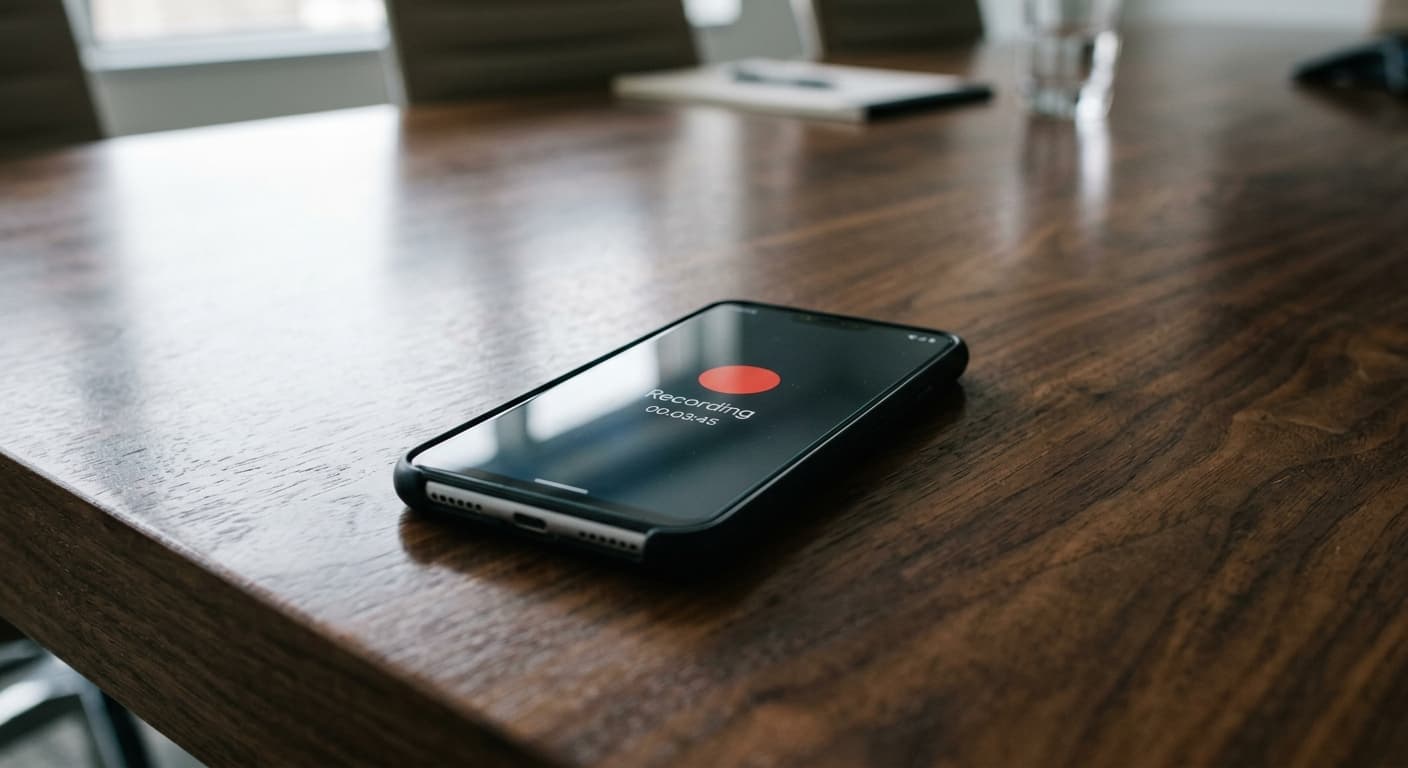
South Dakota is a one-party consent state under SDCL 23A-35A-20, so employees may record any workplace conversation they participate in without notifying coworkers or supervisors. Employers may enforce no-recording policies through discipline, but recording a conversation you join is not a crime under South Dakota law.
South Dakota's one-party consent law gives employees the legal right to record workplace conversations they participate in. Under SDCL 23A-35A-20, you can record meetings with your boss, conversations with HR, interactions with coworkers, and any other workplace discussion you are part of, all without telling anyone you are recording.
At the same time, employers have their own rights to use video surveillance in common areas, and they can adopt internal policies restricting employee recording. This guide explains how South Dakota's recording laws apply in the workplace, what both employees and employers can and cannot do, and how the federal National Labor Relations Act interacts with state law.
Employee Recording Rights in South Dakota
Your Right to Record Workplace Conversations
As a one-party consent state, South Dakota allows you to record any conversation you are part of without notifying or getting permission from the other participants. In the workplace, this means you can legally record:
- Meetings with your supervisor about performance, assignments, or expectations
- HR conversations including disciplinary meetings, grievance discussions, and exit interviews
- Conversations with coworkers about workplace conditions, safety concerns, or disputes
- Phone calls with clients, vendors, or other business contacts that you participate in
- Performance reviews and feedback sessions
- Training sessions that you attend
You can use a smartphone, a dedicated voice recorder, or any other recording device. The statute does not restrict the type of device used.
What You Cannot Record at Work
One-party consent has limits. You cannot:
- Record conversations you are not part of. Planting a recorder in a conference room and leaving to capture a meeting you are not attending is illegal wiretapping under SDCL 23A-35A-20.
- Install hidden cameras in private areas. SDCL 22-21-1 prohibits placing surveillance devices in bathrooms, locker rooms, and other private spaces.
- Intercept electronic communications between others. Reading a coworker's emails or intercepting their phone calls without consent violates both state and federal wiretapping laws.
Documenting Workplace Issues
Recording can be a valuable tool for documenting workplace problems. Common reasons employees record at work include:
- Harassment. Recording verbal harassment from a supervisor or coworker creates contemporaneous evidence that is difficult to dispute.
- Discrimination. Capturing discriminatory statements during meetings or conversations provides direct proof of discriminatory intent.
- Retaliation. Recording interactions after filing a complaint can help demonstrate a pattern of retaliatory conduct.
- Unsafe working conditions. Documenting safety violations through audio or video can support complaints to OSHA or state regulators.
- Wage disputes. Recording conversations about pay, hours, or benefits can preserve evidence of verbal agreements.
Employer Surveillance in South Dakota
Video Surveillance in the Workplace
South Dakota does not have a specific statute governing employer video surveillance. However, SDCL 22-21-1 applies to all surveillance devices in private places, including those installed by employers. The general rules are:
Cameras are permitted in:
- Sales floors and retail areas
- Warehouses and loading docks
- Parking lots and garages
- Lobbies and reception areas
- Shared office spaces
- Hallways and stairwells
- Cash register areas
Cameras are prohibited in:
- Bathrooms and restrooms
- Locker rooms and changing areas
- Private break rooms
- Nursing and lactation rooms
- Any area where employees have a reasonable expectation of complete privacy
An employer who installs a camera in a prohibited area faces Class 1 misdemeanor charges under SDCL 22-21-1, carrying up to 1 year in jail and a $2,000 fine.
Audio Surveillance by Employers
Audio recording by employers carries additional legal risk. If the employer (or its representative) is not a party to the conversation being recorded, capturing audio could violate SDCL 23A-35A-20, a Class 5 felony. Employers who install audio recording devices in common areas must ensure that at least one party to any recorded conversation has consented.
Many employers avoid audio recording entirely because of the heightened legal exposure compared to video-only surveillance.
Employer Notice Requirements
South Dakota does not have a statute requiring employers to notify employees about workplace surveillance. However, providing notice is considered a best practice for several reasons:
- It reduces the risk of invasion of privacy claims
- It helps establish that employees have no expectation of privacy in monitored areas
- It promotes transparency and trust in the workplace
- Some federal contracts and industry regulations may require disclosure
Employer No-Recording Policies
Can Your Employer Prohibit Recording?
Yes, but with limitations. South Dakota employers can adopt internal policies that prohibit or restrict employee recording in the workplace. These policies are enforceable as a matter of company discipline. If you violate a no-recording policy, your employer can:
- Issue a verbal or written warning
- Impose disciplinary action
- Suspend you
- Terminate your employment
However, violating a company no-recording policy is not a crime under South Dakota law. The recording itself remains legal under SDCL 23A-35A-20 as long as you are a party to the conversation.
NLRA Protections for Employee Recording
The National Labor Relations Act (NLRA) provides important protections that can override employer no-recording policies in certain circumstances. Under the NLRA, employees have the right to engage in "protected concerted activity," which includes discussing wages, working conditions, and safety concerns with coworkers.
The National Labor Relations Board (NLRB) has found that blanket no-recording policies can violate Section 7 of the NLRA because they chill employees' exercise of protected rights. The current controlling standard is Stericycle, Inc., 372 NLRB No. 113 (August 2, 2023), which adopted a worker-protective balancing test for evaluating workplace rules. NLRB General Counsel Memorandum GC 25-05 (February 2025) is a housekeeping rescission of prior memos and does not reinstate the Boeing standard, and GC 25-07 (June 26, 2025) addresses a narrow bargaining-session recording rule. Stericycle remains controlling.
Recording may be protected under the NLRA when:
- You are documenting unsafe working conditions to share with coworkers or regulators
- You are gathering evidence of wage theft or labor law violations
- You are recording discussions about unionization or collective bargaining
- You are preserving evidence of unfair labor practices
Employers cannot discipline employees for recording activity that falls under NLRA protection, regardless of internal policies.
Whistleblower Protections
South Dakota's whistleblower protections and federal whistleblower statutes may also protect employees who record evidence of illegal activity. Employees who record conversations documenting fraud, safety violations, or other unlawful conduct may be shielded from retaliation under applicable whistleblower laws.
Specific Workplace Recording Scenarios

Can I Record a Meeting With HR?
Yes. Under South Dakota's one-party consent law, you can record any meeting you attend, including HR meetings. This is particularly common during:
- Disciplinary proceedings
- Termination meetings
- Grievance hearings
- Accommodation request discussions
- Return-to-work meetings after leave
HR may have a policy against recording, but the recording itself is legal. Consider whether the value of having a recording outweighs the risk of disciplinary action for violating company policy.
Can I Record a Coworker Who Is Harassing Me?
Yes. If you are the target of verbal harassment and you are present during the harassing conduct, you can record it. This type of evidence can be powerful in:
- Internal complaints to HR or management
- EEOC discrimination and harassment complaints
- State human rights commission proceedings
- Civil lawsuits for hostile work environment
Can My Employer Record Me Without Telling Me?
An employer can conduct video-only surveillance in common areas without specifically notifying individual employees, though posting signage is recommended. For audio recording, the employer or its representative must be a party to the conversation to satisfy one-party consent. An employer cannot install a hidden audio recorder to capture employee conversations that no management representative participates in.
Can I Record a Phone Call With a Client?
Yes, as long as you are a participant in the call. Be aware that if the client is in a two-party consent state, the stricter law may apply. Many businesses address this by including recording notices in their standard call scripts.
Using Workplace Recordings as Evidence
Employment Disputes
Recordings made lawfully under South Dakota's one-party consent law are generally admissible in:
- Employment discrimination cases
- Sexual harassment claims
- Wrongful termination lawsuits
- Wage and hour disputes
- Workers' compensation hearings
- Unemployment benefit appeals
Courts will evaluate the recording's authenticity, relevance, and whether its probative value outweighs any prejudicial effect.
Administrative Proceedings
Recordings can also be submitted as evidence in:
- EEOC complaints and investigations
- OSHA complaints about workplace safety
- South Dakota Department of Labor proceedings
- Unemployment insurance hearings
Best Practices for Workplace Recordings
- Keep the original file unedited. Never alter, splice, or selectively edit a workplace recording.
- Note the date, time, location, and participants as soon as possible after recording.
- Store recordings securely on a personal device or personal cloud storage, not on employer-owned equipment.
- Do not share recordings publicly before consulting with an attorney.
- Back up recordings immediately to prevent accidental loss.
Remote Work and Recording
With more South Dakota employees working remotely, recording rules for virtual meetings have become increasingly relevant. The same one-party consent rules apply:
- You can record Zoom, Teams, or Google Meet calls you participate in
- If other participants are in two-party consent states, the stricter law applies
- Employer policies about recording virtual meetings should be reviewed
- Platform-generated recordings (like Zoom's built-in recording feature) typically notify all participants, which avoids consent issues
More South Dakota Recording Laws
Audio Recording | Video Recording | Voyeurism & Hidden Cameras | Workplace Recording | Recording Police | Phone Call Recording | Security Cameras | Recording in Public | Landlord-Tenant | Dashcam Laws | Schools | Medical Recording
Back to South Dakota Recording Laws
More South Dakota Recording Topics
More South Dakota Laws
Frequently Asked Questions
Can I record my boss in South Dakota?
Yes. South Dakota is a one-party consent state under SDCL 23A-35A-20. You can record any conversation you participate in at work, including meetings with your supervisor, without their knowledge or permission. However, your employer may have a no-recording policy that could result in disciplinary action.
Can my employer record me at work in South Dakota?
Your employer can use video cameras in common work areas like sales floors and hallways. They cannot install cameras in bathrooms, locker rooms, or changing areas under SDCL 22-21-1. Audio recording by employers requires one-party consent, meaning the employer or a representative must be a participant in the recorded conversation.
Can I be fired for recording at work in South Dakota?
While the recording itself is legal under South Dakota law, your employer can fire you for violating a company no-recording policy. However, if your recording is part of protected concerted activity under the National Labor Relations Act (such as documenting unsafe conditions or wage violations), terminating you for recording could be an unfair labor practice.
Can I use a workplace recording as evidence in a lawsuit?
Yes. Recordings made lawfully under South Dakota one-party consent are generally admissible in employment discrimination cases, harassment claims, wage disputes, and other legal proceedings. The recording must be authenticated as genuine and unaltered.
Does my employer have to tell me about security cameras?
South Dakota does not have a specific statute requiring employers to notify employees about video surveillance. However, providing notice through signage or employee handbook policies is considered a best practice and helps establish that employees have no expectation of privacy in monitored areas.
Updates
Independently fact-checked against the cited primary sources; governing law re-checked for recent changes
Governing law re-checked for recent changes
Reviewed and approved by an editor
The Law Behind This Article
This article rests on the statutory provisions below, held in our own legal record and retrieved from the official source. Tap a section to read the operative text.
South Dakota Codified Laws, Chapter 23A-35A: INTERCEPTION OF WIRE, ELECTRONIC, OR ORAL COMMUNICATIONS
§ 23A-35A-20Overhearing or recording communications, conversations, or jury deliberations by means of eavesdropping device as felony.In forcecited in 17 of our articles
Except as provided in § 23A-35A-21, a person is guilty of a Class 5 felony who is not: (1) A sender or receiver of a communication who intentionally and by means of an eavesdropping device overhears or records a communication, or aids, authorizes, employs, procures, or permits another to overhear or record, without the consent of either a sender or receiver of the communication; (2) A person present during a conversation or discussion who intentionally and by means of an eavesdropping device overhears or records the conversation or discussion, or aids, authorizes, employs, procures, or permits another to overhear or record, without the consent of a party to the conversation or discussion; or (3) A member of a jury who intentionally records or listens to by means of an eavesdropping device the deliberations of the jury or aids, authorizes, employs, procures, or permits another to record or listen.
Official text (excerpt) · last checked 2026-08-31 · Read the full text in our law library · Verify at sdlegislature.gov
Cited in 3 court opinions in our collectionLatest citing opinion in our collection: 2022
Opinions citing this section in our collection:
- State v. Woods (South Dakota Supreme Court 1985, 361 N.W.2d 620)“…ent fails. We next address the State’s argument that SDCL 23A-35A-20(2) exempts one party consent recordings…”
- State v. Braddock (South Dakota Supreme Court 1990, 452 N.W.2d 785)“…nsent recordings without prior court authorization” because SDCL 23A-35A-20 exempts from criminal liability a perso…”
- Gantvoort v. Ranschau (South Dakota Supreme Court 2022, 2022 S.D. 22)“…ff when no noise was detected in the room. 3. SDCL 23A-35A-20(1)–(2), which criminalizes recordings m…”
Identified automatically from the court opinions citing this section — not a ranking of which case controls.
Also relied on in: South Dakota Recording Laws (2026): One-Party Consent Rules, South Dakota Security Camera Laws, South Dakota Audio Recording Laws
South Dakota Codified Laws, Chapter 22-21: INVASIONS OF PRIVACY
§ 22-21-1Eavesdropping--Privacy--Misdemeanor.In forcecited in 14 of our articles
No person may, except as authorized by law: (1) Trespass on property with intent to subject anyone to eavesdropping or other surveillance in a private place; or (2) Install in any private place, without the consent of the person or persons entitled to privacy there, any device for observing, photographing, recording, amplifying, or broadcasting sounds or events in such place, or uses any such unauthorized installation. A person who violates this section is guilty of a Class 1 misdemeanor. Subdivision (2) does not apply to law enforcement officers, or to those acting under the direction of a law enforcement officer, while engaged in the performance of the officer's lawful duties.
Official text (excerpt) · last checked 2026-08-31 · Read the full text in our law library · Verify at sdlegislature.gov
Cited in 3 court opinions in our collectionLatest citing opinion in our collection: 2022
Opinions citing this section in our collection:
- State v. Olson (South Dakota Supreme Court 1981, 305 N.W.2d 852)“…9,1980, appellant was arraigned on four counts of violating SDCL 22-21-1(1) 1 and one count of viol…”
- State v. Reif (South Dakota Supreme Court 1992, 490 N.W.2d 511)“…d to "reasonably satisfy" the court that appellant violated SDCL 22-21-1(1) and that these activities were suffi…”
- Gantvoort v. Ranschau (South Dakota Supreme Court 2022, 2022 S.D. 22)“…Further, placing such a device is a class one misdemeanor. SDCL 22-21-1(2), provides in part that:…”
Identified automatically from the court opinions citing this section — not a ranking of which case controls.
Also relied on in: South Dakota Dashcam Laws, South Dakota Landlord-Tenant Recording Laws, South Dakota Medical Recording Laws
United States Code Title 18
§ 2511Interception and disclosure of wire, oral, or electronic communications prohibitedIn forcecited in 422 of our articles
Except as otherwise specifically provided in this chapter any person who— intentionally intercepts, endeavors to intercept, or procures any other person to intercept or endeavor to intercept, any wire, oral, or electronic communication; intentionally uses, endeavors to use, or procures any other person to use or endeavor to use any electronic, mechanical, or other device to intercept any oral communication when— such device is affixed to, or otherwise transmits a signal through, a wire, cable, or other like connection used in wire communication; or such device transmits communications by radio, or interferes with the transmission of such communication; or such person knows, or has reason to know, that such device or any component thereof has been sent through the mail or transported in interstate or foreign commerce; or such use or endeavor to use (A) takes place on the premises of any business or other commercial establishment the operations of which affect interstate or foreign commerce; or (B) obtains or is for the purpose of obtaining information relating to the operations of any business or other commercial establishment the operations of which affect interstate or foreign…
Official text (excerpt) · last checked 2026-08-28 · Read the full text in our law library · Verify at uscode.house.gov
Cited in 2,045 court opinions in our collectionLatest citing opinion in our collection: 2026
In the courts (editorial summary, independently checked):Griggs-Ryan v. Smith (1990) applied the Section 2511(2)(d) prior-consent exception, treating a tenant repeatedly told that all incoming calls were taped as having impliedly consented. United States v. United States District Court (1972) read the then-current Section 2511(3) as conferring no presidential surveillance power.
Opinions citing this section in our collection:
- Mitchell v. Forsyth (Supreme Court of the United States 1985, 472 U.S. 511)✓The Attorney General authorized a warrantless 1970 national security wiretap that caught the plaintiff's calls; the Court held the since-repealed Section 2511(3) disclaimer left the tap lawful under Title III, and that Mitchell had qualified immunity.
- United States v. United States District Court for the Eastern District of Michigan (Supreme Court of the United States 1972, 407 U.S. 297)✓The Attorney General approved warrantless wiretaps on members of a domestic group accused of bombing a CIA office; the Court read Section 2511(3) as a congressional disclaimer conferring no surveillance power, then held the Fourth Amendment required prior judicial approval.
- Forsyth v. Barr (Court of Appeals for the Fifth Circuit 1994, 19 F.3d 1527)✓Dallas police used, in an internal affairs probe of an officer, calls private parties allegedly intercepted illegally; assuming that was unlawful, the Fifth Circuit held Section 2517(1) and (2) allowed the disclosure and use, defeating the Section 2511(1)(c) and (d) claims.
Identified automatically from the court opinions citing this section — not a ranking of which case controls.
Also relied on in: Connecticut Recording Laws (2026): Hybrid Consent Rules Explained, Oregon Recording Laws (2026): Hybrid One-Party and All-Party Rules, US Recording Laws by State (2026): All 50 States Explained
Search our full record of US law — 2.1 million sections, every state + federal →
Sources and References
- SDCL 23A-35A-20 -- Overhearing or Recording Communications by Means of Eavesdropping Device(sdlegislature.gov).gov
- SDCL 22-21-1 -- Trespassing With Intent to Eavesdrop; Hidden Cameras and Drones(sdlegislature.gov).gov
- National Labor Relations Act(nlrb.gov).gov
- NLRB GC Memo 23-02 (2022) - Electronic Surveillance and Algorithmic Management(nlrb.gov).gov
- OSHA -- Occupational Safety and Health Administration(osha.gov).gov
- EEOC -- Equal Employment Opportunity Commission(eeoc.gov).gov
- 18 U.S.C. 2511 -- Federal Wiretap Act(uscode.house.gov).gov