
South Dakota
South Dakota School Recording Laws
Independently fact-checked against primary sources (last audited August 15, 2026). · Reviewed by the RecordingLaw editorial team. · Law checked current as of August 15, 2026. · 7 primary sources cited on this page. How we verify our legal content
South Dakota's one-party consent law (SDCL 23A-35A-20) permits any participant in a conversation, including students and parents, to record meetings, classroom interactions, and school conferences without notifying the other party. FERPA (20 U.S.C. 1232g) separately governs how schools may share recordings that contain identifiable student education records.
Recording in South Dakota schools involves a mix of state recording law, federal student privacy protections, and individual school district policies. South Dakota's one-party consent law (SDCL 23A-35A-20) allows participants in conversations to record without notifying others, but schools also must comply with the Family Educational Rights and Privacy Act (FERPA) and may have their own rules about recording on school grounds.
This guide covers student, parent, and teacher recording rights, school security cameras, school board meeting recording, IEP and special education meeting recording, and how these different legal frameworks interact.
Student Recording Rights
Can Students Record at School?
Under South Dakota's one-party consent law, students can legally record conversations they participate in. This includes:
- Conversations with teachers about grades or assignments
- Discussions with school counselors (subject to counselor-student privilege considerations)
- Interactions with school administrators
- Conversations with other students
However, school districts have the authority to adopt policies that restrict recording on school grounds. A student who records in violation of a school policy could face disciplinary action, even though the recording itself is legal under state law.
Common School Recording Policies
Many South Dakota school districts have policies that:
- Prohibit students from using recording devices during class without teacher permission
- Restrict cell phone use during instructional time
- Require permission before recording other students
- Ban recording in certain areas like locker rooms and restrooms
Before recording at school, students should review their school's student handbook and acceptable use policies.
Recording Bullying and Harassment
Students who are experiencing bullying or harassment may want to record incidents as evidence. Under one-party consent, a student being bullied can record the interaction. These recordings can be valuable when:
- Filing a complaint with school administrators
- Providing evidence to parents
- Supporting a formal bullying investigation
- Documenting a pattern of harassment
South Dakota's anti-bullying law requires school districts to adopt policies that address bullying behavior. Recordings can help substantiate complaints under these policies.
Parent Recording Rights
Recording Meetings With Teachers and Administrators
South Dakota parents can record conversations with teachers, principals, counselors, and other school staff under one-party consent. Common situations where parents record include:
- Parent-teacher conferences. Recording the discussion helps parents remember details about their child's academic progress and teacher recommendations.
- Disciplinary meetings. When a child faces suspension or expulsion, recording the meeting preserves a complete record of what was said.
- Meetings about academic concerns. Recording discussions about grade disputes, curriculum issues, or placement decisions provides documentation.
- Safety discussions. Recording conversations about bullying incidents, safety concerns, or emergency protocols.
IEP and 504 Plan Meetings
Parents of students with disabilities frequently want to record Individualized Education Program (IEP) and Section 504 plan meetings. Under South Dakota's one-party consent law, a parent attending the meeting can record it without notifying the school.
However, some school districts have policies that require advance notice before recording IEP or 504 meetings. The U.S. Department of Education has stated that FERPA does not prohibit parents from recording IEP meetings, and that the decision is left to state law and local policy.
Practical considerations for recording IEP/504 meetings:
- Check whether your school district has a specific recording policy for IEP meetings
- If the district requires notice, provide it in advance to avoid delays or meeting cancellations
- Recording can help you review complex information about accommodations, goals, and services
- If a dispute arises, the recording provides an objective record of what was discussed and agreed upon
Recording DCFS Interactions at Schools
If Department of Social Services workers meet with your child at school and you are present, you can record the interaction under one-party consent. If you are not present, you cannot direct the school to record on your behalf.
Teacher and Staff Recording Rights
Can Teachers Record Students?
Teachers participating in conversations with students can record those conversations under one-party consent. However, teachers should be aware of:
- FERPA restrictions on sharing recordings that contain student educational information
- School district policies that may restrict teacher recording
- Privacy concerns when recording minors
- Union agreements that may address recording in the classroom
Classroom Recording for Educational Purposes
Teachers who record lectures or class sessions for educational purposes (posting to learning management systems, providing to absent students) should:
- Follow their district's policies on recording and sharing classroom content
- Be aware that recordings of students may become education records subject to FERPA
- Obtain appropriate consent if sharing recordings beyond the classroom
- Avoid recording in areas where students have privacy expectations
School Security Cameras
Where Schools Can Place Cameras
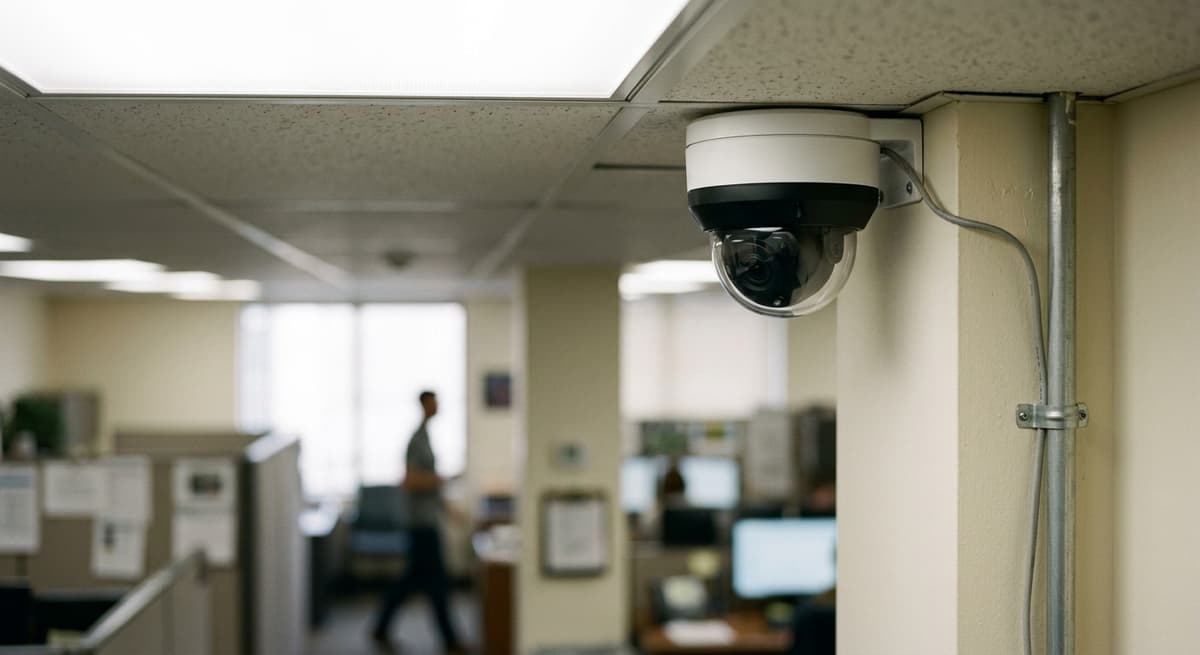
South Dakota schools widely use security cameras for safety and monitoring. Under SDCL 22-21-1, cameras are permitted in areas where students have no reasonable expectation of privacy:
- Hallways and corridors
- Cafeterias and lunch areas
- Gymnasiums (during general use, not as changing areas)
- Parking lots and exterior grounds
- Libraries and common study areas
- School entrances and exits
- Bus loading zones
Where Schools Cannot Place Cameras
Schools cannot install cameras in locations where students have a reasonable expectation of privacy:
- Restrooms and bathrooms
- Locker rooms and changing areas
- Shower facilities
- Health office examination areas
- Counseling offices during private sessions
Violating SDCL 22-21-1 by placing cameras in these areas is a Class 1 misdemeanor carrying up to 1 year in jail and a $2,000 fine.
Audio on School Security Cameras
School security cameras that capture audio raise additional legal concerns. Under SDCL 23A-35A-20, recording audio of conversations requires at least one party's consent. A security camera in a hallway that records conversations between students that no staff member is participating in could technically violate the wiretapping statute. Many school districts use video-only surveillance to avoid this issue.
School Board Meeting Recording
Your Right to Record Open Meetings
South Dakota's Open Meetings Law (SDCL 1-25-11) explicitly protects the right to record public school board meetings. No school board can prevent the public from recording an open meeting as long as the recording is reasonable, obvious, and not disruptive.
You can record:
- Regular school board meetings
- Special school board meetings
- Public hearings on school budgets, policies, or construction
- Committee meetings that are open to the public
Executive Sessions
School boards can close portions of meetings (executive sessions) for specific reasons under SDCL 1-25-2, such as student disciplinary matters, personnel issues, or pending litigation. Recording is not permitted during closed sessions.
FERPA and Recording
How FERPA Affects School Recording
The Family Educational Rights and Privacy Act (FERPA) is a federal law that protects the privacy of student education records. FERPA does not directly regulate recording, but it affects how recordings containing student information can be used and shared.
Key FERPA principles related to recording:
- Recordings of students that become part of their education records are protected by FERPA
- Schools cannot release recordings containing identifiable student information without parent consent (or student consent for students 18 and older)
- Security camera footage that captures identifiable students may be subject to FERPA when maintained as education records
- Parents have the right to inspect and review their own child's education records, which may include recordings
FERPA and Parent Recordings
FERPA does not prevent parents from making their own recordings during school meetings. A parent's personal recording of an IEP meeting or parent-teacher conference is the parent's property, not a school education record. The parent is not bound by FERPA in how they use their own recording.
However, if a parent's recording captures personally identifiable information about other students (for example, other students' names and grades mentioned during a meeting), sharing that recording publicly could raise privacy concerns.
More South Dakota Recording Laws
Audio Recording | Video Recording | Voyeurism & Hidden Cameras | Workplace Recording | Recording Police | Phone Call Recording | Security Cameras | Recording in Public | Landlord-Tenant | Dashcam Laws | Schools | Medical Recording
Back to South Dakota Recording Laws
More South Dakota Recording Topics
More South Dakota Laws
Frequently Asked Questions
Can I record a teacher in South Dakota?
Yes. Under South Dakota's one-party consent law (SDCL 23A-35A-20), you can record any conversation you participate in, including conversations with teachers. However, your school may have a policy that restricts recording, which could result in disciplinary consequences.
Can parents record IEP meetings in South Dakota?
Yes. South Dakota's one-party consent law allows parents to record IEP and 504 meetings they attend. Some school districts may require advance notice. Check your district's policy. The recording can help you review accommodations and services discussed during the meeting.
Can schools put cameras in locker rooms in South Dakota?
No. SDCL 22-21-1 prohibits installing surveillance devices in private places without consent. Locker rooms, restrooms, and changing areas are private places where schools cannot install cameras. Violations are a Class 1 misdemeanor.
Can I record a school board meeting in South Dakota?
Yes. SDCL 1-25-11 explicitly protects the right to record open public meetings, including school board meetings. Your recording must be reasonable, obvious, and not disruptive. You cannot record closed executive sessions.
Does FERPA prevent recording at school?
No. FERPA does not prohibit parents or students from making their own recordings. FERPA restricts how schools share education records, including recordings that contain identifiable student information. Your personal recording of a meeting is your property, not a school record.
Updates
Independently fact-checked against the cited primary sources; governing law re-checked for recent changes
Governing law re-checked for recent changes
Reviewed and approved by an editor
The Law Behind This Article
This article rests on the statutory provisions below, held in our own legal record and retrieved from the official source. Tap a section to read the operative text.
South Dakota Codified Laws, Chapter 23A-35A: INTERCEPTION OF WIRE, ELECTRONIC, OR ORAL COMMUNICATIONS
§ 23A-35A-20Overhearing or recording communications, conversations, or jury deliberations by means of eavesdropping device as felony.In forcecited in 17 of our articles
Except as provided in § 23A-35A-21, a person is guilty of a Class 5 felony who is not: (1) A sender or receiver of a communication who intentionally and by means of an eavesdropping device overhears or records a communication, or aids, authorizes, employs, procures, or permits another to overhear or record, without the consent of either a sender or receiver of the communication; (2) A person present during a conversation or discussion who intentionally and by means of an eavesdropping device overhears or records the conversation or discussion, or aids, authorizes, employs, procures, or permits another to overhear or record, without the consent of a party to the conversation or discussion; or (3) A member of a jury who intentionally records or listens to by means of an eavesdropping device the deliberations of the jury or aids, authorizes, employs, procures, or permits another to record or listen.
Official text (excerpt) · last checked 2026-08-31 · Read the full text in our law library · Verify at sdlegislature.gov
Cited in 3 court opinions in our collectionLatest citing opinion in our collection: 2022
Opinions citing this section in our collection:
- State v. Woods (South Dakota Supreme Court 1985, 361 N.W.2d 620)“…ent fails. We next address the State’s argument that SDCL 23A-35A-20(2) exempts one party consent recordings…”
- State v. Braddock (South Dakota Supreme Court 1990, 452 N.W.2d 785)“…nsent recordings without prior court authorization” because SDCL 23A-35A-20 exempts from criminal liability a perso…”
- Gantvoort v. Ranschau (South Dakota Supreme Court 2022, 2022 S.D. 22)“…ff when no noise was detected in the room. 3. SDCL 23A-35A-20(1)–(2), which criminalizes recordings m…”
Identified automatically from the court opinions citing this section — not a ranking of which case controls.
Also relied on in: South Dakota Recording Laws (2026): One-Party Consent Rules, South Dakota Security Camera Laws, South Dakota Audio Recording Laws
South Dakota Codified Laws, Chapter 1-25: MEETINGS OF PUBLIC AGENCIES
§ 1-25-11Recording of open official meeting to be permitted.In forcecited in 5 of our articles
No public body may prevent a person from recording, through audio or video technology, an official meeting as long as the recording is reasonable, obvious, and not disruptive. This section does not apply to meetings closed to the public pursuant to specific law.
Official text (excerpt) · last checked 2026-07-30 · Read the full text in our law library · Verify at sdlegislature.gov
Also relied on in: South Dakota Laws on Recording Police, South Dakota Laws on Recording in Public, South Dakota Video Recording Laws
South Dakota Codified Laws, Chapter 22-21: INVASIONS OF PRIVACY
§ 22-21-1Eavesdropping--Privacy--Misdemeanor.In forcecited in 14 of our articles
No person may, except as authorized by law: (1) Trespass on property with intent to subject anyone to eavesdropping or other surveillance in a private place; or (2) Install in any private place, without the consent of the person or persons entitled to privacy there, any device for observing, photographing, recording, amplifying, or broadcasting sounds or events in such place, or uses any such unauthorized installation. A person who violates this section is guilty of a Class 1 misdemeanor. Subdivision (2) does not apply to law enforcement officers, or to those acting under the direction of a law enforcement officer, while engaged in the performance of the officer's lawful duties.
Official text (excerpt) · last checked 2026-08-31 · Read the full text in our law library · Verify at sdlegislature.gov
Cited in 3 court opinions in our collectionLatest citing opinion in our collection: 2022
Opinions citing this section in our collection:
- State v. Olson (South Dakota Supreme Court 1981, 305 N.W.2d 852)“…9,1980, appellant was arraigned on four counts of violating SDCL 22-21-1(1) 1 and one count of viol…”
- State v. Reif (South Dakota Supreme Court 1992, 490 N.W.2d 511)“…d to "reasonably satisfy" the court that appellant violated SDCL 22-21-1(1) and that these activities were suffi…”
- Gantvoort v. Ranschau (South Dakota Supreme Court 2022, 2022 S.D. 22)“…Further, placing such a device is a class one misdemeanor. SDCL 22-21-1(2), provides in part that:…”
Identified automatically from the court opinions citing this section — not a ranking of which case controls.
Also relied on in: South Dakota Dashcam Laws, South Dakota Landlord-Tenant Recording Laws, South Dakota Medical Recording Laws
United States Code Title 20
§ 1232gFamily educational and privacy rightsIn forcecited in 29 of our articles
No funds shall be made available under any applicable program to any educational agency or institution which has a policy of denying, or which effectively prevents, the parents of students who are or have been in attendance at a school of such agency or at such institution, as the case may be, the right to inspect and review the education records of their children. If any material or document in the education record of a student includes information on more than one student, the parents of one of such students shall have the right to inspect and review only such part of such material or document as relates to such student or to be informed of the specific information contained in such part of such material. Each educational agency or institution shall establish appropriate procedures for the granting of a request by parents for access to the education records of their children within a reasonable period of time, but in no case more than forty-five days after the request has been made.
Official text (excerpt) · last checked 2026-09-03 · Read the full text in our law library · Verify at uscode.house.gov
Cited in 981 court opinions in our collectionLatest citing opinion in our collection: 2026
In the courts (editorial summary, independently checked):Courts have held Section 1232g is enforced by the Secretary of Education, not by suit. Gonzaga University v. Doe (2002) held FERPA's nondisclosure provisions create no personal rights enforceable under 42 U.S.C. 1983. Kate Frazier v. Fairhaven School Committee (2002) held FERPA confers no private right of action, express or implied.
Opinions citing this section in our collection:
- Goss v. Lopez (Supreme Court of the United States 1975, 419 U.S. 565)“…ucation Amendments of 1974, Pub. L. 93-380, 88 Stat. 571, 20 U. S. C. § 1232g (1970 ed., Supp. IV), adding § 438 to t…”
- Gonzaga University v. Doe (Supreme Court of the United States 2002, 536 U.S. 273)✓A university official told the state teacher-licensing agency about sexual misconduct allegations against a student, who then lost the affidavit he needed to teach; the Supreme Court held FERPA's nondisclosure provisions create no personal rights enforceable under section 1983.
- Foster Children v. Jeb Bush, Kathleen Kearney, Chuck Bates, Robert Williams, Ester Tibbs (Court of Appeals for the Eleventh Circuit 2003, 329 F.3d 1255)“…Family Educational Rights and Privacy Act of 1974 (FERPA), 20 U.S.C. § 1232g. In FERPA Congress directed the Secreta…”
Identified automatically from the court opinions citing this section — not a ranking of which case controls.
Also relied on in: Alaska School Recording Laws: Student Privacy, FERPA, and Classroom Rules (2026), Arkansas School Recording Laws: Student Privacy, FERPA, and Classroom Rules (2026), DC School Recording Laws: Student Privacy, FERPA, and Classroom Rules (2026)
Search our full record of US law — 2.1 million sections, every state + federal →
Sources and References
- SDCL 23A-35A-20 -- Interception of Communications(sdlegislature.gov).gov
- SDCL 22-21-1 -- Hidden Cameras in Private Places(sdlegislature.gov).gov
- SDCL 1-25-11 -- Recording of Open Official Meeting(sdlegislature.gov).gov
- Family Educational Rights and Privacy Act (FERPA)(studentprivacy.ed.gov).gov
- South Dakota Department of Education -- FERPA Information(doe.sd.gov).gov
- U.S. Department of Education(ed.gov).gov
- 20 U.S.C. 1232g -- FERPA Statute(uscode.house.gov).gov