
Colorado
Colorado Audio Recording Laws: One-Party Consent Rules and Penalties
Independently fact-checked against primary sources (last audited August 15, 2026). · Reviewed by the RecordingLaw editorial team. · Law checked current as of August 15, 2026. · 4 primary sources cited on this page. How we verify our legal content
Colorado is a one-party consent state for audio recording. Under C.R.S. 18-9-303 and C.R.S. 18-9-304, any participant in a conversation may record it without notifying the other parties. You only need your own consent as a participant to record legally.
Quick Answer
Colorado follows one-party consent for audio recording. Under C.R.S. 18-9-303 and C.R.S. 18-9-304, you can legally record any conversation you participate in without telling the other people involved. If you are not part of the conversation, you need consent from at least one participant before recording.
This page covers everything you need to know about audio recording in Colorado, including the legal framework, penalties for violations, exceptions, and how newer laws like HB 24-1130 affect biometric data extracted from audio.
The Legal Framework for Audio Recording in Colorado

Two Statutes, Two Types of Recording
Colorado addresses audio recording offenses in two separate statutes that now carry the same misdemeanor classification:
C.R.S. 18-9-303 (Wiretapping) covers telephone, telegraph, and electronic communications. The statute prohibits interception by "any person not a sender or intended receiver." This is a Class 2 misdemeanor.
C.R.S. 18-9-304 (Eavesdropping) covers in-person conversations. The statute prohibits a person "not visibly present" from knowingly overhearing or recording a conversation without at least one party's consent. This is also a Class 2 misdemeanor.
Both offenses carry the same jail exposure rather than prison time. Recording someone's phone call without authorization and recording an in-person conversation you were not part of both expose you to up to 120 days in jail. The statutes differ in what conduct they cover, not in the severity of the penalty.
What One-Party Consent Means in Practice
One-party consent means exactly one person in the conversation must know about and agree to the recording. That person can be you. There is no requirement to:
- Announce that you are recording
- Get verbal or written permission from other participants
- Use a beep tone or other indicator
- Disclose the recording after it happens
If you are a participant in the conversation, your own consent satisfies the statutory requirement. You can use any recording device, whether a smartphone, digital recorder, laptop, or wearable device.
The "Visibly Present" Requirement
C.R.S. 18-9-304 uses the phrase "not visibly present" to define who commits eavesdropping. This means if you are physically present and visible during an in-person conversation, you are generally considered a participant who can record. However, if you hide in another room or place a recording device somewhere and leave, you lose the protection of one-party consent because you are no longer visibly present.
This language does not appear in C.R.S. 18-9-303 (wiretapping), which uses the "sender or intended receiver" framework instead. For phone and electronic communications, what matters is whether you are a party to the communication, not whether you are physically visible.
Types of Audio Recording Covered
Phone Call Recording
Recording phone calls falls under C.R.S. 18-9-303. As a participant in the call, you can record:
- Landline telephone calls
- Cell phone conversations
- VoIP calls through platforms like Zoom, Microsoft Teams, or Google Meet
- Conference calls where you are an active participant
The statute covers "telephone, telegraph, or electronic communication," which courts have interpreted broadly to include modern digital communication methods.
For detailed rules on cross-state calls and business recording, see our Colorado Phone Call Recording Laws page.
In-Person Conversation Recording
Recording face-to-face conversations falls under C.R.S. 18-9-304. You can legally record:
- Private conversations you participate in
- Meetings where you are present
- Discussions in public places
- Interactions with businesses, government officials, or service providers
The key requirement is that you must be "visibly present" during the conversation. Planting a hidden recorder and leaving the room crosses the line from legal one-party consent recording into illegal eavesdropping.
Digital and Electronic Communications
Colorado's wiretapping statute extends to electronic communications beyond traditional phone calls. This includes:
- Voice messages and voicemail
- Audio portions of video calls
- Radio communications (with some exceptions for public frequencies)
- Internet-based audio communication
Ambient and Environmental Audio
Recording ambient sounds in public spaces does not typically trigger Colorado's wiretapping or eavesdropping statutes because there is no reasonable expectation of privacy in conversations held in public. However, deliberately targeting private conversations from a distance using enhanced listening equipment could still constitute eavesdropping under C.R.S. 18-9-304.
Recording Devices and Technology

Traditional Recording Devices
Smartphones, digital voice recorders, and laptop microphones are the most common tools for audio recording. Colorado law does not distinguish between device types. The legal analysis depends entirely on whether the person recording is a party to the conversation, not on what equipment they use.
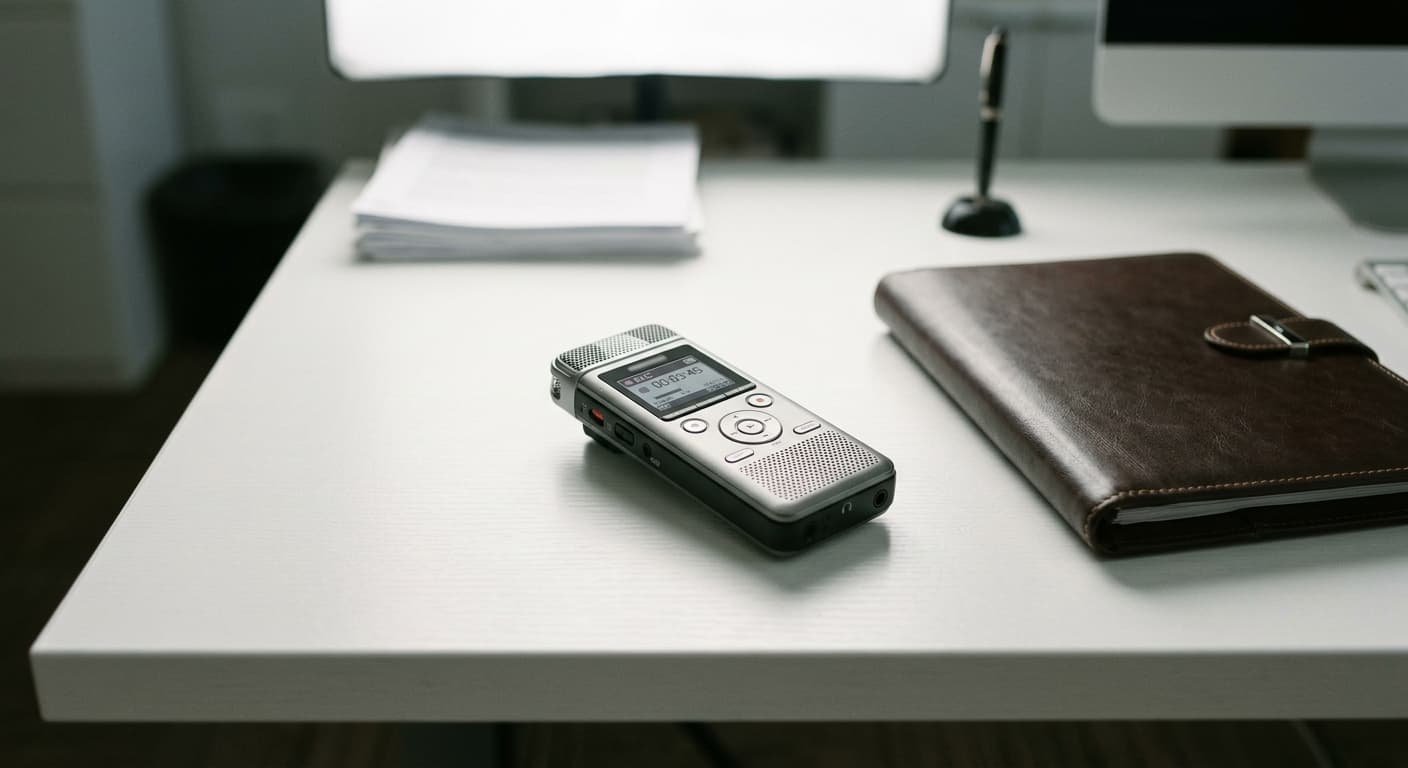
Our recommended Digital Voice Recorder.
AI Voice Recorders and Smart Devices
AI-powered recording devices like the Plaud NotePin, Limitless Pendant, and similar products operate under the same one-party consent rules as any other recorder. These devices often transcribe and summarize conversations automatically, but the legal framework for the initial audio capture remains unchanged.
The key considerations for AI recorders in Colorado:
- You must be a participant in the conversation you record
- The device type does not change the consent requirement
- Automatic transcription of a legally recorded conversation is permissible
- Sharing AI-generated summaries of recorded conversations does not create additional liability if the original recording was lawful
Wearable Recording Devices
Smart glasses, body cameras, AI pins, and other wearable recorders follow the same rules. If you are wearing the device and participating in the conversation, you can legally capture audio. See our guide on wearable recording devices at work for workplace-specific considerations.
Biometric Data from Audio: HB 24-1130
Starting July 1, 2025, HB 24-1130 amended the Colorado Privacy Act (C.R.S. 6-1-1301 et seq.) to require separate, informed consent before collecting biometric identifiers, including voiceprints extracted from audio recordings.
This creates a two-layer consent framework:
- Audio recording consent: One-party consent under C.R.S. 18-9-303/304 (you only need your own consent as a participant)
- Biometric data consent: Separate written consent under HB 24-1130 if you or your employer extract voiceprints or other biometric identifiers from the recording
Recording a conversation is one thing. Running that recording through voice recognition software to build a voiceprint profile is a separate action that requires its own consent under Colorado's amended privacy law.
Penalties for Illegal Audio Recording
Wiretapping (C.R.S. 18-9-303)
| Offense | Classification | Prison/Jail | Fine |
|---|---|---|---|
| General wiretapping (including cordless telephone communications) | Class 2 misdemeanor | Up to 120 days jail | Up to $750 |
| Using intercepted info for unlawful purpose | Class 2 misdemeanor | Up to 120 days jail | Up to $750 |
C.R.S. 18-9-303 does not currently single out cordless telephones for separate treatment. Subsection (1)(e), which once addressed cordless telephones, is now marked "Repealed" in the statute, and subsection (2) sets a single Class 2 misdemeanor classification for wiretapping generally, regardless of the type of telephone involved.
Eavesdropping (C.R.S. 18-9-304)
| Offense | Classification | Jail | Fine |
|---|---|---|---|
| Eavesdropping | Class 2 misdemeanor | Up to 120 days | Up to $750 |
Possession of Eavesdropping Devices (C.R.S. 18-9-302)
Possessing wiretapping or eavesdropping devices with intent to use them unlawfully was reclassified from a Class 2 misdemeanor to a petty offense by HB 23-1293 (effective October 1, 2023).
Civil Liability
Victims of illegal audio recording can pursue civil claims including:
- Invasion of privacy tort claims
- Intentional infliction of emotional distress
- Statutory damages under federal wiretapping laws (18 U.S.C. 2520)
- Punitive damages in cases of willful misconduct
Exceptions to Colorado Audio Recording Laws
Statutory Exceptions Under C.R.S. 18-9-305
C.R.S. 18-9-305 provides several exceptions to the wiretapping and eavesdropping prohibitions:
News agencies may use standard tools and equipment of their medium to report on public and newsworthy events without violating C.R.S. 18-9-302 through 18-9-304. This gives journalists and media organizations broader latitude to record for news-gathering purposes.
Law enforcement officers may listen to recordings or read transcriptions of electronic communications involving a cordless telephone when they come into possession of the materials from a third party.
Good faith reliance on a court order or the provisions of C.R.S. Title 16, Article 15 constitutes a complete defense to any criminal action under these statutes. Law enforcement officers operating under valid wiretap orders are protected by this exception.
Public Conversations
Conversations held in public places where speakers have no reasonable expectation of privacy are generally not protected by C.R.S. 18-9-304. If someone speaks loudly enough for passersby to hear in a park, restaurant, or on a sidewalk, recording that conversation typically does not constitute eavesdropping.
Emergency Situations
While Colorado does not have a specific statutory exception for emergency recordings, the general principle that one-party consent allows a participant to record means that anyone involved in a threatening or dangerous situation can record for safety purposes.
Using Audio Recordings as Evidence in Colorado
Admissibility Standards
Audio recordings made in compliance with Colorado's one-party consent law are generally admissible in court proceedings. The party offering the recording must establish:
- Authentication under Colorado Rules of Evidence Rule 901: The recording must be shown to be genuine and unaltered. The person who made the recording can typically testify to its authenticity.
- Relevance under CRE Rule 401: The recording must tend to make a fact of consequence more or less probable.
- Not unduly prejudicial under CRE Rule 403: The probative value must not be substantially outweighed by the danger of unfair prejudice.
Hearsay Considerations
Statements in audio recordings may face hearsay objections under CRE Rule 802. However, several exceptions commonly apply:
- Statements by a party opponent (CRE Rule 801(d)(2))
- Excited utterances (CRE Rule 803(2))
- Present sense impressions (CRE Rule 803(1))
- Statements against interest (CRE Rule 804(b)(3))
Criminal vs. Civil Proceedings
In criminal cases, illegally obtained recordings are typically excluded under the exclusionary rule. In civil cases, Colorado courts have more discretion but may still exclude evidence obtained through illegal recording as a matter of public policy.
Best Practices for Evidentiary Recordings
If you plan to use a recording as evidence:
- Do not edit, splice, or alter the recording in any way
- Preserve the original file with its metadata
- Note the date, time, location, and participants at the beginning of the recording if possible
- Store backup copies in a secure location
- Document the chain of custody from recording to presentation
Common Audio Recording Scenarios in Colorado
Recording Conversations with Your Landlord
You can record conversations with your landlord as a participant under one-party consent. This is useful for documenting verbal agreements about repairs, complaints about living conditions, or disputes about security deposits. See our Colorado Landlord-Tenant Recording Laws page for more details.
Recording Medical Appointments
Patients can record their own medical appointments in Colorado under one-party consent. This helps with remembering complex medical instructions or preserving a record of informed consent discussions. See our Colorado Medical Recording Laws page for HIPAA considerations.
Recording at Work
Employees can record workplace conversations they participate in. This includes meetings with supervisors, HR discussions, and interactions with coworkers. However, employer policies may restrict recording even though state law permits it. See our Colorado Workplace Recording Laws page.
Recording Police Officers
Colorado provides enhanced protections for recording police under C.R.S. 16-3-311. See our Colorado Laws on Recording Police page.
Interstate Audio Recording Considerations
When you are in Colorado recording a call with someone in another state, the stricter state's law generally applies. If the other party is in a two-party consent state, you may need all parties' consent even though Colorado only requires one-party consent.
States requiring all-party consent include California, Florida, Illinois, Maryland, Massachusetts, Montana, New Hampshire, Pennsylvania, and Washington, plus Connecticut for civil-liability purposes. Connecticut's criminal wiretapping law is one-party consent (C.G.S. 53a-187, 53a-189), but a separate civil statute, C.G.S. 52-570d, creates liability for recording a private telephone call without all parties' consent, notice, or a beep tone. Always check the other state's requirements before recording a cross-state call.
Federal wiretapping law under 18 U.S.C. 2511 also follows a one-party consent standard. A recording that is legal under federal law may still violate a stricter state law.
More Colorado Recording Topics
More Colorado Recording Laws
More Colorado Laws
Frequently Asked Questions
Can I audio record a conversation in Colorado without telling the other person?
Yes. Colorado is a one-party consent state. Under C.R.S. 18-9-303 and C.R.S. 18-9-304, you can record any conversation you participate in without notifying the other parties. Your own consent as a participant satisfies the legal requirement.
What is the penalty for illegally recording a phone call in Colorado?
Illegal wiretapping under C.R.S. 18-9-303, including interception of cordless telephone communications, is a Class 2 misdemeanor punishable by up to 120 days in jail and fines up to $750. The statute does not set a separate classification for cordless telephones.
Can I use an AI voice recorder in Colorado?
Yes. AI voice recorders operate under the same one-party consent rules as any other recording device. If you participate in the conversation, you can legally record it with an AI device. However, if the device extracts voiceprints or other biometric identifiers, HB 24-1130 (effective July 2025) requires separate consent for that biometric data collection.
Is it illegal to leave a recording device in a room in Colorado?
Yes, if you are not present during the recorded conversation. C.R.S. 18-9-304 prohibits recording by a person who is not visibly present. Planting a hidden recorder and leaving the room constitutes eavesdropping, which is a Class 2 misdemeanor.
Are audio recordings admissible in Colorado courts?
Recordings made legally under one-party consent are generally admissible in both criminal and civil proceedings. The recording must be authenticated as genuine and unaltered, relevant to the case, and not unduly prejudicial. Illegally obtained recordings are typically excluded.
Updates
Corrected Connecticut's classification in the interstate-call comparison list: Connecticut's criminal wiretapping law is one-party consent, and the all-party requirement is a separate civil statute (C.G.S. 52-570d), not a blanket all-party criminal rule.
Independently fact-checked against the cited primary sources; governing law re-checked for recent changes
Governing law re-checked for recent changes
Corrected C.R.S. 18-9-303 wiretapping from a Class 6 felony to a Class 2 misdemeanor (matching the statute's current text, the same classification as eavesdropping under 18-9-304), across the key takeaways, penalty table, and FAQ.
Removed the 'cordless telephone wiretapping' penalty row and FAQ framing that presented it as a distinct, currently-operative sub-offense: the current text of C.R.S. 18-9-303 does not single out cordless telephones at all (former subsection (1)(e) is marked Repealed), and subsection (2) sets one uniform Class 2 misdemeanor classification for wiretapping.
Governing law re-checked for recent changes
Reviewed and approved by an editor
The Law Behind This Article
This article rests on the statutory provisions below, held in our own legal record and retrieved from the official source. Tap a section to read the operative text.
Colorado Revised Statutes, Title 18: Criminal Code
§ 18-9-304Eavesdropping prohibited - penaltyIn forcecited in 14 of our articles
(1) Any person not visibly present during a conversation or discussion commits eavesdropping if he: (a) Knowingly overhears or records such conversation or discussion without the consent of at least one of the principal parties thereto, or attempts to do so; or (b) Intentionally overhears or records such conversation or discussion for the purpose of committing, aiding, or abetting the commission of an unlawful act; or (c) Knowingly uses for any purpose, discloses, or attempts to use or disclose to any other person the contents of any such conversation or discussion while knowing or having reason to know the information was obtained in violation of this section; or (d) Knowingly aids, authorizes, agrees with, employs, permits, or intentionally conspires with any person to violate the provisions of this section. (2) Eavesdropping is a class 2 misdemeanor.
Official text (excerpt) · last checked 2026-08-31 · Read the full text in our law library · Verify at olls.info
§ 18-9-303Wiretapping prohibited - penaltyIn forcecited in 16 of our articles
(1) Any person not a sender or intended receiver of a telephone or telegraph communication commits wiretapping if he: (a) Knowingly overhears, reads, takes, copies, or records a telephone, telegraph, or electronic communication without the consent of either a sender or a receiver thereof or attempts to do so; or (b) Intentionally overhears, reads, takes, copies, or records a telephone, telegraph, or electronic communication for the purpose of committing or aiding or abetting the commission of an unlawful act; or (c) Knowingly uses for any purpose or discloses to any person the contents of any such communication, or attempts to do so, while knowing or having reason to know the information was obtained in violation of this section; or (d) Knowingly taps or makes any connection with any telephone or telegraph line, wire, cable, or instrument belonging to another or with any electronic, mechanical, or other device belonging to another or installs any device whether connected or not which permits the interception of messages; or (e) Repealed.
Official text (excerpt) · last checked 2026-08-28 · Read the full text in our law library · Verify at olls.info
Cited in 4 court opinions in our collectionLatest citing opinion in our collection: 2001
Opinions citing this section in our collection:
- Bartnicki v. Vopper (Supreme Court of the United States 2001, 532 U.S. 514)“…5-60-120 (1997); Cal. Penal Code Ann. §631 (West 1999); Colo. Rev. Stat. §18-9-303 (2000); Del. Code Ann., Tit. 11, § 133…”
- Boehner, John A. v. McDermott, James A. (Court of Appeals for the D.C. Circuit 1999, 191 F.3d 463)“…oncert with them); Cal.Penal Code §§ 631, 632 (West 1999); Colo. Rev. Stat. § 18-9-303 (1986 & Supp.1995); Conn. Gen. Stat. §…”
- Sequa Corp. v. Lititech, Inc. (District Court, D. Colorado 1992, 807 F. Supp. 653)“…Menaman. Defendants rely on Colorado’s wiretapping statute, C.R.S. § 18-9-303, which provides in relevant part:…”
Identified automatically from the court opinions citing this section — not a ranking of which case controls.
§ 18-9-305ExceptionsIn forcecited in 3 of our articles
(1) Nothing in sections 18-9-302 to 18-9-304 shall be interpreted to prevent a news agency, or an employee thereof, from using the accepted tools and equipment of that news medium in the course of reporting or investigating a public and newsworthy event; nor shall said sections prevent any person from using wiretapping or eavesdropping devices on his own premises for security or business purposes if reasonable notice of the use of such devices is given to the public. (2) No part of sections 18-9-302 to 18-9-304 shall apply to the normal use of services, facilities, and equipment provided by a provider of wire or electronic communication service pursuant to its tariffs on file with the public utilities commission of the state of Colorado and with the federal communications commission; and said sections shall not apply to the normal functions of any operator of a switchboard nor to any officer, agent, or employee of a provider of wire or electronic communication service or other person engaged in the business of providing service, equipment, and facilities for communication who performs an otherwise prohibited act if such act is necessary to provide the communication services,…
Official text (excerpt) · last checked 2026-07-29 · Read the full text in our law library · Verify at olls.info
United States Code Title 18
§ 2511Interception and disclosure of wire, oral, or electronic communications prohibitedIn forcecited in 418 of our articles
Except as otherwise specifically provided in this chapter any person who— intentionally intercepts, endeavors to intercept, or procures any other person to intercept or endeavor to intercept, any wire, oral, or electronic communication; intentionally uses, endeavors to use, or procures any other person to use or endeavor to use any electronic, mechanical, or other device to intercept any oral communication when— such device is affixed to, or otherwise transmits a signal through, a wire, cable, or other like connection used in wire communication; or such device transmits communications by radio, or interferes with the transmission of such communication; or such person knows, or has reason to know, that such device or any component thereof has been sent through the mail or transported in interstate or foreign commerce; or such use or endeavor to use (A) takes place on the premises of any business or other commercial establishment the operations of which affect interstate or foreign commerce; or (B) obtains or is for the purpose of obtaining information relating to the operations of any business or other commercial establishment the operations of which affect interstate or foreign…
Official text (excerpt) · last checked 2026-08-28 · Read the full text in our law library · Verify at uscode.house.gov
Cited in 2,045 court opinions in our collectionLatest citing opinion in our collection: 2026
In the courts (editorial summary, independently checked):Griggs-Ryan v. Smith (1990) applied the Section 2511(2)(d) prior-consent exception, treating a tenant repeatedly told that all incoming calls were taped as having impliedly consented. United States v. United States District Court (1972) read the then-current Section 2511(3) as conferring no presidential surveillance power.
Opinions citing this section in our collection:
- Mitchell v. Forsyth (Supreme Court of the United States 1985, 472 U.S. 511)✓The Attorney General authorized a warrantless 1970 national security wiretap that caught the plaintiff's calls; the Court held the since-repealed Section 2511(3) disclaimer left the tap lawful under Title III, and that Mitchell had qualified immunity.
- United States v. United States District Court for the Eastern District of Michigan (Supreme Court of the United States 1972, 407 U.S. 297)✓The Attorney General approved warrantless wiretaps on members of a domestic group accused of bombing a CIA office; the Court read Section 2511(3) as a congressional disclaimer conferring no surveillance power, then held the Fourth Amendment required prior judicial approval.
- Forsyth v. Barr (Court of Appeals for the Fifth Circuit 1994, 19 F.3d 1527)✓Dallas police used, in an internal affairs probe of an officer, calls private parties allegedly intercepted illegally; assuming that was unlawful, the Fifth Circuit held Section 2517(1) and (2) allowed the disclosure and use, defeating the Section 2511(1)(c) and (d) claims.
Identified automatically from the court opinions citing this section — not a ranking of which case controls.
§ 2520Recovery of civil damages authorizedIn forcecited in 115 of our articles
Except as provided in section 2511(2)(a)(ii), any person whose wire, oral, or electronic communication is intercepted, disclosed, or intentionally used in violation of this chapter may in a civil action recover from the person or entity, other than the United States, which engaged in that violation such relief as may be appropriate. In an action under this section, appropriate relief includes— such preliminary and other equitable or declaratory relief as may be appropriate; damages under subsection (c) and punitive damages in appropriate cases; and a reasonable attorney’s fee and other litigation costs reasonably incurred.
Official text (excerpt) · last checked 2026-07-28 · Read the full text in our law library · Verify at uscode.house.gov
Cited in 860 court opinions in our collectionLatest citing opinion in our collection: 2026
In the courts (editorial summary, independently checked):Walker v. Darby (1990) held a 2520 plaintiff need not prove the contents of intercepted conversations, only interception and a justified expectation against it. Bartnicki v. Vopper (2001) barred 2520 damages against defendants who took no part in the interception, obtained the tape lawfully, and disclosed a matter of public concern.
Opinions citing this section in our collection:
- Jessie Walker v. Thomas E. Darby, Hugh L. Robinson, Jr., and Kenneth Day (Court of Appeals for the Eleventh Circuit 1990, 911 F.2d 1573)✓A postal letter carrier said three supervisors wired an intercom near his workstation to listen in. Reversing summary judgment, the Eleventh Circuit held a section 2520 plaintiff can show interception without proving the contents of specific conversations.
- Gelbard v. United States (Supreme Court of the United States 1972, 408 U.S. 41)“…disclosure, or use is entitled to recover civil damages, 18 U. S. C. § 2520 . Title III also bars the use as eviden…”
- DirecTV, Inc. v. Hoa Huynh (Court of Appeals for the Ninth Circuit 2007, 503 F.3d 847)“…7 U.S.C. § 605 (e)(4), or alternatively, for violations of 18 U.S.C. § 2520 (a), or alternatively, for violations o…”
Identified automatically from the court opinions citing this section — not a ranking of which case controls.
Explore the law
This article also draws on these acts and chapters (opening at their first section): Colorado Revised Statutes, Title 18: Criminal Code § 18-1.3-101 (Pretrial diversion - appropriation - repeal)
Related law for further reading — not part of this article’s citations.
Search our full record of US law — 2.1 million sections, every state + federal →
Sources and References
- C.R.S. 18-9-303 - Wiretapping Prohibited(law.justia.com)
- C.R.S. 18-9-304 - Eavesdropping Prohibited(law.justia.com)
- C.R.S. 18-9-305 - Exceptions(law.justia.com)
- HB 24-1130 - Privacy of Biometric Identifiers(leg.colorado.gov).gov
- SB 21-271 - Misdemeanor Reform(leg.colorado.gov).gov
- HB 23-1293 - Felony Sentencing Commission(leg.colorado.gov).gov
- 18 U.S.C. 2511 - Federal Wiretapping(law.cornell.edu)
- Colorado Title 18 Criminal Code(content.leg.colorado.gov).gov