
Oklahoma
Oklahoma Windshield Mounting Laws (2026 Guide)
Independently fact-checked against primary sources (last audited August 17, 2026). · Reviewed by the RecordingLaw editorial team. · Law checked current as of August 7, 2026. · 3 primary sources cited on this page. How we verify our legal content
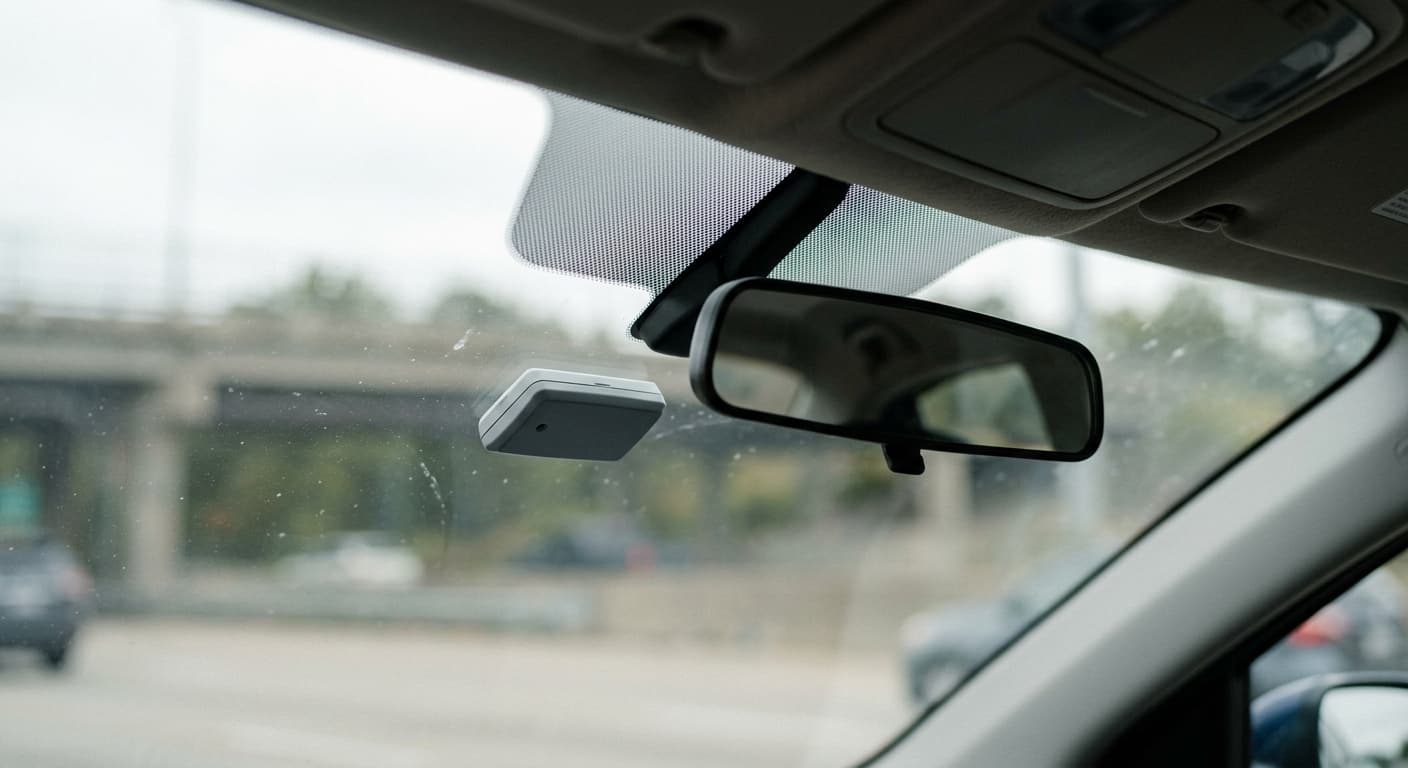
Oklahoma regulates windshield-mounted dashcam, GPS, and phone holders under two statutes. 47 O.S. Section 12-404 bans any object that materially obstructs, obscures, or impairs the driver's clear view, and 47 O.S. Section 12-422(B) goes further, making it unlawful to operate a vehicle with any object placed or affixed upon the windshield except as that section provides. Dashboard and vent-clip mounts are the safest legal alternatives.
Oklahoma does not have a statute that addresses GPS mounts, phone holders, or dashcams on the windshield by name. Two general statutes do that work instead. 47 O.S. Section 12-404 asks whether the device "materially obstructs" the driver's view. 47 O.S. Section 12-422(B) asks a blunter question: is the object on the windshield, and does the section list an exemption that covers it?
This guide covers the exact language of both statutes, how Oklahoma compares to other states, what you can and cannot place on your windshield, the handheld phone ban in school and road construction zones, penalties, and practical mounting advice.
Oklahoma Windshield Obstruction Law: 47 O.S. Section 12-404
The first statute governing windshield obstructions in Oklahoma is 47 O.S. Section 12-404, titled "Windshields Must be Unobstructed and Equipped With Wipers."
What the Law Says
Under subsection C, no person shall drive any motor vehicle with any sign, poster, other nontransparent material, or debris upon the front windshield, side wings, or side or rear windows. The statute also prohibits suspending any sign, poster, object, or other material from the interior of the vehicle that "materially obstructs, obscures, or impairs the driver's clear view of the highway ahead or to either side or of any intersecting highway."
This language covers two distinct categories. The first is nontransparent material physically placed on the glass, including snow, ice, and frost. The second is any object suspended from the interior, such as a phone mount, GPS holder, or hanging decoration, that interferes with forward or lateral visibility.
The "Materially Obstructs" Standard
Oklahoma's legal test is the phrase "materially obstructs, obscures, or impairs." This is more specific than states that simply prohibit any obstruction. The word "materially" introduces a threshold. A small device placed where it does not meaningfully reduce the driver's ability to see the road may not violate the statute.
However, the determination of what qualifies as a material obstruction is left to law enforcement discretion. There is no published guidance from the Oklahoma Department of Public Safety defining specific dimensions or placement zones. An officer who believes your mounted device blocks enough of your view to be considered material can issue a citation.
This threshold is also not the whole rule. A second statute, Section 12-422, reaches objects on the windshield without any threshold at all.
The Second Statute: 47 O.S. Section 12-422(B)
47 O.S. Section 12-422 is usually described as Oklahoma's window tinting law, and it is, but subsection B is broader than tint. It makes it unlawful, "except as provided by this section," to sell, install, or operate a motor vehicle with any object or material "placed, displayed, installed, affixed, or applied upon the windshield or side or rear windows," or placed anywhere in the vehicle "so as to obstruct or reduce a driver's clear view through the windshield or side or rear windows."
Read literally, the first clause is a categorical rule. It carries no "materially obstructs" threshold and no size allowance. An object on the windshield is either covered by one of the exemptions in subsections D and E, or it is unlawful.
The Exemptions in Subsection D
Subsection D lists what the section does not apply to. The entries that matter to a driver deciding where to put a device are:
- Rearview mirrors, under D(3).
- Adjustable nontransparent sun visors mounted forward of the side windows and "not attached to the glass," under D(4).
- Signs, stickers, or other materials displayed in a forty-nine-square-inch area in the lower corner of the windshield farthest removed from the driver, or in a forty-nine-square-inch area in the lower corner nearest the driver, under D(5).
- Transparent material on the topmost portion of the windshield that does not extend below the AS-1 line or more than five inches from the top, whichever is closer to the top, and is not red or amber in color, under D(11).
- Federal, state, or political subdivision certificates required by law to be displayed on a window, under subsection E.
No entry on that list covers a GPS unit, a phone holder, a dashcam, or a toll transponder. D(5) is the closest thing to a device allowance, and because it is written for signs, stickers, and "other materials," whether a suction-cup mount fits inside it has not been tested in Oklahoma. Nothing in the statute or in published state guidance says that it does.
Penalty Under Section 12-422
Under Section 12-422(I), any violation of the section is a misdemeanor punished under 47 O.S. Section 17-101, the same $5 to $500 first-offense exposure that applies to a Section 12-404 obstruction.
How This Compares to Other States
Some states, such as California and New York, define specific square-inch areas in the lower corners of the windshield where devices may be mounted. Oklahoma defines square-inch corner areas too, in Section 12-422(D)(5), but its version is written for signs, stickers, and other materials rather than for electronic devices, so it is not the device-mounting permission that the California and New York provisions are.
Other states, such as Texas, use a similar broad obstruction standard. The practical result in Oklahoma is that a driver faces both a discretionary standard under Section 12-404 and a categorical rule under Section 12-422(B), so the safest approach is to keep devices off the windshield entirely.
Windshield Damage Requirements
Section 12-404 also sets specific standards for windshield physical condition. These rules define when a damaged windshield makes a vehicle illegal to operate.
Critical Area Definition
The statute defines the "critical area" as the area cleaned by the normal sweep of the windshield wiper blade on the driver's side. This is the zone where damage standards are most strictly enforced.
Prohibited Damage
No person may operate a motor vehicle with the following windshield damage in the critical area:
- Star break or shot damage that is three inches or more in diameter. This type of damage involves a vented break with cracks radiating from the point of impact.
- Two or more stress or hairline cracks with a combined length of twelve inches or more. A stress or hairline crack is defined as a crack with no visible point of impact.
These specific measurements give Oklahoma one of the more detailed windshield damage standards in the country. Unlike states that use vague language about "impaired visibility," Oklahoma provides numeric thresholds that officers and drivers can measure.
Windshield Wiper Requirements
Every motor vehicle windshield must be equipped with an electric windshield wiper mechanism for clearing rain, snow, or other moisture. Every wiper blade and wiper mechanism must be maintained in good working order. When replacing wiper blades, the blade length must not be reduced from the manufacturer's original specification.
What Can Be Placed on an Oklahoma Windshield
Despite the general prohibition on obstructions, certain items are either explicitly permitted or commonly accepted in practice.
PikePass Toll Transponders
The PikePass toll transponder, issued by the Oklahoma Turnpike Authority, is designed for windshield mounting. Drivers place the small adhesive transponder on the inside of the windshield behind the rearview mirror. Because of its small size and placement behind the mirror, a properly installed PikePass does not materially obstruct the driver's view.
Section 12-422(D) does not list toll transponders among its exemptions, so the practical safety of a PikePass rests on its size and its placement behind the mirror rather than on a statutory carve-out. Other compatible transponders, including SunPass and K-TAG, follow the same mounting guidelines when used on Oklahoma turnpikes.
Law-Required Stickers and Certificates
Section 12-422(E) expressly permits federal, state, and political subdivision certificates that applicable law requires to be displayed on a window. That is the exemption covering required government stickers and decals.
Windshield Tint Above the AS-1 Line
Under Section 12-422(D)(11), transparent material may be applied to the topmost portion of the windshield if it does not extend below the AS-1 line marked by the manufacturer, or more than five inches from the top of the windshield, whichever is closer to the top. The material must not be red or amber in color.
What Should Not Be Mounted on an Oklahoma Windshield
The following items carry varying levels of legal risk when mounted directly on the windshield glass.
GPS Devices on Suction Cup Mounts
Suction-cup GPS mounts attached to the windshield appear nowhere in the Section 12-422(D) exemption list, so subsection B reaches them on its face regardless of the unit's size or position. If the unit also blocks part of the driver's forward or lateral view, it can be cited as a material obstruction under Section 12-404(C) as well.
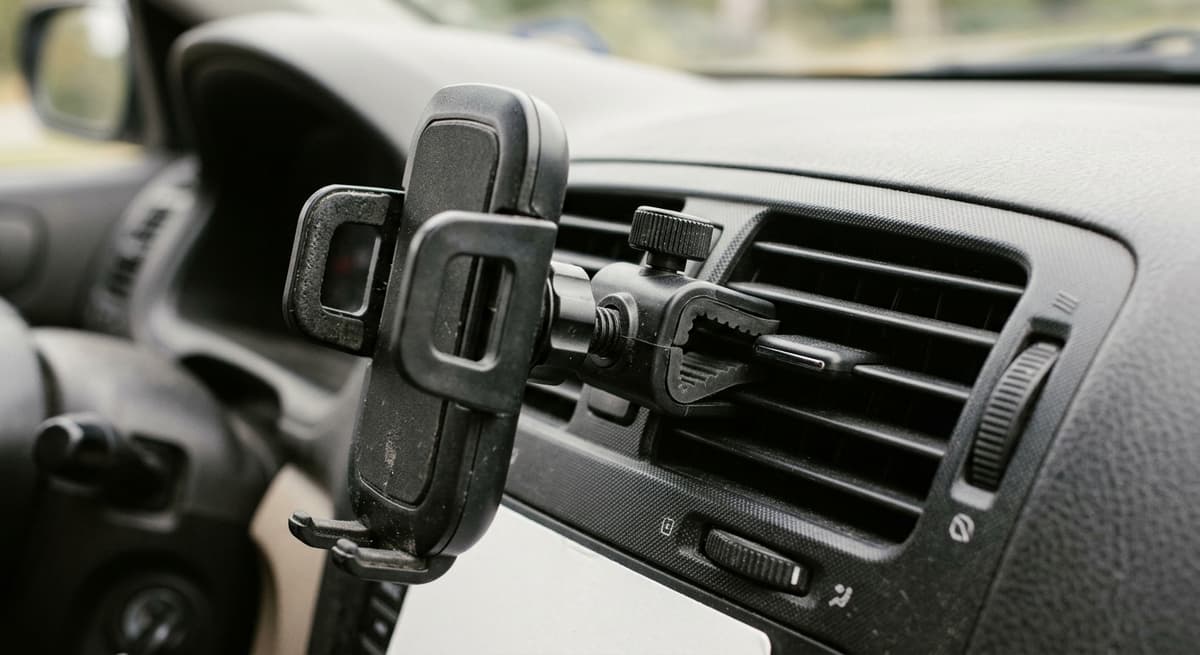
The safer alternative is a dashboard friction mount or a vent-clip mount that keeps the device off the glass entirely.
Phone Mounts on the Windshield
Phone holders attached to the windshield via suction cups or adhesive brackets face the same legal analysis as GPS mounts. The device itself is not illegal, but putting it on the glass exposes the driver to both statutes: the materially obstructs standard in Section 12-404 and the categorical windshield rule in Section 12-422(B).
Given the passage of HB 2263 requiring hands-free phone use in school and road construction zones, drivers have an added incentive to mount their phones in accessible but legally safe locations. A dashboard mount or vent clip satisfies both the obstruction statutes and the hands-free requirement.
Dashcams
Dashcams are legal to use in Oklahoma, and the state is a one-party consent state for audio recording. However, mounting a dashcam directly on the windshield glass triggers the same two-statute analysis, and Section 12-422(D) has no dashcam exemption.
The commonly recommended placement is behind the rearview mirror, positioned so the camera does not extend beyond the mirror's outline. That reduces the obstruction risk under Section 12-404, but a camera behind the mirror is still an object affixed to the windshield for purposes of Section 12-422(B). A dashboard mount is the safest legal alternative, because it keeps the camera off the glass entirely while maintaining a clear recording angle.
Hanging Objects and Decorations
Air fresheners, parking permits, graduation tassels, and other items suspended from the rearview mirror are covered by Section 12-404(C). If the object materially obstructs the driver's view, it is a violation. While enforcement of hanging decorations varies, officers do have the legal authority to issue citations for these items.
Oklahoma Window Tinting Rules
Section 12-422 also governs the use of glass coating materials and sunscreening devices on all vehicle windows.
Windshield Tinting
Tinting material on the windshield must not extend below the AS-1 line or more than five inches from the top of the windshield, whichever is closer to the top, and it must not be red or amber in color.
Side and Rear Window Tinting
Oklahoma does not ban side and rear tint. Section 12-422(C) prohibits transparent material that alters the color or reduces the light transmittance of the glass, but subsection D(1) then exempts side or back windows with a light transmission of at least twenty-five percent (25%) and a luminous reflectance of at most twenty-five percent (25%). That 25 percent light transmission and 25 percent reflectance pair is the operative standard for most vehicles.
For vehicles manufactured before the 1996 model year, D(10) allows windows to the rear of the driver, and back windows, down to ten percent (10%) light transmission with the same 25 percent reflectance limit, provided the vehicle has outside mirrors on both sides that reflect at least 200 feet of highway to the rear.
Medical Exemptions
The Commissioner of Public Safety may issue an exemption from tinting restrictions for a motor vehicle belonging to a person who, for medical reasons, must be shielded from direct sunlight. The exemption requires written attestation from a physician. Any person may operate a vehicle in accordance with a valid medical exemption.
Violations
Violating any provision of Section 12-422, whether it involves tint or an object on the glass, is a misdemeanor punished under 47 O.S. Section 17-101. Any person who sells, installs, applies, or operates a vehicle in violation of the section is subject to prosecution.
HB 2263: Handheld Phone Ban in School and Construction Zones
One of the most significant recent changes to Oklahoma driving law is House Bill 2263, which took effect on November 1, 2025 and is codified at 47 O.S. Section 11-901e, titled "Use of Cell Phones In A School or Construction Zone." This law directly affects how drivers use mounted phones and other electronic devices.
What the Law Prohibits
Section 11-901e makes it unlawful to operate a motor vehicle in motion while holding or using a hand-held cellular telephone, or while using a hand-held device to manually compose, send, or read a text message, in either of two places: a properly marked school zone where a posted reduced speed limit is in effect during certain times due to the presence or potential presence of school children, or a road construction zone. The reduced-speed-limit condition attaches to the school zone; the construction zone provision does not depend on it.
This goes beyond the existing texting ban. Simply holding your phone in your hand while driving through a school or construction zone is enough for a citation, even if you are not sending or reading a text message.
What Is Still Allowed
The law permits the use of hands-free technology. Subsection D exempts use of the phone or device in conjunction with hands-free or voice-operated technology, and use for the sole purpose of contacting an emergency response operator, an ambulance service, a fire service, or a law enforcement agency about an imminent emergency. Bluetooth connections, Apple CarPlay, and Android Auto fall on the permitted side of that line.
Penalties
A violation carries a fine of not more than $100 under subsection C, and subsection F bars the Department of Public Safety from recording or assessing license points for it. Under subsection G, without the driver's consent an officer may not confiscate the device to check compliance or hold it as evidence pending trial, and may not extract or download information from it unless there is probable cause that the device was used in the commission of a crime, a valid search warrant, or other legal authorization.
Legislative History
HB 2263 was authored by Rep. Nicole Miller, with Sen. Todd Gollihare as the principal Senate author. The Governor vetoed the measure on May 13, 2025. Both chambers overrode the veto on May 29, 2025, the House 68 to 21 and the Senate 38 to 7, and the bill was filed with the Secretary of State the same day. The law took effect on November 1, 2025.
Municipal Authority
Subsection E authorizes Oklahoma municipalities to adopt and enforce ordinances covering the same conduct, but it caps them. Municipal ordinances must contain the same provisions as the statute, their enforcement provisions may not be more stringent than the statute, and total fine and court costs for a municipal violation may not exceed $100.
Existing Distracted Driving Laws
HB 2263 builds on Oklahoma's existing distracted driving statutes. Understanding the full framework helps clarify how windshield-mounted devices fit into the legal picture.
Texting While Driving: 47 O.S. Section 11-901d
Under 47 O.S. Section 11-901d, it is illegal to drive a motor vehicle while using a hand-held electronic communication device to manually compose, send, or read an electronic text message while the vehicle is in motion. This is a primary enforcement law, meaning officers can pull you over solely for observing texting behavior.
The fine for a first offense is $100. The Department of Public Safety does not assess points on the driver's license for texting violations.
Exceptions include using voice commands to dial, answer calls, or check voicemail. Inputting or reading information on a GPS or navigation system is also permitted under this section.
Commercial Drivers: 47 O.S. Section 11-901c
Under 47 O.S. Section 11-901c, commercial motor vehicle operators and public transit drivers face stricter rules. These drivers are prohibited from using a hand-held mobile telephone while operating their vehicles. The penalty for commercial driver violations is a fine of $500.
School bus drivers may use a hand-held phone only when necessary to communicate with law enforcement, emergency services, or their school transportation department.
Penalties for Windshield Obstruction Violations
General Penalty
Violating either 47 O.S. Section 12-404 or 47 O.S. Section 12-422 is a misdemeanor, and both sections route the penalty to the same place. Under the general penalty provision in 47 O.S. Section 17-101, a first conviction carries a fine of not less than $5 and not more than $500, or imprisonment for not more than ten days, or both.
Enhanced Penalties
If the offense occurs while the driver's license is suspended, revoked, canceled, denied, or disqualified, the fine is doubled along with all court costs and fees collected by the court.
Insurance Impact
A windshield obstruction citation is a traffic violation that goes on the driver's record. While Oklahoma does not assess license points for many equipment violations, insurance companies may consider the citation when calculating premiums.
Comparison of Oklahoma Windshield-Related Fines
| Violation | Statute | Maximum Fine | Points on License |
|---|---|---|---|
| Windshield obstruction, materially obstructs standard | 47 O.S. 12-404 | $500 | No |
| Object on the windshield, or illegal tint | 47 O.S. 12-422 | $500 | No |
| Texting while driving | 47 O.S. 11-901d | $100 | No |
| Handheld phone in school or construction zone | 47 O.S. 11-901e | $100 | No |
| Commercial driver phone use | 47 O.S. 11-901c | $500 | Varies |
Practical Tips for Oklahoma Drivers
For GPS devices: Mount on the dashboard using a friction pad or adhesive mount. Avoid suction-cup windshield mounts. No exemption in Section 12-422(D) covers a GPS mount, so a device on the glass remains exposed to citation even when it is small and tucked against the mirror.
For phone mounts: Use a vent clip, dashboard mount, or console-mounted holder. This keeps you clear of both windshield statutes and satisfies the hands-free requirement in school and road construction zones.
For dashcams: A dashboard-mounted camera is the safest option, because it is the only placement that avoids Section 12-422(B) entirely. If you mount on the glass, keep the camera behind the rearview mirror so that it does not extend beyond the mirror's outline. Oklahoma's one-party consent law means you can legally record audio inside your vehicle as long as you are a participant in the conversation.
For PikePass transponders: Follow the Oklahoma Turnpike Authority's installation instructions and place the transponder behind the rearview mirror on the inside of the windshield.
For windshield tint: Keep any tinting material above the AS-1 line or within the top five inches of the windshield. If you need full-windshield protection from sunlight for medical reasons, apply for a medical exemption through the Commissioner of Public Safety.
For windshield damage: Repair star breaks before they reach three inches in diameter. Address stress cracks before combined length reaches twelve inches in the critical area (driver's side wiper sweep zone).
More Oklahoma Laws
Frequently Asked Questions
Can I mount a GPS or phone on my windshield in Oklahoma?
Oklahoma law does not ban GPS or phone mounts by name, but two statutes reach them. 47 O.S. Section 12-404 prohibits any object on the windshield that materially obstructs, obscures, or impairs the driver's clear view. 47 O.S. Section 12-422(B) is stricter: it makes it unlawful to operate a vehicle with any object placed or affixed upon the windshield unless that section exempts it, and its exemption list has no entry for a phone or GPS mount. Either violation is a misdemeanor carrying a fine of up to $500. The safest legal option is a dashboard mount, vent clip, or console mount.
Is a dashcam legal on an Oklahoma windshield?
Dashcams are legal to use in Oklahoma, and the state's one-party consent recording law allows you to record audio and video inside your vehicle. Mounting one directly on the windshield can violate 47 O.S. Section 12-404 if it materially obstructs your view, and it also falls within the categorical rule in 47 O.S. Section 12-422(B), which has no dashcam exemption. Placement behind the rearview mirror, where the camera does not extend beyond the mirror's outline, reduces the obstruction risk, and a dashboard mount avoids the windshield rule altogether.
What is Oklahoma's hands-free phone law under HB 2263?
HB 2263 took effect on November 1, 2025 and is codified at 47 O.S. Section 11-901e. It prohibits holding or using a hand-held cellular telephone while a vehicle is in motion in a properly marked school zone with a posted reduced speed limit in effect, or in a road construction zone. The fine is not more than $100, and the Department of Public Safety may not assess license points. Hands-free and voice-operated technology such as Bluetooth, Apple CarPlay, and Android Auto is still permitted, as is contacting emergency services about an imminent emergency. Without the driver's consent, an officer may not seize the phone or extract data from it absent probable cause of a crime, a warrant, or other legal authorization.
Does Oklahoma have a legal square-inch mounting zone on the windshield?
Not one written for devices. 47 O.S. Section 12-422(D)(5) exempts signs, stickers, or other materials displayed in a forty-nine-square-inch area in the lower corner of the windshield farthest from the driver, and in a forty-nine-square-inch area in the lower corner nearest the driver. Those two corner windows are real, but the provision is written for signs, stickers, and other materials, and Oklahoma has not tested whether a suction-cup phone or GPS mount qualifies. Unlike California and New York, Oklahoma has no provision that names electronic device mounts.
What are the penalties for a windshield obstruction ticket in Oklahoma?
A windshield obstruction violation under 47 O.S. Section 12-404 is a misdemeanor. Under the general penalty provision in 47 O.S. Section 17-101, a first conviction carries a fine between $5 and $500, or up to ten days in jail, or both. If the driver's license is suspended or revoked at the time of the offense, the fine and all court costs are doubled.
How much windshield damage is allowed in Oklahoma before it is illegal?
Oklahoma sets specific damage thresholds for the critical area, which is the zone covered by the driver's side windshield wiper. Star breaks or shot damage measuring three inches or more in diameter are prohibited. Two or more stress or hairline cracks with a combined length of twelve inches or more are also illegal. These standards apply specifically to the driver's side wiper sweep area.
Updates
Corrected the windshield-mounting analysis to add 47 O.S. Section 12-422(B), which bars objects on the windshield outright, noted the two 49-square-inch lower-corner allowances in Section 12-422(D)(5), added the 25 percent side and rear tint standard, and replaced a link that pointed to the wrong HB 2263.
Independently fact-checked against the cited primary sources
Governing law re-checked for recent changes
Reviewed and approved by an editor
The Law Behind This Article
This article rests on the statutory provisions below, held in our own legal record and retrieved from the official source. Tap a section to read the operative text.
Oklahoma Statutes, Title 47: MOTOR VEHICLES
§ 12-404Windshields and windows - Obstruction, obscuring, orIn force
impairing of driver's view - Electric windshield wiper mechanism. A. As used in this section: 1. "Critical area" means the area cleaned by the normal sweep of the windshield wiper blade on the driver's side. The area covered by the wiper blade cannot be reduced from manufacturer's original specifications; 2. "Noncritical areas" means all other areas; 3. "Outright breakage" means glass which is severely cracked or shattered to the extent that air passes through it or, if by running a fingertip over the cracked area, the glass moves or sharp edges can be felt; 4. "Star break or shot damage" means a vented break with cracks radiating from the point of impact; and 5. "Stress or hairline crack" means a crack which has no visible point of impact. B. No person shall operate any motor vehicle which: 1. Is not equipped with a windshield; 2. Has any outright breakage in the windshield or in the window on either side of the driver; 3. Has any star break or shot damage, three (3) inches or more in diameter, located in the critical area; or 4. Has two or more stress or hairline cracks, twelve (12) inches or more in combined length, located in the critical area. C.
Official text (excerpt) · last checked 2026-09-08 · Read the full text in our law library · Verify at oklegislature.gov
§ 12-422Restrictions on use of glass coating materials orIn forcecited in 2 of our articles
sunscreening devices on windshields and windows. A. As used in this section: 1. "Glass coating material" or "sunscreening devices" means materials, films, applications or devices which are used in conjunction with approved vehicle glazing materials for the purpose of reducing the effects of sun, but shall not include materials, films, applications, or devices with a mirrored or mirror-like finish; 2. "Light transmission" means the percentage of total light which is allowed to pass through a window; 3. "Luminous reflectance" means the ratio of the amount of total light, expressed in percentages, which is reflected outward by the glass coating material or sunscreening device to the amount of total light falling on the glass coating material; 4. "Manufacturer" means: a. a person who engages in the manufacturing or assembling of sunscreening devices, or b. a person who fabricates, laminates, or tempers glazing materials, incorporating the capacity to reflect or to reduce the transmittance of light during the manufacturing process; and 5. "Window" means the windshield, side or rear glass of a motor vehicle, including any glazing material, glass coating or sunscreening device. B.
Official text (excerpt) · last checked 2026-09-01 · Read the full text in our law library · Verify at oklegislature.gov
Also relied on in: Oklahoma Window Tint Laws (2026): Legal VLT Limits
§ 17-101Misdemeanor violations - PenaltiesIn force
A. It is a misdemeanor for any person to violate any of the provisions of this title unless such violation is by this title or other law of this state declared to be a felony. B. 1. Every person convicted of a misdemeanor for a violation of any of the provisions of Sections 10-101 through 14-121 or Sections 16-101 through 16-114 of this title for which another penalty is not provided shall upon conviction thereof be punished by a fine of not less than Five Dollars ($5.00) nor more than Five Hundred Dollars ($500.00) or by imprisonment for not more than ten (10) days; for a second such conviction within one (1) year after the first conviction by imprisonment for not more than twenty (20) days; upon a third or subsequent conviction within one (1) year after the first conviction by imprisonment for not more than six (6) months, or by both such fine and imprisonment. 2.
Official text (excerpt) · last checked 2026-07-31 · Read the full text in our law library · Verify at oklegislature.gov
§ 11-901dText messaging - PenaltiesIn force
A. It shall be unlawful for any person to operate a motor vehicle on any street or highway within this state while using a hand-held electronic communication device to manually compose, send or read an electronic text message while the motor vehicle is in motion. B. Any person who violates the provisions of subsection A of this section shall, upon conviction, be punished by a fine of not more than One Hundred Dollars ($100.00). C. The Department of Public Safety shall not record or assess points for violations of this section on any license holder's traffic record maintained by Service Oklahoma. D. The provisions of subsection A of this section shall not apply if the person is using the cellular telephone or electronic communication device for the sole purpose of communicating with any of the following regarding an imminent emergency situation: 1. An emergency response operator; 2. A hospital, physician's office or health clinic; 3. A provider of ambulance services; 4. A provider of firefighting services; or 5. A law enforcement agency. E.
Official text (excerpt) · last checked 2026-07-31 · Read the full text in our law library · Verify at oklegislature.gov
§ 11-901cUnlawful use of cellular telephoneIn force
A. It shall be unlawful for any person to operate a commercial motor vehicle or for a public transit driver to operate a motor vehicle on any street or highway within this state while: 1. Using a cellular telephone or electronic communication device to write, send, or read a text-based communication; or 2. Using a hand-held mobile telephone while operating a commercial motor vehicle. For the purposes of paragraphs 1 and 2 of this subsection, using a hand-held mobile telephone is permissible by drivers of a commercial motor vehicle when necessary to communicate with law enforcement officials, other emergency services or by a public school bus driver to and from a central dispatch school transportation department or its equivalent. B. Any person who violates the provisions of subsection A of this section shall, upon conviction, be guilty of a misdemeanor punishable by a fine of Five Hundred Dollars ($500.00). C. As used in this section: 1. "Cellular telephone" means an analog or digital wireless telephone authorized by the Federal Communications Commission to operate in the frequency bandwidth reserved for cellular telephones; 2.
Official text (excerpt) · last checked 2026-07-31 · Read the full text in our law library · Verify at oklegislature.gov
§ 11-901eHolding or using a hand-held cell phone orReserved
Official text (excerpt) · last checked 2026-07-31 · Read the full text in our law library · Verify at oklegislature.gov
Search our full record of US law — 2.1 million sections, every state + federal →
Sources and References
- 47 O.S. Section 12-404 - Windshields and windows obstruction law(law.justia.com)
- 47 O.S. Section 12-422 - Window tinting restrictions(law.justia.com)
- 47 O.S. Section 11-901d - Texting while driving penalties(law.justia.com)
- 47 O.S. Section 11-901c - Commercial driver phone restrictions(law.justia.com)
- 47 O.S. Section 17-101 - Misdemeanor violations and penalties(law.justia.com)
- HB 2263 bill information - Hands-free phone law(oklegislature.gov).gov
- HB 2263 new law requires drivers to go hands-free(okhouse.gov).gov
- 47 O.S. Section 11-901e - Handheld phone ban in school zones(law.justia.com)
- Oklahoma PikePass toll transponder information(pikepass.com).gov
- 47 O.S. Section 12-404 - Windshields Must be Unobstructed and Equipped With Wipers (Oklahoma State Courts Network)(oscn.net)
- 47 O.S. Section 12-422 - Obstructed View, Glass Coating, Lamination of Vehicle Windshields and Windows - Violations (Oklahoma State Courts Network)(oscn.net)
- 47 O.S. Section 11-901e - Use of Cell Phones In A School or Construction Zone (Oklahoma State Courts Network)(oscn.net)
- HB 2263 (2025 Regular Session) bill information and action history - Oklahoma Legislature(oklegislature.gov)