
District of Columbia
DC Car Seat Laws (2026): Ages, Fines & Points
Independently fact-checked against primary sources (last audited September 17, 2026). · 5 primary sources cited on this page. How we verify our legal content
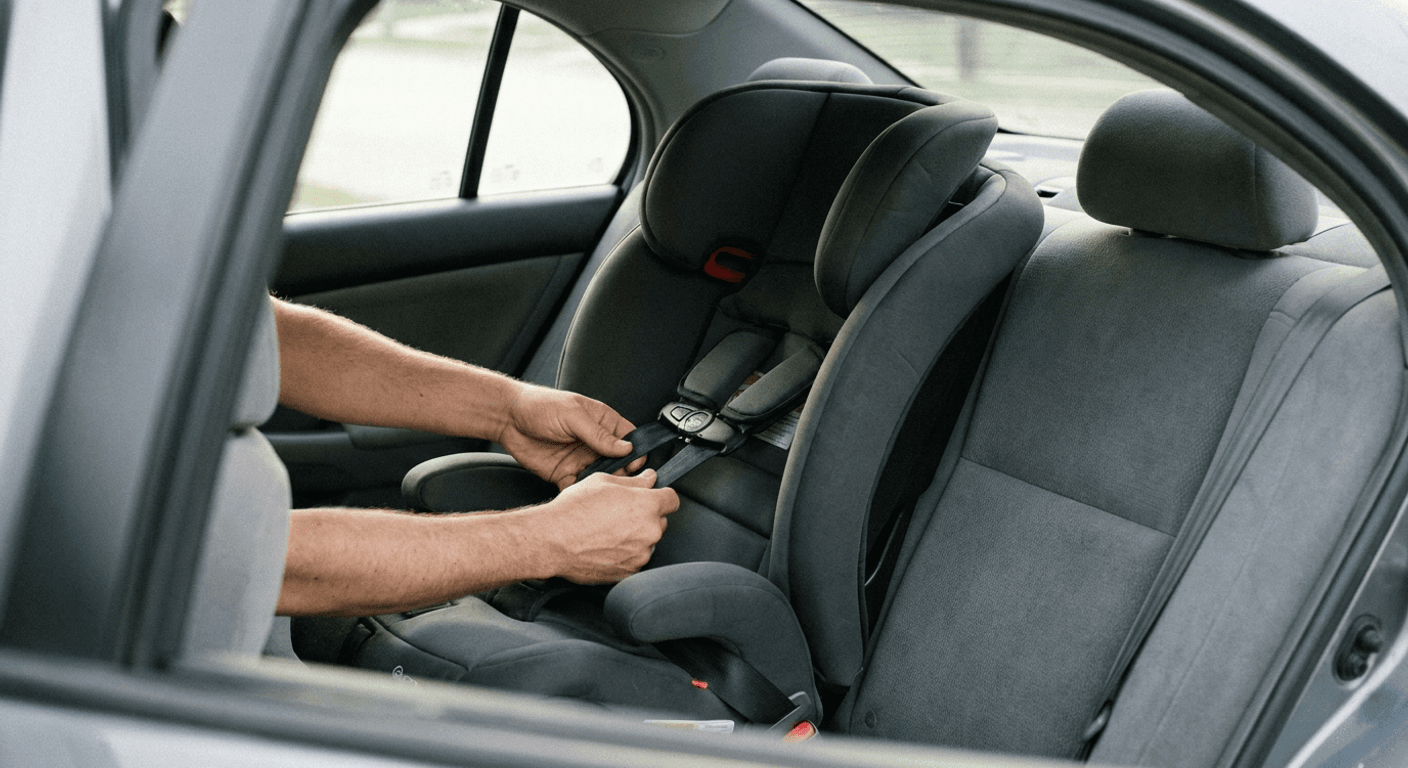
The District of Columbia requires a rear-facing seat until age 2, a child restraint seat until age 3, a restraint or booster seat until age 8, and a restraint or seat belt until age 16, under D.C. Code § 50-1703. This page reflects the statute's text as of September 2026.
Jurisdiction scope: This article covers car seat and child-restraint law in the District of Columbia only. It does not address any other jurisdiction. For other jurisdictions, see the car seat laws hub.
| Stage | Who | Rule | Statute |
|---|---|---|---|
| Rear-facing | Under 2 AND (under 40 lb OR under 40 in) | Rear-facing child restraint seat | D.C. Code § 50-1703(a) |
| Child restraint seat (general) | Under 3 | Child restraint seat | D.C. Code § 50-1703(a) |
| Restraint or booster | Under 8 | Infant, convertible, or booster child safety seat per manufacturer instructions; booster requires lap and shoulder belt | D.C. Code § 50-1703(b) |
| Restraint or seat belt | Under 16 | Approved child safety restraint system or seat belt | D.C. Code § 50-1703(b) |
Birth through age 1: the rear-facing sub-rule
D.C. Code section 50-1703(a) states that "if the child weighs less than 40 pounds or measures less than 40 inches in length, and is under 2 years of age, the child shall be properly restrained in a rear-facing child restraint seat." Both the age condition and one of the two size conditions (weight or height) have to be true for this specific sub-rule to apply. This rear-facing requirement sits inside a broader rule described next, not as a separate, standalone mandate.
Birth through age 2: the general child restraint seat requirement
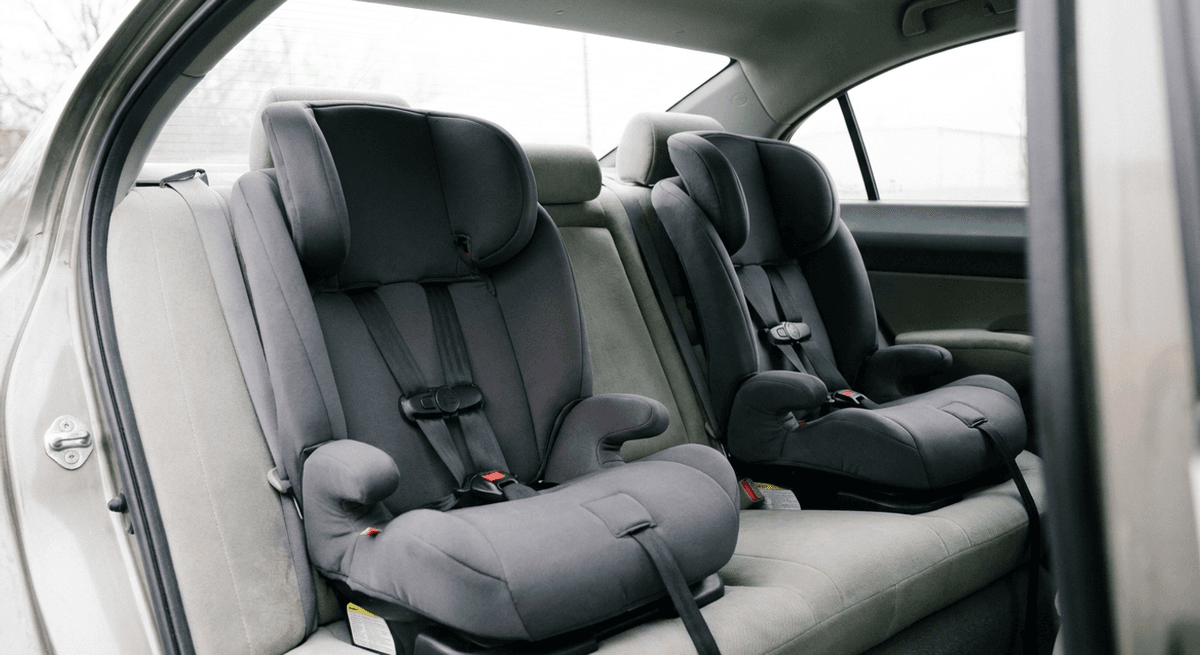
The same subsection separately requires that no one transport "a child of less than 3 years of age unless the child is properly restrained in a child restraint seat." This is the broader rule: every child under 3 needs a child restraint seat, with the rear-facing sub-rule above applying specifically to children under 2 who also fall under the weight or height thresholds.
Ages 3 through 7: restraint seat or booster
Section 50-1703(b) requires that "children under 8 years of age shall be properly seated in an installed infant, convertible (toddler) or booster child safety seat, according to the manufacturer's instructions." The same subsection adds one specific condition for the booster option: "a booster seat shall only be used with both a lap and shoulder belt," not a lap belt alone.
Ages 8 through 15: restraint or seat belt
The same subsection extends coverage further: "child under 16 years of age unless the child is properly restrained in an approved child safety restraint system or restrained in a seat belt." In practice, once a child is 8 or older and has moved beyond the restraint-or-booster stage, a seat belt satisfies this requirement through age 15.
Exemptions from D.C.'s car seat law
D.C. Code § 50-1703(c) provides a real, narrow exemption: "A parent or legal guardian may transport his or her own child without restraint herein if that person is transporting a number of his or her own children of less than 16 years of age which exceeds the number of passenger positions equipped with safety belts in the motor vehicle. However, an unrestrained child may not be transported in the front seat of a motor vehicle." In practice, this covers a parent who has more of their own under-16 children in the vehicle than there are belted seating positions: the extra child or children may ride unrestrained, but never in the front seat.
D.C. Code § 50-1705, governing the application of this chapter, contains two other subsections that do two different things: subsection (a) says the chapter "shall apply to any person operating a motor vehicle in the District of Columbia," and subsection (b) separately says the chapter "shall apply to any motor vehicle that is used for personal use." No taxi or physician-certification exemption is written into Chapter 17 of Title 50 (sections 50-1701 through 50-1708). D.C. Code § 50-1703(d) is not an exemption either; it separately requires automobile rental companies to inform each customer of the chapter's provisions and provide educational materials.
Front-seat placement
The front-seat bar above is not a freestanding rule that reaches every child. It is the proviso on the section 50-1703(c) excess-children exemption described above: a parent invoking that exemption may leave an extra child unrestrained, but that child still may not ride in the front seat. D.C. law does not separately impose a general requirement that every properly restrained child ride in the back seat.
Penalty for a car seat violation
Under D.C. Code § 50-1706, a first violation gives the driver a choice between paying a $75 fine or attending a child restraint safety class, which carries a $25 fee. The fine for a first violation of subsection (a) is waived if the driver presents proof of having acquired an approved child restraint seat. A second offense requires attending the safety class ($25) and paying a $75 fine. A third offense carries a $125 fine, and a fourth or subsequent offense carries a $150 fine each time. Two points are assessed to the driver's record on conviction, and violations are processed and adjudicated as moving violations.
Leaving a child alone in a vehicle
The District of Columbia has no dedicated, vehicle-specific statute addressing a child left unattended in a car. D.C.'s general cruelty-to-children statute, D.C. Code § 22-1101, could theoretically apply in an abandonment-type scenario, but it is a general-purpose statute rather than one written for the vehicle context, and whether it applies to a specific situation depends on the facts.
Smoking with a minor in the vehicle
D.C.'s general smoking-restrictions statute, D.C. Code § 7-1703, addresses smoking in vehicles, but its motor-vehicle provision covers only a passenger vehicle owned or operated by the D.C. government, or a passenger vehicle for hire, during passenger transport. It does not mention private vehicles or the presence of a minor at all. No D.C. statute prohibits smoking in a private vehicle with a minor present.
Federal guidance vs. D.C. law
The federal standard that governs car seats as products, FMVSS 213 (49 CFR 571.213), regulates what a manufacturer may sell, not how a parent must use the seat; D.C.'s own statute, described above, already sets a staged, conjunctive age-and-weight-or-height structure across four tiers. NHTSA and the American Academy of Pediatrics separately recommend keeping a child rear-facing as long as the seat's own height and weight limits allow, which can extend past D.C.'s own statutory floor of age 2 and 40 pounds or 40 inches. That's safety guidance exceeding the statutory minimum, not a separate legal requirement.
Related District of Columbia traffic law pages
Disclaimer: This article provides general legal information about car seat law in the District of Columbia as of September 2026. It is not legal advice. Statutes, exemptions, and penalties change; verify the current text of the law before relying on it, and talk to a lawyer licensed in the District of Columbia about a specific situation.
Statutes cited reflect their in-force version as of 2026-09-16. Last updated: 2026-09-16.
Frequently Asked Questions
Until what age does D.C. require a rear-facing car seat?
A child under 2 who weighs less than 40 pounds or measures less than 40 inches must be rear-facing, under D.C. Code section 50-1703(a). More broadly, every child under 3 must be in a child restraint seat of some kind.
What is the fine for a car seat violation in D.C.?
A first violation is $75 or a $25 safety class, with the fine waived on proof of acquiring an approved seat when the child was under 3. A second offense is the class plus $75; a third is $125; a fourth or later offense is $150. Two points are assessed to the driver's record on any conviction under the chapter, not just repeat offenses.
Are taxis exempt from D.C.'s car seat law?
Chapter 17 names no taxi exemption, but the answer is not a flat no either. Section 50-1705(a) applies the chapter to any person operating a motor vehicle in the District; section 50-1705(b) separately limits the chapter to a motor vehicle used for personal use, which cuts toward a for-hire taxi falling outside Chapter 17's coverage, unsettled on the statute's own text. The one exemption Chapter 17 does contain, in section 50-1703(c), is narrower: it lets a parent transport more of their own under-16 children unrestrained than the vehicle has belted positions, and even then not in the front seat.
Until what age does a child need a booster seat in D.C.?
Children under 8 must be in an infant, convertible, or booster seat per the manufacturer's instructions, under D.C. Code section 50-1703(b). A booster seat requires both a lap and shoulder belt.
Is it illegal to leave a child alone in a car in D.C.?
There is no dedicated vehicle-specific statute. D.C.'s general cruelty-to-children statute, D.C. Code section 22-1101, could theoretically apply in an abandonment scenario, depending on the facts.
Updates
Clarified that the first-offense fine waiver under D.C. Code § 50-1706(b) applies only when the child was under 3, matching the statute and the penalty section.
Independently fact-checked against the cited primary sources
The Law Behind This Article
This article rests on the statutory provisions below, held in our own legal record and retrieved from the official source. Tap a section to read the operative text.
Code of the District of Columbia, Title 50: Motor and Non-Motor Vehicles and Traffic. - Chapter 17: Child Restraint.
§ 50-1703Requirements.In forcecited in 3 of our articles
(a) The operator of a motor vehicle may not transport any child of less than 3 years of age unless the child is properly restrained in a child restraint seat; provided, that, if the child weighs less than 40 pounds or measures less than 40 inches in length, and is under 2 years of age, the child shall be properly restrained in a rear-facing child restraint seat. (b) The operator of a motor vehicle shall not transport any child under 16 years of age unless the child is properly restrained in an approved child safety restraint system or restrained in a seat belt. Children under 8 years of age shall be properly seated in an installed infant, convertible (toddler) or booster child safety seat, according to the manufacturer’s instructions. A booster seat shall only be used with both a lap and shoulder belt. (c) A parent or legal guardian may transport his or her own child without restraint herein if that person is transporting a number of his or her own children of less than 16 years of age which exceeds the number of passenger positions equipped with safety belts in the motor vehicle. However, an unrestrained child may not be transported in the front seat of a motor vehicle.
Official text (excerpt) · last checked 2026-09-23 · Read the full text in our law library · Verify at github.com
Also relied on in: DC Dashcam Laws: Recording Rules, Windshield Mounting, and Legal Limits (2026), Car Seat Laws by State 2026: Rear-Facing, Booster, Front Seat Rules
§ 50-1706Penalty; waiver of fine.In force
(1) First time offenders of this chapter shall be given a choice of paying a $75 fine or attending a child restraint safety class, for which they will be charged $25. For the second offense, offenders shall be required to attend a child safety class, for which they will be charged $25 and pay a $75 fine. For the third offense, offenders shall be fined $125. For the fourth, and each subsequent offense, offenders shall receive a $150 fine. (2) Violations shall be processed and adjudicated as moving violations. (b) The fine for the first violation of § 50-1703(a) by any operator shall be waived upon presentation of proof by the operator that an approved child restraint seat has been acquired subsequent to the violation, either by purchase, gift, or through an officially designated child restraint seat loan program, by the operator or by the parent or legal guardian of the child who was transported without being properly restrained. (c) The Director of the Department of Transportation shall assign 2 points under the provisions of 18 DCMR to the driver record of any person convicted of a violation of this chapter.
Official text (excerpt) · last checked 2026-07-30 · Read the full text in our law library · Verify at github.com
§ 50-1705Application of chapter.In force
(a) This chapter shall apply to any person operating a motor vehicle in the District of Columbia. (b) This chapter shall apply to any motor vehicle that is used for personal use.
Official text (excerpt) · last checked 2026-07-30 · Read the full text in our law library · Verify at github.com
§ 50-1701Findings; purpose.In force
The Council of the District of Columbia finds that: (A) Nationally, motor vehicle accidents are the leading cause of death of children of less than 6 years of age; (B) In 1981, over 600 children of less than 6 years of age were reported injured in motor vehicle accidents in the District of Columbia, reflecting an increase of 16% over reported injuries in 1980 and 40% over reported injuries in 1979; (C) Young children, due to their small size and early skeletal development, are at a much greater risk of serious bodily injury in motor vehicle accidents than are adults; (D) Proper use of child restraint seats and safety belts has been estimated to reduce by as much as 90% and 67%, respectively, the fatalities and injuries to children resulting from motor vehicle accidents; (E) Reducing fatalities and injuries to children from motor vehicle accidents through the proper use of child restraint seats and safety belts would result in a significant reduction of the social and economic burdens which these accidents place upon families, insurers, and the public generally; (F) Project Safe-Child is a cooperative program conducted by the Office of Child Health Advocacy at Children’s…
Official text (excerpt) · last checked 2026-07-30 · Read the full text in our law library · Verify at github.com
§ 50-1708Rules; public information program.In force
Within 180 days from March 7, 1992, the Mayor shall issue rules to implement this chapter and, through public or private programs, shall maintain a child restraint seat loan program for residents of the District of Columbia, and make available to the public information about this chapter.
Official text (excerpt) · last checked 2026-07-30 · Read the full text in our law library · Verify at github.com
Code of the District of Columbia, Title 22: Criminal Offenses and Penalties. - Chapter 11: Cruelty to Children.
§ 22-1101Definition and penalty.In force
(a) A person commits the crime of cruelty to children in the first degree if that person intentionally, knowingly, or recklessly tortures, beats, or otherwise willfully maltreats a child under 18 years of age or engages in conduct which creates a grave risk of bodily injury to a child, and thereby causes bodily injury. (b) A person commits the crime of cruelty to children in the second degree if that person intentionally, knowingly, or recklessly: (1) Maltreats a child or engages in conduct which causes a grave risk of bodily injury to a child; or (2) Exposes a child, or aids and abets in exposing a child in any highway, street, field house, outhouse or other place, with intent to abandon the child. (1) Any person convicted of cruelty to children in the first degree shall be fined not more than $10,000 or be imprisoned not more than 15 years, or both. (2) Any person convicted of cruelty to children in the second degree shall be fined not more than the amount set forth in § 22-3571.01 or be imprisoned not more than 10 years, or both.
Official text (excerpt) · last checked 2026-07-30 · Read the full text in our law library · Verify at github.com
Cited in 10 court opinions in our collectionLatest citing opinion in our collection: 2026
Opinions citing this section in our collection:
- Lee Carrell v. United States (Revised Version) (District of Columbia Court of Appeals 2017, 165 A.3d 314)“…control, or who aids or abets that act” (emphasis added)); D.C. Code § 22-1101 (b)(1) (2012 Repl.) ("A person commits…”
- CHRISTINA BELT, v.UNITED STATES (District of Columbia Court of Appeals 2016, 149 A.3d 1048)“…ty to children (for driving with her son in the back seat), D.C. Code § 22-1101 (b) (2012 Repl.). 7 Pre…”
- DION M. SLATER-EL v. UNITED STATES (District of Columbia Court of Appeals 2016, 142 A.3d 530)“…I. Facts 1 D.C. Code § 22-1101 (b) (1) (2012 Repl.); see ante at 2 n.1…”
Identified automatically from the court opinions citing this section — not a ranking of which case controls.
Code of the District of Columbia, Title 7: Human Health Care and Safety. - Chapter 17: Restrictions on Tobacco Smoking. - Subchapter I: General.
§ 7-1703Smoking restrictions.In force
(a) Smoking shall be prohibited in the following: (1) Any elevator, except in a single-family dwelling; (2) Any public selling area of a retail store, except in a tobacco shop or store primarily concerned with selling tobacco and smoking equipment; (3) Any public assembly or hearing room which is owned or leased by any branch, agency, or instrumentality of the District of Columbia government; this subsection shall not apply to the District of Columbia National Guard Armory ; (4) Any educational facility except as provided in § 7-1702(1A); (5) While transporting passengers within the corporate limits of the District of Columbia, any passenger vehicle owned or operated by the District of Columbia government, or any passenger vehicle for hire regulated under § 47-2829; (6) Any area of a health care facility frequented by the general public, including hallways, waiting rooms and lobbies. The operator of a health care facility may designate separate areas as smoking areas.
Official text (excerpt) · last checked 2026-07-30 · Read the full text in our law library · Verify at github.com
Code of Federal Regulations Title 49
§ 571.213Child restraint systems; Applicable unless a vehicle or child restraint system is certified to § 571.213b.In forcecited in 51 of our articles
S1. Scope. This standard specifies requirements for child restraint systems used in motor vehicles and aircraft. S2. Purpose. The purpose of this standard is to reduce the number of children killed or injured in motor vehicle crashes and in aircraft. S3. Application. This standard applies to passenger cars, multipurpose passenger vehicles, trucks and buses, and to child restraint systems for use in motor vehicles and aircraft, manufactured before December 5, 2026. FMVSS No. 213b applies to child restraint systems manufactured on or after December 5, 2026. S4. Definitions. Add-on child restraint system means any portable child restraint system. Backless child restraint system means a child restraint, other than a belt-positioning seat, that consists of a seating platform that does not extend up to provide a cushion for the child's back or head and has a structural element designed to restrain forward motion of the child's torso in a forward impact.
Official text (excerpt) · last checked 2026-07-28 · Read the full text in our law library · Verify at ecfr.gov
Cited in 16 court opinions in our collectionLatest citing opinion in our collection: 2022
Opinions citing this section in our collection:
- Welsh Ex Rel. Welsh v. Century Products, Inc. (District Court, D. Maryland 1990, 745 F. Supp. 313)“…afety Act”) and Federal Motor Vehicle Safety Standard 213, 49 C.F.R. § 571.213 (1989) (“FMVSS 213”). In particular, C…”
- Hendrix Ex Rel. Gp v. Evenflo Co., Inc. (Court of Appeals for the Eleventh Circuit 2010, 609 F.3d 1183)“…meets the requirements imposed by federal regulations. See 49 C.F.R. § 571.213. When used properly, the base is positio…”
- Hendrix v. Evenflo Co. (District Court, N.D. Florida 2009, 255 F.R.D. 568)“…ance requirements and a testing procedure for CRS modules. 49 C.F.R. § 571.213 . Van Arsdell’s mechanical engineering…”
Identified automatically from the court opinions citing this section — not a ranking of which case controls.
Also relied on in: Alabama Car Seat Laws (2026): Ages, Stages & Penalties, Alaska Car Seat Laws (2026): 5 Stages & Penalties, Arizona Car Seat Laws (2026): Booster Age & Penalty Rules
Search our full record of US law — 2.1 million sections, every state + federal →
Sources and References
- D.C. Code § 50-1703: Requirements(code.dccouncil.gov).gov
- D.C. Code § 50-1705: Application of chapter(code.dccouncil.gov).gov
- D.C. Code § 50-1706: Penalties(code.dccouncil.gov).gov
- D.C. Code § 22-1101: Cruelty to children(code.dccouncil.gov).gov
- D.C. Code § 7-1703: Smoking restrictions(code.dccouncil.gov).gov
- American Academy of Pediatrics, Car Safety Seats: Information for Families(healthychildren.org)