
South Carolina
South Carolina Open Container Law (2026): Two Statutes Explained
Independently fact-checked against primary sources (last audited September 24, 2026). · 3 primary sources cited on this page. How we verify our legal content
South Carolina bans having an open container of beer or wine in a vehicle under S.C. Code Ann. § 61-4-110, and separately bans transporting an opened container of distilled spirits under § 61-6-4020(A). The beer/wine statute reaches the driver and every passenger through its possession language; the liquor statute is framed as a transport prohibition and does not use that same by-any-occupant possession language. As of September 2026, both sections were confirmed against South Carolina's official code website.
Jurisdiction scope: This article addresses South Carolina's two state open container statutes, covering beer/wine and distilled spirits. It does not address South Carolina's DUI laws in detail. For South Carolina's DUI penalties, see South Carolina DUI laws.
South Carolina's Beer and Wine Open Container Law
South Carolina's beer and wine statute reads:
"It is unlawful for a person to have in his possession, except in the trunk or luggage compartment, beer or wine in an open container in a motor vehicle of any kind while located upon the public highways or highway rights of way of this State. This section must not be construed to prohibit the transporting of beer or wine in a closed container, and this section does not apply to vehicles parked in legal parking places during functions such as sporting events where law enforcement officers are on duty to perform traffic control duties."
This is a possession rule, not a drinking rule. The text bans having an open beer or wine container in the vehicle, but it does not separately state that drinking beer or wine while riding is itself a crime. Because the statute simply says "a person," it reaches the driver and every passenger equally. "Beer or wine" is defined in the section as any beer or wine containing one-half of one percent or more alcohol by volume. The parking-lot exception is narrow: it applies only to a vehicle legally parked during an event like a sporting event where officers are on duty directing traffic, not to parked vehicles generally.
South Carolina's Liquor Open Container Law
A separate statute governs distilled spirits. Section 61-6-4020(A) reads, in relevant part:
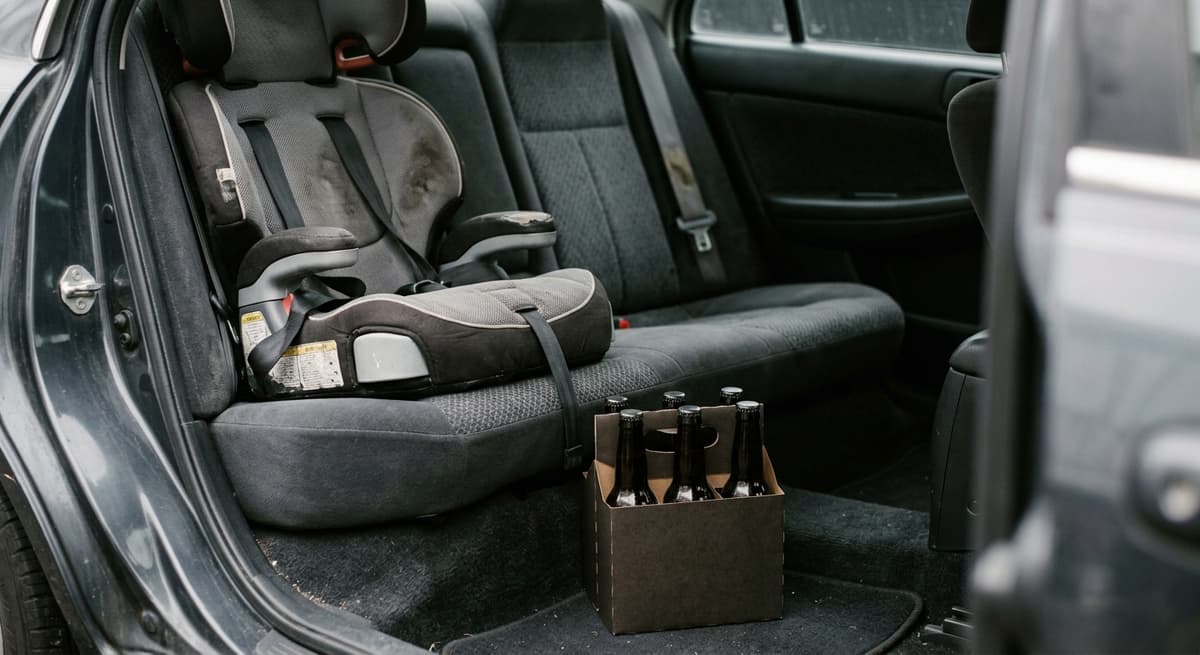
"If the cap or seal on the container has been opened or broken, it is unlawful to transport the liquors in a motor vehicle, except in a trunk, luggage compartment, or cargo area that is separate and distinct from the driver's and passengers' compartments. For purposes of this exception, the luggage compartment or cargo area is not required to be a closed trunk that is accessible only from the exterior of the motor vehicle."
This section covers "alcoholic liquors," meaning distilled spirits of any alcohol-by-volume percentage, and frames the offense as unlawfully transporting an opened container rather than simply possessing one, though the practical effect is similar to the beer/wine rule. The exempted storage area is defined more flexibly than a traditional trunk: a cargo area in a vehicle without a separate enclosed trunk, such as an SUV or hatchback, can qualify as long as it is separate and distinct from the driver's and passengers' compartments.
Penalties
Both statutes carry the same penalty structure. A conviction under either § 61-4-110 or § 61-6-4020(A) is a misdemeanor, punishable by a fine of not more than $100 or imprisonment of not more than 30 days.
Federal Compliance
Federal law, 23 U.S.C. § 154, conditions a share of a state's highway funding on having an open container law that bans both possession and consumption, covers the whole passenger area, reaches every occupant, and is primarily enforced. States that fall short have 2.5 percent of certain federal highway apportionments reserved and redirected to highway safety programs, under FHWA's annual apportionment notice. South Carolina is not on FHWA's list of non-conforming states for fiscal year 2026 (FHWA Notice N4510.905, dated October 1, 2025).
Disclaimer: This article provides general legal information about open container laws in the United States as of September 2026. It is not legal advice. Open container statutes, exemptions, and penalties change; verify the current text of your state's law before relying on it, and consult a lawyer licensed in your state for advice about a specific situation.
Related reading: open container laws by state, South Carolina DUI laws, and South Carolina window tint laws.
Statutes cited reflect their in-force version as of 2026-09-16. Last updated: 2026-09-16.
Frequently Asked Questions
Can a passenger have an open beer in the car in South Carolina?
No, unless it is in the trunk or luggage compartment. S.C. Code Ann. Section 61-4-110 bans any person from having an open beer or wine container in the vehicle, except in the trunk or luggage compartment, and it applies equally to the driver and every passenger.
Is the rule different for liquor than for beer and wine in South Carolina?
Yes. Beer and wine are governed by Section 61-4-110, which exempts only the trunk or luggage compartment. Distilled spirits are governed by a separate statute, Section 61-6-4020(A), which exempts a trunk, luggage compartment, or cargo area that is separate and distinct from the driver's and passengers' compartments.
Can I keep an opened bottle of liquor in the cargo area of an SUV in South Carolina?
Section 61-6-4020(A) allows this if the cargo area is separate and distinct from the driver's and passengers' compartments; it does not have to be a fully enclosed trunk accessible only from outside the vehicle.
What is the penalty for an open container violation in South Carolina?
A conviction under either the beer/wine statute or the liquor statute is a misdemeanor, with a fine of not more than $100 or imprisonment of not more than 30 days.
Updates
Independently fact-checked against the cited primary sources
Independently fact-checked against the cited primary sources
The Law Behind This Article
This article rests on the statutory provisions below, held in our own legal record and retrieved from the official source. Tap a section to read the operative text.
South Carolina Code of Laws, Title 61: ALCOHOL AND ALCOHOLIC BEVERAGES
§ 61-4-110Open containers in motor vehicleIn force
It is unlawful for a person to have in his possession, except in the trunk or luggage compartment, beer or wine in an open container in a motor vehicle of any kind while located upon the public highways or highway rights of way of this State. This section must not be construed to prohibit the transporting of beer or wine in a closed container, and this section does not apply to vehicles parked in legal parking places during functions such as sporting events where law enforcement officers are on duty to perform traffic control duties. A person who violates the provisions of this section is guilty of a misdemeanor and, upon conviction, must be fined not more than one hundred dollars or imprisoned not more than thirty days. For purposes of this section, beer or wine means any beer or wine containing one-half of one percent or more of alcohol by volume.
Official text (excerpt) · last checked 2026-09-24 · Read the full text in our law library · Verify at scstatehouse.gov
§ 61-6-4020Transportation in motor vehicleIn force
(A) A person who is twenty-one years of age or older may transport lawfully acquired alcoholic liquors to and from a place where alcoholic liquors may be lawfully possessed or consumed. If the cap or seal on the container has been opened or broken, it is unlawful to transport the liquors in a motor vehicle, except in a trunk, luggage compartment, or cargo area that is separate and distinct from the driver's and passengers' compartments. For purposes of this exception, the luggage compartment or cargo area is not required to be a closed trunk that is accessible only from the exterior of the motor vehicle. A person who violates this section is guilty of a misdemeanor and, upon conviction, must be fined not more than one hundred dollars or imprisoned for not more than thirty days. For purposes of this section, alcoholic liquors means all distilled spirits regardless of the percentage of alcohol by volume that they contain. (B) Sections 61-6-4290 and 61-6-4300 do not apply to violations of this section, including violations prior to the effective date of this section.
Official text (excerpt) · last checked 2026-07-29 · Read the full text in our law library · Verify at scstatehouse.gov
United States Code Title 23
§ 154Open container requirementsIn forcecited in 46 of our articles
In this section, the following definitions apply: The term “alcoholic beverage” has the meaning given the term in section 158(c). The term “motor vehicle” means a vehicle driven or drawn by mechanical power and manufactured primarily for use on public highways, but does not include a vehicle operated exclusively on a rail or rails. The term “open alcoholic beverage container” means any bottle, can, or other receptacle— that contains any amount of alcoholic beverage; and that is open or has a broken seal; or the contents of which are partially removed. The term “passenger area” shall have the meaning given the term by the Secretary by regulation. For the purposes of this section, each State shall have in effect a law that prohibits the possession of any open alcoholic beverage container, or the consumption of any alcoholic beverage, in the passenger area of any motor vehicle (including possession or consumption by the driver of the vehicle) located on a public highway, or the right-of-way of a public highway, in the State.
Official text (excerpt) · last checked 2026-09-23 · Read the full text in our law library · Verify at uscode.house.gov
Cited in 20 court opinions in our collectionLatest citing opinion in our collection: 2004
Opinions citing this section in our collection:
- Foremost Insurance v. Richardson (Supreme Court of the United States 1982, 457 U.S. 668)“…er traffic, just as it has done for some land traffic. See 23 U. S. C. § 154 (55 m.p.h. speed limit). Yet no one su…”
- United States v. Kevin Bishop, United States of America v. Edward Stokes (Court of Appeals for the Third Circuit 1995, 66 F.3d 569)“…nder the Spending Clause, not the Commerce Clause. See 23 U.S.C. § 154 (Supp.1995) (conditioning receipt of f…”
- Mrs. Lizzie Beatrice Easterwood v. Csx Transportation, Inc. (Court of Appeals for the Eleventh Circuit 1991, 933 F.2d 1548)“…ce with the national highway speed limit. See 23 U.S.C.A. § 154 (1990). Easterwood argues that an auto…”
Identified automatically from the court opinions citing this section — not a ranking of which case controls.
Also relied on in: Open Container Laws by State (2026): Passengers, Exemptions, Penalties, Maine Open Container Law (2026): Statute and Exemptions, Alabama Open Container Law (2026): The $25 Fine and No-Points Rule
Search our full record of US law — 2.1 million sections, every state + federal →
Sources and References
- S.C. Code Ann. § 61-4-110 - Open containers in motor vehicle (beer/wine); verified live 2026-09-16(scstatehouse.gov).gov
- S.C. Code Ann. § 61-6-4020 - Transportation of alcoholic liquors in motor vehicle; verified live 2026-09-16(scstatehouse.gov).gov
- 23 U.S.C. § 154(a) - Open container requirements(law.cornell.edu)
- FHWA Notice N4510.905 - FY2026 Apportionment of Federal-Aid Highway Program Funds (open container non-conforming states list)(highways.dot.gov).gov