Idaho
Idaho Open Container Law (2026): Rules and Penalties
Independently fact-checked against primary sources (last audited September 23, 2026). · 3 primary sources cited on this page. How we verify our legal content
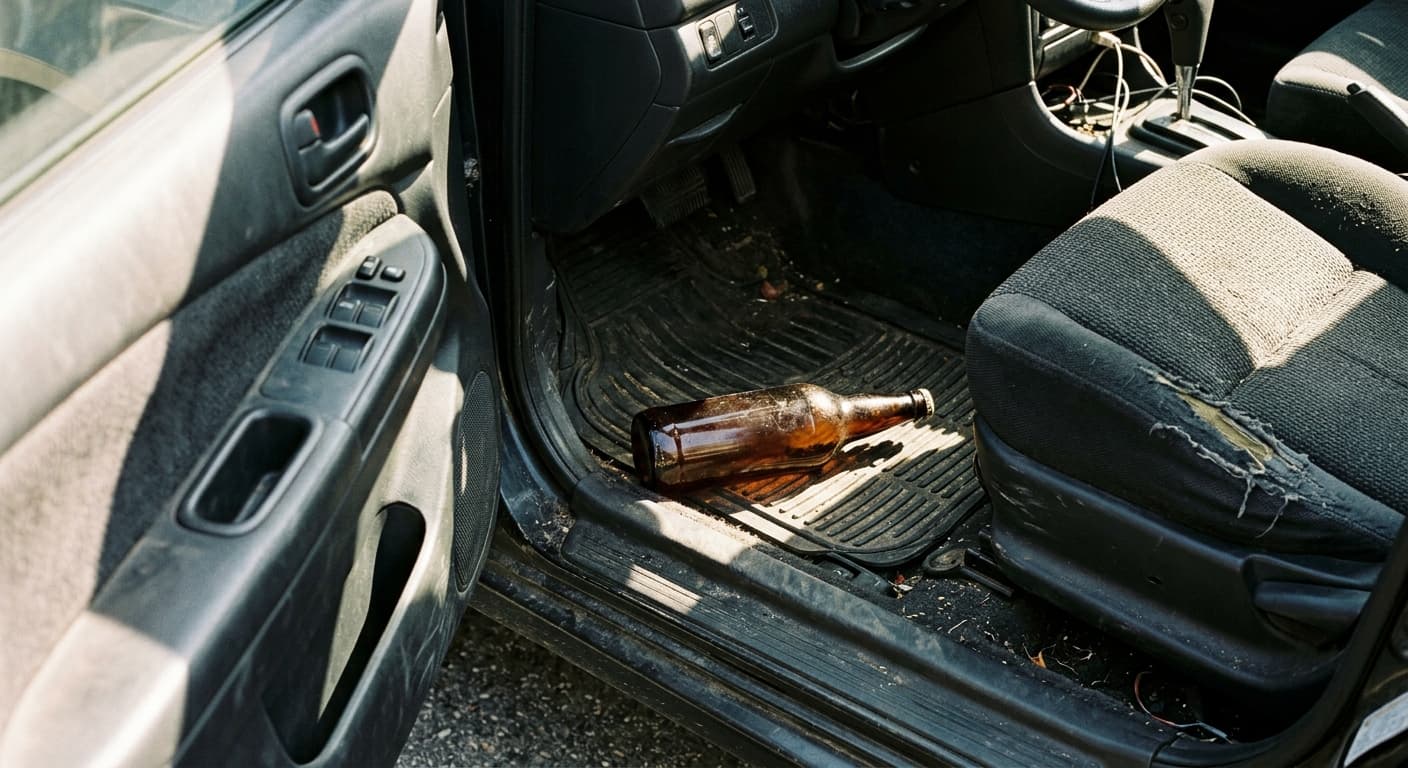
As of September 2026, Idaho law makes it illegal for both the driver and any passenger to drink or possess an open container of alcohol in a vehicle on a public highway, under the state's general open container statute, Idaho Code § 23-505(2).
Jurisdiction scope: This article addresses Idaho's statewide open container law for motor vehicles under Idaho Code § 23-505 and the federal framework in 23 U.S.C. § 154. It does not address Idaho's DUI statute (which supplies the "actual physical control" standard used for penalty purposes), watercraft open container rules, or any local ordinance.
What Idaho's Open Container Law Prohibits
Idaho's operative open container statute is Idaho Code § 23-505(2), which provides that no person in a motor vehicle, while the vehicle is on a public highway or the right-of-way of a public highway, may drink or possess an open container of beer, wine, or liquor. The ban covers both drinking (consumption) and simple possession of an open container, and it applies to the driver and to every passenger, not just the person behind the wheel.
Idaho also has an older, narrower statute, Idaho Code § 23-1333, which bans possession of an open wine container in a vehicle and has not been amended since 1971. That statute predates § 23-505 and covers only wine. Both statutes remain in force. Unlike § 23-505(2), § 23-1333 contains no for-hire-vehicle or recreational-vehicle exception, so on its face a wine container in a taxi or in an RV's living quarters could still be prohibited under § 23-1333 even though § 23-505(2) would permit it. No repeal, preemption case, or Attorney General opinion resolving this conflict was found for this article.
Who the Law Applies To
Idaho's ban applies to "any person" in the vehicle, meaning the driver and every passenger are each individually subject to it. This is a broader rule than some neighboring states, where only the driver's own consumption or possession is restricted by statute.
Exemptions
Idaho Code § 23-505(1) prohibits breaking open, or drinking or using, a container of alcoholic liquor while it is being transported in the vehicle, but it permits an unsealed alcoholic beverage container to be transported in the vehicle's enclosed trunk compartment, or, in a vehicle without a trunk compartment, behind the last upright seat. Two further exemptions apply to specific categories of occupant:
- A passenger, other than the person in actual physical control of the vehicle, may drink or possess an open container in the passenger area of a for-hire vehicle, such as a taxi or limousine.
- A passenger may drink or possess an open container in the living quarters of a recreational vehicle.
Neither exemption extends to the driver or to the person in actual physical control of the vehicle.
Penalties
Idaho ties the penalty to the violator's role in the vehicle rather than setting a single flat offense. The person in actual physical control of the vehicle, defined the same way it is for Idaho's DUI statute (Idaho Code § 18-8004), commits a misdemeanor for violating § 23-505(2). Any other violator, such as a passenger, commits an infraction. Idaho's statute does not specify a dollar fine amount for either violation level within the text reviewed for this article, and this article does not state one.
How Idaho's Law Fits the Federal Rule
Federal law, 23 U.S.C. § 154, conditions a portion of each state's highway funding on having an open container law that meets minimum federal standards. Under 23 CFR § 1270.4, a compliant law must ban both possession and consumption, cover the driver and all passengers, apply on public highways, and be primarily enforced, while still permitting states to allow the trunk, locked-container, for-hire vehicle, and motorhome exemptions described above.
A state without a compliant law has 2.5 percent of certain federal highway funds reserved and redirected to highway safety programs rather than released for ordinary use. FHWA's FY2026 apportionment notice (Notice N4510.905, dated October 1, 2025) lists 12 states as non-conforming for this purpose: Alaska, Connecticut, Delaware, Hawaii, Louisiana, Maine, Mississippi, Missouri, Ohio, Tennessee, Virginia, and Wyoming. Idaho is not one of them. That absence from the list means Idaho's law was not flagged as non-conforming in the FY2026 notice; it is not the same thing as an independent, per-state federal certification of every detail of Idaho's statute.
Disclaimer: This article provides general legal information about open container laws in the United States as of September 2026. It is not legal advice. Open container statutes, exemptions, and penalties change; verify the current text of your state's law before relying on it, and consult a lawyer licensed in your state for advice about a specific situation.
For the federal framework and how every state compares, see the open container laws by state hub. Related reading: Idaho DUI laws and Idaho window tint laws.
Statutes cited reflect their in-force version as of 2026-09-16. Last updated: 2026-09-16.
Frequently Asked Questions
Does Idaho's open container law apply to passengers, or just the driver?
It applies to both. Idaho Code § 23-505(2) bars any person in the vehicle, driver or passenger, from possessing or drinking an open alcoholic beverage container.
Can a passenger legally drink alcohol in a car in Idaho?
No, unless the passenger is riding in a for-hire vehicle such as a taxi or limousine, or is in the living quarters of a recreational vehicle. Outside those exceptions, Idaho's general open container law bans consumption by any occupant of the vehicle, not just the driver, while the vehicle is on a public highway.
Is there an exception for taxi or limousine passengers in Idaho?
Yes. A passenger, other than the person in actual physical control of the vehicle, may drink or possess an open container in the passenger area of a for-hire vehicle such as a taxi or limousine.
What happens if you're caught with an open container in Idaho?
The person in actual physical control of the vehicle commits a misdemeanor; any other violator, such as a passenger, commits an infraction. Idaho's statute as reviewed does not specify a fine amount for either level.
Updates
Independently fact-checked against the cited primary sources
Independently fact-checked against the cited primary sources
The Law Behind This Article
This article rests on the statutory provisions below, held in our own legal record and retrieved from the official source. Tap a section to read the operative text.
Idaho Code
§ 23-505Transportation of alcoholic beveragesIn force
23-505. Transportation of alcoholic beverages. (1) Alcoholic liquor lawfully purchased may be transported, but no person shall break open, or allow to be broken or opened any container of alcoholic liquor, or drink, or use, or allow to be drunk, or used any alcoholic liquor therein while the same…
Official text (excerpt) · last checked 2026-09-23 · Read the full text in our law library · Verify at legislature.idaho.gov
§ 23-1333Open or unsealed containers of wine in motor vehicles on highways prohibited. No person may, while operating or riding in or upon a motor vehicle upon a public highway of this state, have in his possession any wine in an open or unsealed container of any kindIn force
23-1333. Open or unsealed containers of wine in motor vehicles on highways prohibited. No person may, while operating or riding in or upon a motor vehicle upon a public highway of this state, have in his possession any wine in an open or unsealed container of any kind.
Official text (excerpt) · last checked 2026-08-01 · Read the full text in our law library · Verify at legislature.idaho.gov
§ 18-8004Persons under the influence of alcohol, drugs or any other intoxicating substancesIn forcecited in 2 of our articles
18-8004. Persons under the influence of alcohol, drugs or any other intoxicating substances. (1) (a) It is unlawful for any person who is under the influence of alcohol, drugs or any other intoxicating substances, or any combination of alcohol, drugs and/or any other intoxicating substances, or who…
Official text (excerpt) · last checked 2026-09-04 · Read the full text in our law library · Verify at legislature.idaho.gov
Cited in 429 court opinions in our collectionLatest citing opinion in our collection: 2026
In the courts (editorial summary, independently checked):Idaho courts have applied section 18-8004 broadly. State v. Rhonda Trusdall (2014) held a utility type vehicle is a motor vehicle under the statute and that the UTV-specific DUI law did not bar charging under it. State v. Brant Lee Eversole (2016) declined to read an operability requirement into actual physical control.
Opinions citing this section in our collection:
- State v. Rhonda Trusdall (Idaho Court of Appeals 2014, 155 Idaho 965)✓A woman spun a Polaris Ranger in circles in a church parking lot with six unhelmeted children aboard and tested at .169; the court held a utility type vehicle is a motor vehicle under section 18-8004, so the State could charge her under the general DUI statute.
- State v. Gary L. Schall (Idaho Supreme Court 2014, 157 Idaho 488)✓Schall's DUI charge was raised to a felony by two prior convictions, one from Wyoming; the court held the priors are predicates for an enhancement rather than elements of a separate crime, so the offense charged remains the violation of section 18-8004.
- State v. Brant Lee Eversole (Idaho Supreme Court 2016, 160 Idaho 239)✓An intoxicated man sat in the driver's seat of a running truck high-centered on a brick berm with its rear wheels spinning; the court declined to read an operability requirement into section 18-8004, since actual physical control needs only the driver's seat and a running motor.
Identified automatically from the court opinions citing this section — not a ranking of which case controls.
Also relied on in: Idaho DUI Laws: Penalties, BAC Limit & License (2026)
Code of Federal Regulations Title 23
§ 1270.4Compliance criteria.In forcecited in 20 of our articles
(a) To avoid the reservation of funds specified in § 1270.6, a State must enact and enforce an open container law that prohibits the possession of any open alcoholic beverage container, and the consumption of any alcoholic beverage, in the passenger area of any motor vehicle (including possession or consumption by the driver of the vehicle) located on a public highway, or the right-of-way of a public highway, in the State. (b) The law must apply to: (1) The possession of any open alcoholic beverage container and the consumption of any alcoholic beverage; (2) The passenger area of any motor vehicle; (3) All alcoholic beverages; (4) All occupants of a motor vehicle; and (5) All motor vehicles located on a public highway or the right-of-way of a public highway. (c) The law must provide for primary enforcement. (d) Exceptions.
Official text (excerpt) · last checked 2026-07-28 · Read the full text in our law library · Verify at ecfr.gov
Also relied on in: Maine Open Container Law (2026): Statute and Exemptions, Open Container Laws by State (2026): Passengers, Exemptions, Penalties, Alaska Open Container Law (2026): A Driver-Only Driving Offense
United States Code Title 23
§ 154Open container requirementsIn forcecited in 46 of our articles
In this section, the following definitions apply: The term “alcoholic beverage” has the meaning given the term in section 158(c). The term “motor vehicle” means a vehicle driven or drawn by mechanical power and manufactured primarily for use on public highways, but does not include a vehicle operated exclusively on a rail or rails. The term “open alcoholic beverage container” means any bottle, can, or other receptacle— that contains any amount of alcoholic beverage; and that is open or has a broken seal; or the contents of which are partially removed. The term “passenger area” shall have the meaning given the term by the Secretary by regulation. For the purposes of this section, each State shall have in effect a law that prohibits the possession of any open alcoholic beverage container, or the consumption of any alcoholic beverage, in the passenger area of any motor vehicle (including possession or consumption by the driver of the vehicle) located on a public highway, or the right-of-way of a public highway, in the State.
Official text (excerpt) · last checked 2026-09-23 · Read the full text in our law library · Verify at uscode.house.gov
Cited in 20 court opinions in our collectionLatest citing opinion in our collection: 2004
Opinions citing this section in our collection:
- Foremost Insurance v. Richardson (Supreme Court of the United States 1982, 457 U.S. 668)“…er traffic, just as it has done for some land traffic. See 23 U. S. C. § 154 (55 m.p.h. speed limit). Yet no one su…”
- United States v. Kevin Bishop, United States of America v. Edward Stokes (Court of Appeals for the Third Circuit 1995, 66 F.3d 569)“…nder the Spending Clause, not the Commerce Clause. See 23 U.S.C. § 154 (Supp.1995) (conditioning receipt of f…”
- Mrs. Lizzie Beatrice Easterwood v. Csx Transportation, Inc. (Court of Appeals for the Eleventh Circuit 1991, 933 F.2d 1548)“…ce with the national highway speed limit. See 23 U.S.C.A. § 154 (1990). Easterwood argues that an auto…”
Identified automatically from the court opinions citing this section — not a ranking of which case controls.
Also relied on in: Alabama Open Container Law (2026): The $25 Fine and No-Points Rule, Arkansas Open Container Law (2026): Rules, Exemptions, and Penalty, California Open Container Law (2026): The Full Rule
Search our full record of US law — 2.1 million sections, every state + federal →
Sources and References
- Idaho Code § 23-505 (open container prohibition, motor vehicles, exemptions, and penalty)(legislature.idaho.gov).gov
- Idaho Code § 23-1333 (open or unsealed containers of wine in motor vehicles on highways prohibited)(legislature.idaho.gov).gov
- 23 U.S.C. § 154(a), federal open container law requirements for state highway funding(law.cornell.edu)
- 23 CFR § 1270.4, federal compliance criteria and permitted state exemptions(law.cornell.edu)
- FHWA Notice N4510.905, FY2026 Apportionment of Federal-Aid Highway Program Funds (non-conforming state list, dated 2025-10-01)(highways.dot.gov).gov