Iowa
Iowa Fireworks Laws (2026): Dates, Age, Penalties
Independently fact-checked against primary sources (last audited September 18, 2026). · 9 primary sources cited on this page. How we verify our legal content
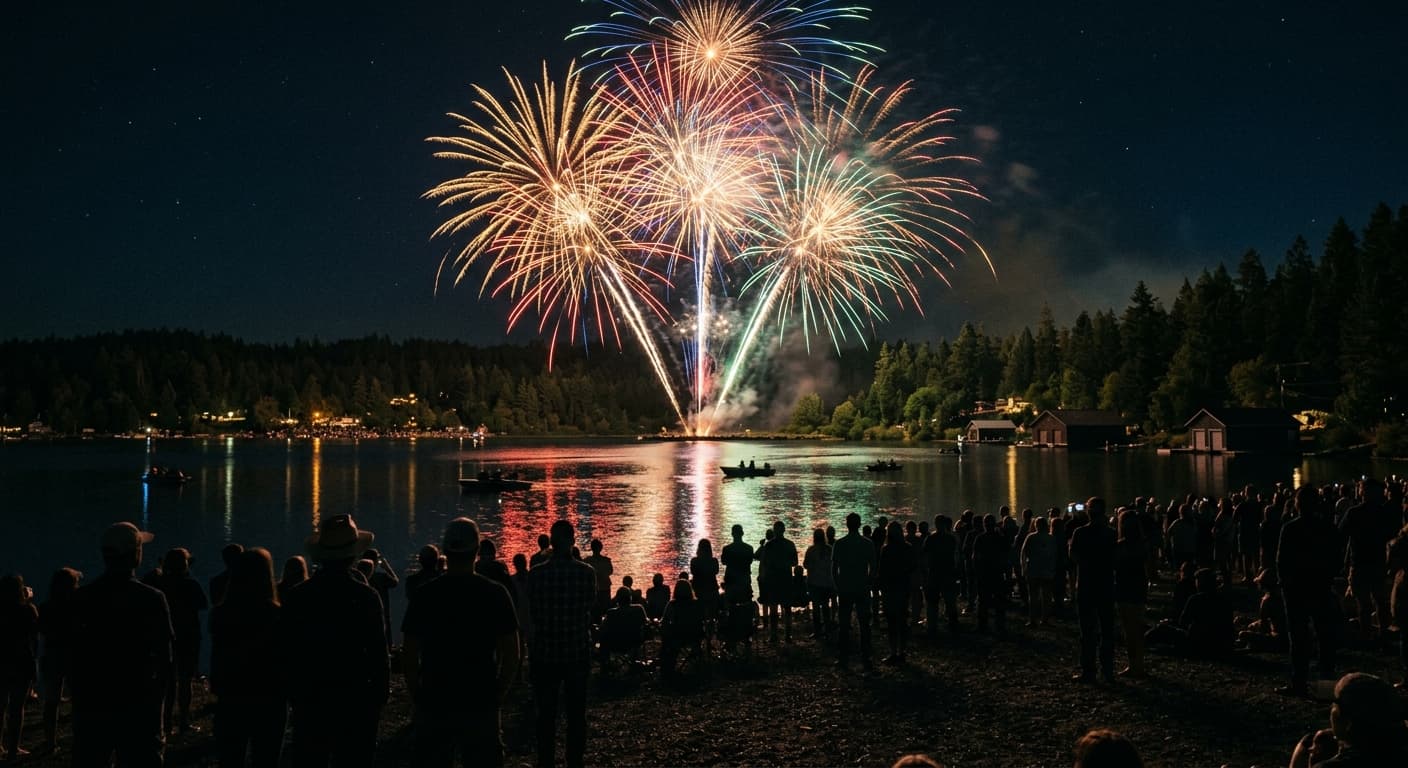
Iowa Code § 727.2(3)(a) lets any person possess, use, or explode "consumer fireworks," a two-tier category defined by cross-reference to American Pyrotechnics Association Standard 87-1, on their own property or property where the owner has consented under § 727.2(4)(c); that subsection sets no age floor on possession or use itself. Selling consumer fireworks to a buyer under 18, and purchasing them while under 18, are each a separate crime under § 727.2(3)(b). Use is confined to two annual windows, June 1 through July 8 and December 10 through January 3, and to set daily hours, under § 727.2(4); retail sale runs on its own, narrower calendar under § 10A.519(4)(c). "Display fireworks," the broader explosive category not enumerated as consumer fireworks or novelties, may not be sold or used by the general public, apart from a handful of statutory exceptions; sale and use is otherwise limited to city- or county-permitted public displays run by a competent operator.
Jurisdiction scope: This article covers Iowa's state fireworks law under Iowa Code § 727.2 (consumer and display fireworks, use windows, hours, age, penalties) and § 10A.519 (seller licensing), along with the local-option authority in §§ 364.2(6) and 331.301(17). It does not catalog every Iowa city or county's individual ordinance restricting the non-protected dates; those must be checked locally.
What's Legal: Consumer Fireworks and Novelties
Iowa Code § 727.2(3)(a) permits a person, firm, partnership, or corporation to "possess, use, or explode consumer fireworks in accordance with this subsection and subsection 4." "Consumer fireworks" is a defined category split into first-class devices (aerial shell kits and reloadable tubes, chasers, helicopter and aerial spinners, firecrackers, mine and shell devices, missile-type rockets, Roman candles, sky and bottle rockets, and certain multi-tube devices) and second-class devices (fountains, flitter sparklers, ground and hand-held sparkling devices, ground spinners, illuminating torches, certain toy smoke devices, wheels, and non-novelty wire or dipped sparklers), all defined by cross-reference to American Pyrotechnics Association Standard 87-1, chapter 3. A separate "novelties" category, defined in the same standard's chapter 3 and subject to federal labeling rules, falls outside the consumer fireworks definition entirely, and § 727.2(5)(c) excludes novelties from the section unless it specifically provides otherwise. It does so in § 727.2(3)(c): using novelties in violation of a city or county ordinance, or of a suspension order under § 10A.511(6), is a simple misdemeanor punishable by a fine of not less than $250.
Use of consumer fireworks is limited to the person's own property, or property belonging to someone else who has consented to the use, under § 727.2(4)(c). Iowa does not set its own gram or weight caps in statute for either tier; § 727.2 and § 10A.519 define first-class and second-class consumer fireworks entirely by cross-reference to APA Standard 87-1, not by a numeric threshold written into the Iowa Code itself.
What's Banned: Display Fireworks
"Display fireworks," meaning explosive compositions or articles for visible or audible effect that are not enumerated as novelties or consumer fireworks, cannot be offered for sale, exposed for sale, sold at retail, or used by the general public. Iowa Code § 727.2(2)(a) states:
"A person, firm, partnership, or corporation who offers for sale, exposes for sale, sells at retail, or uses or explodes any display fireworks, commits a simple misdemeanor, punishable by a fine of not less than two hundred fifty dollars. However, a city council of a city or a county board of supervisors may, upon application in writing, grant a permit for the display of display fireworks by municipalities, fair associations, amusement parks, and other organizations or groups of individuals approved by the city or the county board of supervisors when the display fireworks will be handled by a competent operator, but no such permit shall be required for the display of display fireworks at the Iowa state fairgrounds by the Iowa state fair board, at incorporated county fairs, or at district fairs receiving state aid. Sales of display fireworks for such display may be made for that purpose only."
In practice, that means display fireworks (the large aerial shows most people associate with "fireworks displays") are legal for the general public only as a permitted event run by a competent operator, not as something a private individual can buy or set off for personal use. The Iowa State Fair, incorporated county fairs, and state-aid district fairs do not need a separate permit for their own displays.
The ban on display-fireworks sale and use is not absolute. § 727.2(5)(a) provides that the section does not prohibit several specific transactions. The first, sale "by a resident, dealer, manufacturer, or jobber of such fireworks as are not prohibited by this section," is not a display-fireworks exception, since it covers only fireworks the section does not prohibit. The display-relevant ones are these: any kind of fireworks may be sold if they are to be shipped out of Iowa, and blank cartridges may be sold or used for a stage or theater show, for athletic-sports or railroad/truck signal purposes, or by a recognized military organization. § 727.2(5)(b) separately exempts substances or compositions sold for medicinal or fumigation purposes, and § 727.2(5)(c) excludes novelties from the section unless the section specifically provides otherwise.
When You Can Use Fireworks
Iowa sets two separate calendars: a use window that governs when a buyer may lawfully use or explode what they bought, and a narrower sale window that governs when a licensed retailer may sell it. The use window comes from § 727.2(4)(a):
"A person shall not use or explode consumer fireworks on days other than June 1 through July 8 and December 10 through January 3 of each year, all dates inclusive."
Iowa Code § 727.2(4)(a)
Hours are separately restricted, with extended windows around the two marquee holidays:
"A person shall not use or explode consumer fireworks at times other than between the hours of 9:00 a.m. and 10:00 p.m., except that on the following dates consumer fireworks shall not be used at times other than between the hours specified: (1) Between the hours of 9:00 a.m. and 11:00 p.m. on July 4 and the Saturdays and Sundays immediately preceding and following July 4. (2) Between the hours of 9:00 a.m. on December 31 and 12:30 a.m. on the immediately following day. (3) Between the hours of 9:00 a.m. and 11:00 p.m. on the Saturdays and Sundays immediately preceding and following December 31."
Iowa Code § 727.2(4)(b)
Standard hours are 9:00 a.m. to 10:00 p.m. every day within the two use windows above. That expands to 9:00 a.m. to 11:00 p.m. on July 4 and the weekend days immediately before and after it, and to 9:00 a.m. to 11:00 p.m. on the weekend days immediately before and after December 31. On December 31 itself, use is allowed from 9:00 a.m. through 12:30 a.m. the following day.
Retail sale runs on its own, narrower calendar. Under Iowa Code § 10A.519(4)(c), the director's rules must permit a licensed retailer or community group to sell consumer fireworks:
"(1) At a permanent building that meets the requirements of paragraph 'a', between June 1 and July 8 and between December 10 and January 3 each year, all dates inclusive. (2) At a temporary structure that meets the requirements of paragraph 'a' between June 13 and July 8 each year, both dates inclusive."
Iowa Code § 10A.519(4)(c)
A permanent-building retailer's sale window matches the use window exactly. A temporary-structure retailer's window is narrower: it opens June 13, not June 1, and runs only through July 8, with no December 10-January 3 winter season at all.
Age
Iowa's age rule attaches to sale and purchase, not to possession or use itself: § 727.2(3)(a), the general possess/use/explode permission, contains no age element. § 727.2(3)(b) sets the age line on both sides of a sale:
"A person, firm, partnership, or corporation who sells consumer fireworks to a person who is less than eighteen years of age commits a simple misdemeanor, punishable by a fine of not less than two hundred fifty dollars. A person who is less than eighteen years of age who purchases consumer fireworks commits a simple misdemeanor, punishable by a fine of not less than two hundred fifty dollars."
A seller who sells to a buyer under 18, and a buyer under 18 who purchases, are each separately guilty of a simple misdemeanor with the same $250 minimum fine. Separately, a licensed retailer or community group may not transfer consumer fireworks to anyone under 18 at all, regardless of who is paying, under Iowa Code § 10A.519(5).
Licensing and Permits
Selling consumer fireworks at retail requires a state Consumer Fireworks Seller License from Iowa's Department of Inspections, Appeals, and Licensing, under Iowa Code § 10A.519. The annual fee is tiered by facility type and how much of the retail floor space is devoted to first-class consumer fireworks:
"A person shall possess a consumer fireworks seller license under this section in order to sell consumer fireworks. ... For a retailer at a permanent building who devotes fifty percent or more of the retailer's retail floor space to the sale or display of first-class consumer fireworks, an annual fee of one thousand dollars."
Iowa Code § 10A.519(2)(b), (3)(a)
The fee tiers run from $1,000 for a permanent building devoting at least half its floor space to first-class fireworks, down to $500 for a temporary structure at the same threshold, $400 for a retailer under that threshold or for a community group selling first-class fireworks, and $100 for a retailer or community group selling only second-class fireworks. Iowa does not require an individual purchase permit; a buyer's legal status turns on age and the use-window and hours rules above, not on holding a permit of their own. Display fireworks require the separate city- or county-issued display permit described above rather than a seller license.
Local Option: Protected Dates
Cities and counties can restrict fireworks use beyond the state's baseline rule, but the statute carves out three dates a locality cannot touch. Iowa Code § 364.2(6) provides:
"A city council may by ordinance or resolution prohibit or limit the use of consumer fireworks, display fireworks, or novelties, as described in section 727.2, on any day other than July 3, July 4, and December 31 in accordance with section 727.2, subsection 4."
County boards of supervisors have a narrower version of the same power under § 331.301(17): a county ordinance reaches only "consumer fireworks or display fireworks," leaving out novelties, and the board may act only "if the board determines that the use of such devices would constitute a threat to public safety or private property, or if the board determines that the use of such devices would constitute a nuisance to neighboring landowners," a predicate finding the city power carries no equivalent of. In effect, July 3, July 4, and December 31 are a protected floor: a city, or a county that has made the required finding, can ban or restrict fireworks use on every other day within the statewide use window described above, including most of June, early July days other than the 4th, and most of December, but not on those three dates.
Regulations and Suspension Authority
Retail sale of consumer fireworks must follow NFPA 1124 (2006 edition), the national fire code for manufacture, transportation, storage, and retail sale of fireworks, under § 727.2(3)(d):
"Any retailer or community group offering for sale at retail any consumer fireworks shall do so in accordance with the national fire protection association standard 1124, published in the code for the manufacture, transportation, storage, and retail sales of fireworks and pyrotechnic articles, 2006 edition, and shall not be subject to any other standards or requirements unless provided for by the director of the department of inspections, appeals, and licensing under section 10A.519."
Separately, the director of the Department of Inspections, Appeals, and Licensing may order a suspension of consumer fireworks, display fireworks, or novelties use if the state fire marshal determines that the use of such devices would constitute a threat to public safety, under Iowa Code § 10A.511(6). Using fireworks in violation of an active suspension order is itself a separate simple-misdemeanor offense under § 727.2(2)(b)(2) and (3)(c)(2), on top of whatever other violation it might also be. Violating § 10A.519 itself, or a rule the director adopts under it (for example, selling without a license or without the required insurance), is separately a simple misdemeanor under § 10A.519(9).
Recent Changes
Iowa's consumer-fireworks-seller and wholesaler-registration provisions were recodified in 2023. 2023 Iowa Acts, ch. 19, § 1711 transferred the former § 100.19 (seller licensing) and § 100.19A (wholesaler registration) into their current locations, § 10A.519 and § 10A.520; both former sections now display only a transfer notice in the live Iowa Code. The move shifted the licensing framework from chapter 100, formerly the State Fire Marshal's chapter, into chapter 10A, the Department of Inspections, Appeals, and Licensing's chapter. The recodification carried its own penalty along with the licensing scheme: § 10A.519(9) makes a violation of that section, or of a rule adopted under it, a simple misdemeanor, so fireworks criminal penalties are not confined to § 727.2.
Federal Layer
Federal law sets a floor underneath Iowa's rules. Consumer fireworks sold anywhere in the country must meet U.S. Consumer Product Safety Commission construction and labeling standards for DOT Class 1.4G devices (16 CFR Parts 1500.17 and 1507). Separately, 27 CFR 555.141(a)(7) exempts the importation, distribution, and storage of consumer fireworks (not their manufacture) from the federal explosives-licensing requirements that otherwise apply. It is a federal crime under 18 U.S.C. § 836 to transport fireworks, other than in the course of continuous interstate transportation through a state, into any state whose law specifically prohibits or regulates the use of fireworks, knowing they will be delivered, possessed, stored, transshipped, distributed, sold, or otherwise dealt with in a manner or for a use prohibited by that state's law; a violation is punishable by a fine or up to one year of imprisonment, or both. The statute exempts common and contract carriers, international or domestic water carriers engaged in interstate commerce, and transportation into a state for the use of federal agencies in their own operations. USPS Publication 52 § 341.22 separately classifies all fireworks, including novelty items, as nonmailable explosives.
Penalties
Iowa Code § 727.2 routes nearly every fireworks violation to the same "simple misdemeanor" label, but the consequences differ depending on which subsection was violated. Unauthorized display-fireworks sale or use, sale to a minor, and underage purchase each carry a fine of not less than $250, quoted above. Violating a fire-marshal or director suspension order is a separate simple misdemeanor under § 727.2(2)(b)(2) and (3)(c)(2). Violating a local ordinance restriction on a non-protected date is also a simple misdemeanor.
The dates, hours, and property-consent limitations in § 727.2(4) carry an unusual carve-out:
"A person who violates this subsection commits a simple misdemeanor. A court shall not order imprisonment for violation of this subsection."
Iowa Code § 727.2(4)(d)
So using consumer fireworks on the wrong date, at the wrong hour, or without the property owner's consent is fine-only in practice, even though it shares the same "simple misdemeanor" label as violations that can carry jail time under Iowa's general misdemeanor sentencing.
For how Iowa's rule compares with the rest of the country, see fireworks laws by state. Iowa also has its own Iowa open container law covering a different vehicle-related rule.
Disclaimer: This article provides general legal information about fireworks laws in the United States as of September 2026. It is not legal advice. Fireworks statutes, local ordinances, use windows, and penalties change frequently and are often further restricted by city or county ordinance beyond what state law requires; verify the current rule for your specific city and county before buying, selling, or using fireworks, and consult a lawyer licensed in your state for advice about a specific situation.
Statutes cited reflect their in-force version as of 2026-09-17. Last updated: 2026-09-17.
Frequently Asked Questions
Are fireworks legal in Iowa?
Yes. Iowa Code § 727.2(3)(a) lets any person possess, use, or explode "consumer fireworks" on their own property or property where the owner consented (§ 727.2(4)(c)), within the statutory use windows and hours. Buying and selling consumer fireworks is restricted to age 18 and up under § 727.2(3)(b).
When can you use fireworks in Iowa?
June 1 through July 8 and December 10 through January 3 each year, under § 727.2(4)(a). Daily hours are 9:00 a.m. to 10:00 p.m., extended to 11:00 p.m. on July 4 and the surrounding weekend, and through 12:30 a.m. on New Year's Day.
Is there a separate window for buying fireworks in Iowa?
Yes. A licensed retailer at a permanent building may sell June 1-July 8 and December 10-January 3, matching the use window, but a retailer at a temporary structure may sell only June 13-July 8, with no winter season, under Iowa Code § 10A.519(4)(c).
What is the minimum age to buy fireworks in Iowa?
18. Under § 727.2(3)(b), both selling consumer fireworks to a buyer under 18 and purchasing them while under 18 are separately simple misdemeanors, and a licensed retailer may not transfer fireworks to anyone under 18 under § 10A.519(5). Iowa's statute sets no age floor for using consumer fireworks itself.
Can a city or county ban fireworks in Iowa?
A city can prohibit or limit fireworks use on any day except July 3, July 4, and December 31, which the statute protects as a floor localities cannot ban, under Iowa Code § 364.2(6). A county can do the same under § 331.301(17), but only for consumer and display fireworks (not novelties) and only on a finding that the use threatens public safety or property, or is a nuisance to neighbors.
What is the penalty for violating Iowa's fireworks law?
Most violations are a simple misdemeanor with a fine of not less than $250. Violating the dates, hours, or property-consent rule in § 727.2(4) is also a simple misdemeanor, but the statute bars a court from ordering imprisonment for that specific violation. Violating the seller-license statute itself is a separate simple misdemeanor under § 10A.519(9).
Updates
Corrected how the page describes Iowa's novelties rules, the Section 727.2(5)(a) exemptions, and the $400 seller-license fee tier, and removed two statements the statutes do not support.
Independently fact-checked against the cited primary sources
The Law Behind This Article
This article rests on the statutory provisions below, held in our own legal record and retrieved from the official source. Tap a section to read the operative text.
Iowa Code, Chapter 727: HEALTH, SAFETY, AND WELFARE
§ 727.2Fireworks.In force
1. Definitions. For purposes of this section: a. “Consumer fireworks” includes first-class consumer fireworks and second-class consumer fireworks as those terms are defined in section 10A.519, subsection 1. “Consumer fireworks” does not include novelties enumerated in chapter 3 of the American pyrotechnics association’s standard 87-1 or display fireworks enumerated in chapter 4 of the American pyrotechnics association’s standard 87-1. b. “Display fireworks” includes any explosive composition, or combination of explosive substances, or article prepared for the purpose of producing a visible or audible effect by combustion, explosion, deflagration, or detonation, and includes fireworks containing any explosive or flammable compound, or other device containing any explosive substance. “Display fireworks” does not include novelties or consumer fireworks enumerated in chapter 3 of the American pyrotechnics association’s standard 87-1. c. “Novelties” includes all novelties enumerated in chapter 3 of the American pyrotechnics association’s standard 87-1, and that comply with the labeling regulations promulgated by the United States consumer product safety commission. 2.
Official text (excerpt) · last checked 2026-09-23 · Read the full text in our law library · Verify at legis.iowa.gov
Iowa Code, Chapter 10A: DEPARTMENT OF INSPECTIONS, APPEALS, AND LICENSING
§ 10A.519Consumer fireworks seller licensing — penalty — fund.In force
1. As used in this section: a. “APA 87-1” means the American pyrotechnics association standard 87-1, as published in December 2001. b. “Community group” means a nonprofit entity that is open for membership to the general public which is exempt from federal income taxation pursuant to section 501(c)(3) of the Internal Revenue Code or a fraternal benefit society, as that term is defined in section 512B.3. c. “First-class consumer fireworks” means the following consumer fireworks, as described in APA 87-1, chapter 3: (1) Aerial shell kits and reloadable tubes. (2) Chasers. (3) Helicopter and aerial spinners. (4) Firecrackers. (5) Mine and shell devices. (6) Missile-type rockets. (7) Roman candles. (8) Sky rockets and bottle rockets. (9) Multiple tube devices under this paragraph “c” that are manufactured in accordance with APA 87-1, section 3.5. d. “Retailer” means as defined in section 423.1. e. “Second-class consumer fireworks” means the following consumer fireworks, as described in APA 87-1, chapter 3: (1) Cone fountains. (2) Cylindrical fountains. (3) Flitter sparklers.
Official text (excerpt) · last checked 2026-07-29 · Read the full text in our law library · Verify at legis.iowa.gov
§ 10A.511Fire control duties.In force
The duties of the director relating to fire control shall be as follows: 1. To enforce all laws, and the rules and regulations of the department concerned with all of the following: a. The prevention of fires. b. The storage, transportation, handling, and use of flammable liquids, combustibles, fireworks, and explosives. c. The storage, transportation, handling, and use of liquid petroleum gas. d. The electric wiring and heating, and adequate means of exit in case of fire, from churches, schools, hotels, theaters, amphitheaters, asylums, hospitals, health care facilities as defined in section 135C.1, college buildings, lodge halls, public meeting places, and all other structures in which persons congregate from time to time, whether publicly or privately owned. 2. To promote fire safety and reduction of loss by fire through educational methods. 3. To promulgate fire safety rules in consultation with the state fire marshal. The director shall have exclusive right to promulgate fire safety rules as they apply to enforcement or inspection requirements by the department, but the rules shall be promulgated pursuant to chapter 17A.
Official text (excerpt) · last checked 2026-07-29 · Read the full text in our law library · Verify at legis.iowa.gov
§ 10A.520Consumer fireworks wholesaler — registration — penalty.In force
1. For purposes of this section: a. “Consumer fireworks” means first-class consumer fireworks and second-class consumer fireworks, as those terms are defined in section 10A.519. b. “Wholesaler” means a person who engages in the business of selling or distributing consumer fireworks for the purpose of resale in this state. 2. The director shall adopt rules to require all wholesalers to annually register with the director. The director may also adopt rules to regulate the storage or transfer of consumer fireworks by wholesalers and to require wholesalers to maintain insurance. 3. The director shall establish an annual registration fee of one thousand dollars for wholesalers of consumer fireworks within the state. Registration fees collected pursuant to this section shall be deposited in the consumer fireworks fee fund created in section 10A.519. 4. A person who violates a provision of this section or a rule adopted pursuant to this section is guilty of a simple misdemeanor.
Official text (excerpt) · last checked 2026-07-29 · Read the full text in our law library · Verify at legis.iowa.gov
Iowa Code, Chapter 364: POWERS AND DUTIES OF CITIES
§ 364.2Vesting of power — franchises.In force
1. A power of a city is vested in the city council except as otherwise provided by a state law. 2. The enumeration of a specific power of a city does not limit or restrict the general grant of home rule power conferred by the Constitution of the State of Iowa. A city may exercise its general powers subject only to limitations expressly imposed by a state or city law. 3. An exercise of a city power is not inconsistent with a state law unless it is irreconcilable with the state law. 4. a. A city may grant to any person a franchise to erect, maintain, and operate plants and systems for electric light and power, heating, telegraph, cable television, district telegraph and alarm, motor bus, trolley bus, street railway or other public transit, waterworks, sewer services, or gasworks, within the city for a term of not more than twenty-five years. When considering whether to grant, amend, extend, or renew a franchise, a city shall hold a public hearing on the question. Notice of the time and place of the hearing shall be published as provided in section 362.3.
Official text (excerpt) · last checked 2026-07-29 · Read the full text in our law library · Verify at legis.iowa.gov
Cited in 36 court opinions in our collectionLatest citing opinion in our collection: 2020
Opinions citing this section in our collection:
- Goodell v. Humboldt County (Supreme Court of Iowa 1998, 575 N.W.2d 486)“…l amendment. See Iowa Const, art. Ill, § 38A. See also Iowa Code § 364.2 (2) and (3) (1983). Under home rule, a…”
- Kragnes v. City of Des Moines (Supreme Court of Iowa 2006, 714 N.W.2d 632)“…de for collection of a franchise fee under the Iowa Code. ( Iowa Code § 364.2 ) • The city council may grant,…”
- Lisa Kragnes v. City of Des Moines, Iowa (Supreme Court of Iowa 2012, 810 N.W.2d 492)“…relief was unnecessary because the legislature had amended Iowa Code section 364.2(4)(f) to allow municipalities to impose…”
Identified automatically from the court opinions citing this section — not a ranking of which case controls.
Iowa Code, Chapter 331: COUNTY HOME RULE IMPLEMENTATION
§ 331.301General powers and limitations.In force
1. A county may, except as expressly limited by the Constitution of the State of Iowa, and if not inconsistent with the laws of the general assembly, exercise any power and perform any function it deems appropriate to protect and preserve the rights, privileges, and property of the county or of its residents, and to preserve and improve the peace, safety, health, welfare, comfort, and convenience of its residents. This grant of home rule powers does not include the power to enact private or civil law governing civil relationships, except as incident to an exercise of an independent county power, or to enact private or civil law which violates section 675.4. 2. A power of a county is vested in the board, and a duty of a county shall be performed by or under the direction of the board except as otherwise provided by law. 3. The enumeration of a specific power of a county, the repeal of a grant of power, or the failure to state a specific power does not limit or restrict the general grant of home rule power conferred by the Constitution and this section. A county may exercise its general powers subject only to limitations expressly imposed by a state law. 4.
Official text (excerpt) · last checked 2026-07-29 · Read the full text in our law library · Verify at legis.iowa.gov
Cited in 28 court opinions in our collectionLatest citing opinion in our collection: 2025
Opinions citing this section in our collection:
- Goodell v. Humboldt County (Supreme Court of Iowa 1998, 575 N.W.2d 486)“…onstitutional principle is also found in our statutory law. Iowa Code section 331.301 (1995) states: 1. A county may, excep…”
- Miller v. Marshall County (Supreme Court of Iowa 2002, 641 N.W.2d 742)“…ts based on the population of the county. See Iowa Code § 331.301 (10)(e)(1), (2) (1993). This appeal req…”
- Site A Landowners and Mahaska County v. South Central Regional Airport Agency, City of Pella, and City of Oskaloosa (Supreme Court of Iowa 2022)“…of Supervisors, 654 N.W.2d 910, 913 (Iowa 2002) (quoting Iowa Code 331.301(1) (1999)). The legislature has set fo…”
Identified automatically from the court opinions citing this section — not a ranking of which case controls.
Iowa Code, Chapter 100: STATE FIRE MARSHAL
§ 100.19Consumer fireworks seller licensing — penalty — fund. Transferred to §10A.519;In force
2023 Acts, ch 19, §1711 .
Official text (excerpt) · last checked 2026-07-29 · Read the full text in our law library · Verify at legis.iowa.gov
Cited in 1 court opinions in our collectionLatest citing opinion in our collection: 2018
Opinions citing this section in our collection:
- Bellino Fireworks, Inc. v. City of Ankeny (District Court, S.D. Iowa 2018, 332 F. Supp. 3d 1071)“…issued by the state fire marshal. SF 489 § 3 (codified at Iowa Code § 100.19 ). 2 Licensing criteria *1079 inclu…”
Identified automatically from the court opinions citing this section — not a ranking of which case controls.
§ 100.19AConsumer fireworks wholesaler — registration — penalty. Transferred to §10A.520;In force
2023 Acts, ch 19, §1711 .
Official text (excerpt) · last checked 2026-07-29 · Read the full text in our law library · Verify at legis.iowa.gov
Code of Federal Regulations Title 27
§ 555.141Exemptions.In forcecited in 41 of our articles
(a) General. Except for the provisions of §§ 555.180 and 555.181, this part does not apply to: (1) Any aspect of the transportation of explosive materials via railroad, water, highway, or air which is regulated by the U.S. Department of Transportation and its agencies, and which pertains to safety. For example, regulations issued by the Department of Transportation addressing the security risk of aliens transporting explosives by commercial motor or railroad carrier from Canada preclude the enforcement of 18 U.S.C. 842(i)(5) against persons shipping, transporting, receiving, or possessing explosives incident to and in connection with the commercial transportation of explosives by truck or rail from Canada into the United States. Questions concerning this exception should be directed to ATF's Explosives Industry Program Branch in Washington, DC. (2) The use of explosive materials in medicines and medicinal agents in the forms prescribed by the official United States Pharmacopeia or the National Formulary.
Official text (excerpt) · last checked 2026-07-28 · Read the full text in our law library · Verify at ecfr.gov
Cited in 1 court opinions in our collectionLatest citing opinion in our collection: 2006
Opinions citing this section in our collection:
- Tripoli Rocketry Ass'n v. Bureau of Alcohol, Tobacco, Firearms, & Explosives (Court of Appeals for the D.C. Circuit 2006, 437 F.3d 75)“…imported, or distributed for their intended purposes.” See 27 C.F.R. § 555.141(a)(8) (2005) (current exemption); 26 C.…”
Identified automatically from the court opinions citing this section — not a ranking of which case controls.
Also relied on in: Fireworks Laws by State (2026): What Is Legal, Sale Dates, Penalties, Delaware Fireworks Laws (2026): Sparklers, Novelties, Dates, DC Fireworks Laws: Permitted List, Licensing, Penalties
United States Code Title 18
§ 836Transportation of fireworks into State prohibiting sale or useIn forcecited in 52 of our articles
Whoever, otherwise than in the course of continuous interstate transportation through any State, transports fireworks into any State, or delivers them for transportation into any State, or attempts so to do, knowing that such fireworks are to be delivered, possessed, stored, transshipped, distributed, sold, or otherwise dealt with in a manner or for a use prohibited by the laws of such State specifically prohibiting or regulating the use of fireworks, shall be fined under this title or imprisoned not more than one year, or both. This section shall not apply to a common or contract carrier or to international or domestic water carriers engaged in interstate commerce or to the transportation of fireworks into a State for the use of Federal agencies in the carrying out or the furtherance of their operations. In the enforcement of this section, the definitions of fireworks contained in the laws of the respective States shall be applied. As used in this section, the term “State” includes the several States, Territories, and possessions of the United States, and the District of Columbia. This section shall be effective from and after July 1, 1954.
Official text (excerpt) · last checked 2026-07-28 · Read the full text in our law library · Verify at uscode.house.gov
Cited in 15 court opinions in our collectionLatest citing opinion in our collection: 2024
Opinions citing this section in our collection:
- United States v. James A. Womack (Court of Appeals for the Fifth Circuit 1981, 654 F.2d 1034)“…eworks has been traditionally left to the states. He cites 18 U.S.C.A. § 836 , which prohibits the transportation of…”
- United States v. Bernard J. Semel (Court of Appeals for the Fourth Circuit 1965, 347 F.2d 228)“…y an information containing eighteen counts with violating 18 U.S.C.A. § 836 by having feloniously caused to be tra…”
- Cohen v. Bredehoeft (District Court, S.D. Texas 1968, 290 F. Supp. 1001)“…the states from legislating in this area. On the contrary, 18 U.S.C. Sec. 836 indicates an intent to encourage state…”
Identified automatically from the court opinions citing this section — not a ranking of which case controls.
Also relied on in: Alabama Fireworks Laws (2026): Legal Fireworks, Age Rules, Penalties, Alaska Fireworks Laws (2026): Age-18 Minimum, No Sale Window, Arizona Fireworks Laws (2026): Legal Devices, Local Rules, Penalties
Search our full record of US law — 2.1 million sections, every state + federal →
Sources and References
- Iowa Code § 727.2 - Fireworks: consumer/display fireworks definitions, use windows, hours, age, local option, penalties(legis.iowa.gov).gov
- Iowa Code § 10A.519 - Consumer fireworks seller license, fee tiers by facility type and floor space(legis.iowa.gov).gov
- Iowa Code § 364.2(6) - City local-option authority to prohibit or limit fireworks use, protected dates July 3, July 4, December 31(legis.iowa.gov).gov
- Iowa Code § 331.301(17) - County local-option authority, narrower than the city power (no novelties; requires a public-safety or nuisance finding)(legis.iowa.gov).gov
- Iowa Code § 100.19/§ 100.19A - Former seller license/wholesaler registration sections, transferred to §§ 10A.519/10A.520 by 2023 Iowa Acts, ch. 19, § 1711(legis.iowa.gov).gov
- 16 CFR 1500.17 / 1507 - CPSC consumer fireworks (1.4G) construction and safety standards(ecfr.gov).gov
- 27 CFR 555.141(a)(7) - Federal explosives-licensing exemption for importation, distribution, and storage of consumer fireworks(ecfr.gov).gov
- 18 U.S.C. § 836 - Federal crime to transport fireworks into any state whose law specifically prohibits or regulates fireworks use; fine or up to one year imprisonment; carrier, water-carrier, federal-agency, and agricultural-use exceptions(uscode.house.gov).gov
- USPS Publication 52 § 341.22 - Fireworks classified as nonmailable explosives(pe.usps.com).gov