
Louisiana
Louisiana Nursing Home Camera Laws: The Nursing Home Virtual Visitation Act
Independently fact-checked against primary sources (last audited August 14, 2026). · 5 primary sources cited on this page. How we verify our legal content
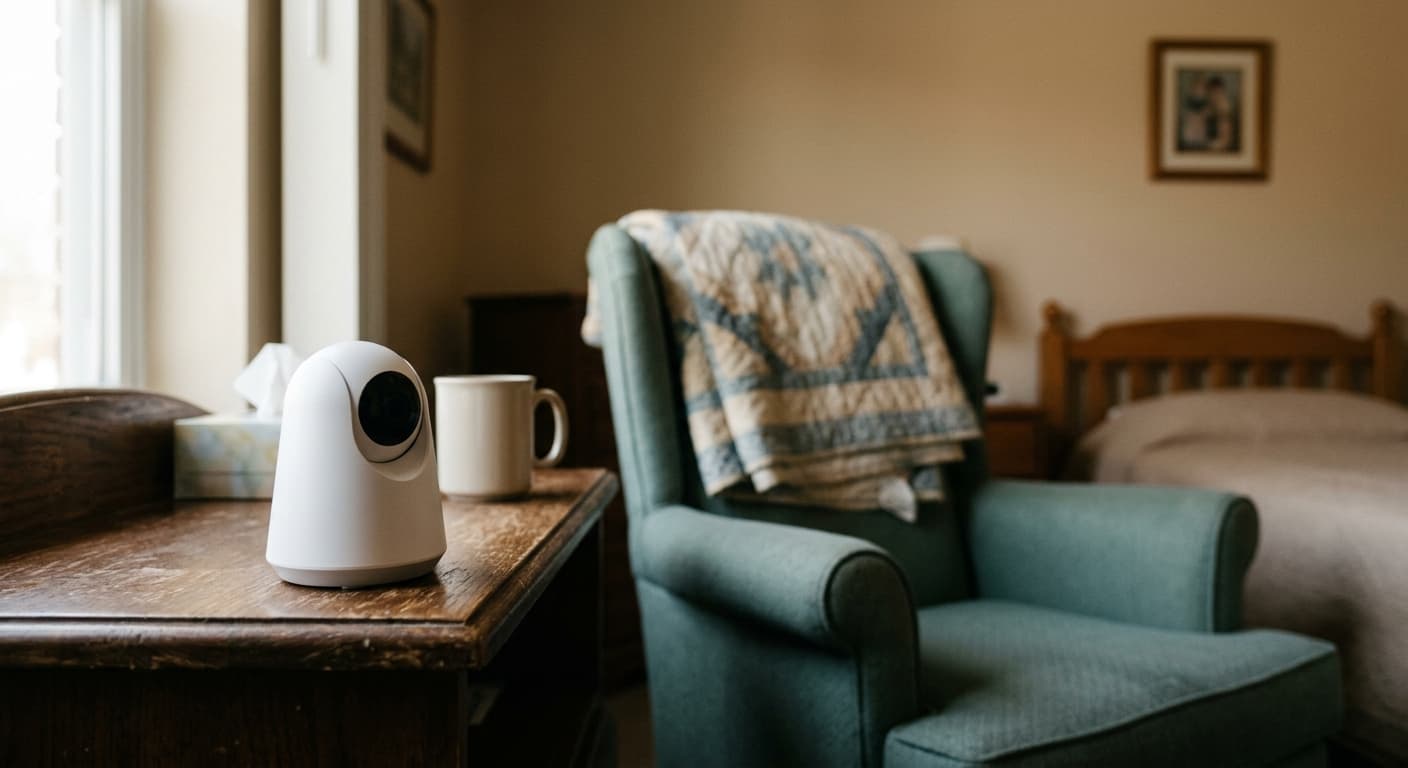
Louisiana gives a nursing home resident with capacity, or their legal representative, the right to install a video or audio monitoring device in the resident's own room, under the Nursing Home Virtual Visitation Act, La. R.S. 40:1193.1 through 40:1193.11, in force since August 1, 2018.
Information last verified on 2026-08-14. This article has not yet been reviewed by a licensed lawyer.
This article covers Louisiana's Nursing Home Virtual Visitation Act, La. R.S. 40:1193.1 through 40:1193.11, which applies to nursing homes only. It does not cover Louisiana's general one-party consent recording law in full, which has its own dedicated page linked below, and it does not apply to assisted living.
What Louisiana's Electronic Monitoring Law Grants
A resident with the capacity to consent, or their legal representative, may authorize installation of a monitoring device. The Act defines "monitoring device" as a surveillance instrument that transmits and records activity and is not connected to the facility's computer network, and it explicitly excludes a device limited to still photographs. "Nursing home" is defined by cross-reference to La. R.S. 40:2009.2, and this right is also cross-referenced directly in the Residents' Bill of Rights at La. R.S. 40:2010.8(24).
Does Louisiana's Law Cover Assisted Living?
No. The Act's definitions section, and its authorization provision, both tie the right specifically to "nursing home" as defined by La. R.S. 40:2009.2. There is no assisted-living or other facility-type coverage anywhere in the statute's text. A family with a relative in a Louisiana assisted living facility does not have a right under this Act, and needs to look instead at the facility's own admission-agreement policy.
Authorization, Roommate Consent, and Installation
Authorization requires written notice to the nursing home, a date and time stamp on any video recording, and written consent from every other resident in the room who has the capacity to consent, or their legal representative. The facility must inform residents about the monitoring option at admission, and a resident or roommate may install or remove a device "at any time" during residency. The facility must keep authorization records accessible to the ombudsman.
Act 596 of the 2018 Regular Session, which created this Part, carried no effective-date section, so it took effect on August 1, 2018 under the default rule in La. Const. art. III, sec. 19. Section 2 of that Act separately required every licensed nursing home to deliver the department's choice form to each resident already in residence on or before January 1, 2019. That was a one-time rollout deadline for existing residents, not the date the statute began to apply.

If roommates disagree about monitoring, the facility must make a reasonable attempt to accommodate the requesting resident, which can include offering to move either resident to another shared room. If a resident chooses a private room specifically to enable monitoring, they pay the private-room rate, and the facility must reassess the request every two weeks if no space is immediately available. A device must remain in a fixed, stationary position and monitor only the resident who consents to it.
Consent, Waiver, and Withdrawal
Consent may be given only by the resident or their legal representative, and must include a release of the nursing home from privacy-related liability. The resident or representative may reverse a monitoring choice "at any time," on notice to both the nursing home and the ombudsman.
Notice and Signage
A main-entrance sign, titled "Electronic Monitoring," is required, stating that the rooms of some residents may be equipped with monitoring devices installed by or on behalf of the resident. The nursing facility pays for that entrance sign. A separate sign is required at each monitored resident's own room entrance, stating that the room is electronically monitored, and the cost of that room-entrance sign is the resident's or legal representative's responsibility, per facility policy.
Who Pays for the Device
The resident pays for the device itself, installation, operation, and maintenance. Structural alterations needed to install a device require a licensed contractor and facility approval, and devices must comply with NFPA Life Safety regulations.
Immunity and Refusal-to-Admit Ban
A nursing home may not deny admission, discharge, or discriminate against a resident based on their choice to install a monitoring device, with violations subject to departmental enforcement. Separately, compliance with the Act is a complete defense to a civil or criminal action a resident, representative, or the nursing home might otherwise bring over the device's use or presence, and a recording made without following the Act's prescribed process cannot be used against the nursing home in a civil action.
Tampering: What the Statute Says
It is unlawful for any person to intentionally hamper, obstruct, tamper with, or destroy a monitoring device or a recording, with an exception for the device-owning resident or legal representative. The Act itself prescribes no criminal grade or penalty for that prohibition. Section 40:1193.8 is headed "Prohibited acts; civil and criminal penalties," but no section of the Part, 40:1193.1 through 40:1193.11, attaches a fine, a jail term, or a misdemeanor or felony classification to it, and the departmental-enforcement clause at 40:1193.8(A)(2) reaches only the anti-retaliation duty in Subsection A. A criminal prosecution for tampering with a resident's camera would therefore have to rest on a general statute, such as La. R.S. 14:110.3, which prohibits intentionally tampering with, obstructing, or disabling "any surveillance, accounting, inventory, or monitoring system of any nature or purpose" and carries a fine of up to $1,000, imprisonment with or without hard labor for up to one year, or both.

Using Recordings as Evidence of Abuse or Neglect
Anyone who views a recorded incident that a reasonable person would consider abuse or neglect must report it to the facility "as soon as is practicable." The facility must then receive a copy of the relevant recording, and if a format conversion is needed, the facility covers that cost through a qualified professional who verifies the recording was not altered.
Harmed by a product or exposure? Speak with an attorney about your options
If you or a loved one may have been harmed, you can speak with an attorney about your legal options at no cost. Whether you have a claim depends on the specific facts. This is attorney advertising, not a guarantee that you qualify or of any particular outcome.
Camera vs. Microphone: Louisiana's Consent Law
Louisiana is a one-party consent state for recording generally: see Louisiana Recording Laws for the full framework. Because only one party to a conversation needs to consent, a resident present in their own room who consents to their own device generally satisfies the general consent rule for their own conversations. A device that captures a staff member's conversation with a visitor, where the resident is not a participant, is the scenario where the general one-party consent rule still applies on its own terms, separate from the Act's own roommate-consent process.
Installing a Camera in a Louisiana Nursing Home
- Confirm the facility is a nursing home. Assisted living is not covered.
- Notify the nursing home in writing and confirm capacity to consent, or have the legal representative act.
- Obtain written roommate consent, or work through the reasonable-accommodation process if a roommate refuses.
- Arrange installation through a licensed contractor if structural work is needed, and confirm devices meet Life Safety Code standards.
- Post the required signs, entrance and room, and budget for the device's ongoing cost.
If You Suspect Abuse or Neglect
Louisiana residents and families can report suspected abuse or neglect to the Louisiana Department of Health or to the state's Long-Term Care Ombudsman program, which the Act itself requires be kept informed of monitoring authorizations and any reversal of a monitoring choice. The federal Long-Term Care Ombudsman program, operating in every state under the Older Americans Act, covers assisted living residents too, even though Louisiana's own camera statute does not.

Related Resources
- Nursing Home Camera Laws by State covers the national picture across all 18 statute states.
- Louisiana Recording Laws covers Louisiana's general one-party consent rule for audio recording.
- Nursing Home Abuse & Neglect covers how an abuse or neglect claim works once evidence, including camera footage, is in hand.
Last updated: 2026-08-14.
Frequently Asked Questions
Can a resident install a camera in a Louisiana nursing home?
Yes. The Nursing Home Virtual Visitation Act, La. R.S. 40:1193.1 through 40:1193.11, gives a resident with capacity, or their legal representative, the right to install a monitoring device in the resident's own room, in force since August 1, 2018. The January 1, 2019 date sometimes cited for this Act is not its effective date; it was the one-time deadline for facilities to give the choice form to residents already in residence.
Does Louisiana's camera law cover assisted living facilities?
No. The Act applies specifically to nursing homes, as defined by cross-reference to La. R.S. 40:2009.2. There is no assisted living or other facility-type coverage under this statute.
Does a roommate have to consent to a camera in a Louisiana nursing home room?
Yes, in writing, from every roommate with the capacity to consent. If a roommate refuses, the facility must make a reasonable attempt to accommodate the requesting resident, which can include offering to move either resident to another shared room, reassessed every two weeks.
Does a Louisiana nursing home camera have to record audio?
No, and it cannot be a still-image-only camera either. The Act defines a monitoring device as a surveillance instrument that transmits and records activity and is not connected to the facility's network, explicitly excluding a device limited to still photographs.
Can a Louisiana nursing home refuse to admit a resident who wants a camera?
No. Under La. R.S. 40:1193.8(A), a nursing home may not deny admission, discharge, or discriminate against a resident based on their choice to install a monitoring device, with violations subject to departmental enforcement.
Who pays for a monitoring device in a Louisiana nursing home?
The resident bears all costs, including the device, installation, operation, maintenance, and removal. Structural alterations to install it require a licensed contractor and facility approval.
Updates
Corrected the effective date of Louisiana's Nursing Home Virtual Visitation Act to August 1, 2018 (January 1, 2019 was the deadline for facilities to give existing residents the choice form, not the date the law took effect), and replaced the open question about tampering penalties with a confirmed answer: the Act sets no criminal grade, so a prosecution would rest on a general statute such as La. R.S. 14:110.3.
Independently fact-checked against the cited primary sources
The Law Behind This Article
This article rests on the statutory provisions below, held in our own legal record and retrieved from the official source. Tap a section to read the operative text.
Louisiana Revised Statutes
§ 40:1193.3Monitoring device; authorization and useIn force
A. A resident who has the capacity to consent as determined by emergency rules promulgated by the department pursuant to this Part or his legal representative may authorize the installation and use of a monitoring device in a nursing home if all of the following conditions are met: (1) The resident or his legal representative gives notice of the installation to the nursing home. (2) If the monitoring device records activity visually, the recordings made by the device include a record of the date and time. (3) The resident pays for the monitoring device and all installation, operation, maintenance, and removal costs associated with the device. (4) Each resident occupying the same room who has the capacity to consent as determined by emergency rules promulgated by the department pursuant to this Part, or that resident's legal representative, gives written consent for the installation of the monitoring device. B. If the structure of the resident's room must be altered in order to accommodate a monitoring device, then the renovation to the room may be done only by a licensed contractor, subject to approval by the facility. C.
Official text (excerpt) · last checked 2026-08-31 · Read the full text in our law library · Verify at legis.la.gov
§ 40:1193.4Monitoring device option; installation; consent of residents in shared rooms; accommodation by nursing homeIn force
A.(1) At the time of a person's admission to a nursing home, the nursing home shall notify the person of his right to have a monitoring device installed in his room, and shall offer the person the option to have a monitoring device. The resident or his roommate may exercise the right to install or remove a monitoring device at any time during which he resides in the nursing home. The nursing home shall keep a record of the person's authorization or choice not to have a monitoring device. (2) The nursing home shall make the record provided for in Paragraph (1) of this Subsection accessible to the ombudsman. B.(1) If a resident who is residing in a shared room wishes to have a monitoring device installed in the room and another resident living in or moving into the same shared room refuses to consent to the use of the monitoring device, then the nursing home shall make a reasonable attempt to accommodate the resident who wishes to have the monitoring device installed.
Official text (excerpt) · last checked 2026-07-29 · Read the full text in our law library · Verify at legis.la.gov
§ 40:1193.2DefinitionsIn force
As used in this Part, the following terms have the meaning ascribed in this Section: (1) "Department" means the Louisiana Department of Health. (2) "Legal representative" means a legal guardian or a legally appointed substitute decision-maker who is authorized to act on behalf of a nursing home resident. (3)(a) "Monitoring device" means a surveillance instrument that transmits and records activity and is not connected to the facility's computer network. (b) The term "monitoring device" shall not include a camera that records still images exclusively. (4) "Nursing home" means a nursing facility or nursing home as defined in R.S. 40:2009.2. (5) "Ombudsman" means the administrator of the office of the state long-term care ombudsman established within the office of elderly affairs by the provisions of R.S. 40:2010.2. (6) "Resident" means a person who is a resident of a nursing home.
Official text (excerpt) · last checked 2026-07-29 · Read the full text in our law library · Verify at legis.la.gov
§ 40:1193.8Prohibited acts; civil and criminal penaltiesIn force
A.(1) No nursing home shall deny a person or resident admission to or discharge from a nursing home, or otherwise discriminate or retaliate against a person or resident, because the person or resident chooses to authorize installation and use of a monitoring device. (2) Any person who knowingly or willfully violates the provisions of Paragraph (1) of this Subsection shall be subject to appropriate action by the department as set forth in rules promulgated pursuant to this Part. B.(1) Except as provided in Paragraph (2) of this Subsection, no person shall intentionally hamper, obstruct, tamper with, or destroy a monitoring device or a recording made by a monitoring device installed in a nursing home pursuant to this Part. (2) The prohibition and penalties provided in this Subsection shall not apply to the resident who owns the monitoring device or recording, or to his legal representative.
Official text (excerpt) · last checked 2026-07-29 · Read the full text in our law library · Verify at legis.la.gov
§ 40:1193.9Public notice; signage of electronic monitoring deviceIn force
A. If a resident of a nursing facility conducts electronic monitoring, a sign shall be clearly and conspicuously posted at the main entrance of the nursing facility building to alert and inform visitors. The sign shall be in a large, clearly legible type and font and bear the words "Electronic Monitoring" and shall further state in equally legible type and font "The rooms of some residents may be equipped with electronic monitoring devices installed by or on behalf of the resident." B. A sign shall be clearly and conspicuously posted at the entrance of a resident's room where authorized electronic monitoring is being conducted. The sign shall be in large, clearly legible type and font and bear the words "This room is electronically monitored." C. The nursing facility shall be responsible for reasonable costs of installation and maintenance of the sign required by Subsection A of this Section. The resident or his legal representative shall be responsible for installing and maintaining the sign required pursuant to Subsection B of this Section, which shall also be in accordance with the written policy of the nursing facility.
Official text (excerpt) · last checked 2026-07-29 · Read the full text in our law library · Verify at legis.la.gov
United States Code Title 18
§ 2511Interception and disclosure of wire, oral, or electronic communications prohibitedIn forcecited in 422 of our articles
Except as otherwise specifically provided in this chapter any person who— intentionally intercepts, endeavors to intercept, or procures any other person to intercept or endeavor to intercept, any wire, oral, or electronic communication; intentionally uses, endeavors to use, or procures any other person to use or endeavor to use any electronic, mechanical, or other device to intercept any oral communication when— such device is affixed to, or otherwise transmits a signal through, a wire, cable, or other like connection used in wire communication; or such device transmits communications by radio, or interferes with the transmission of such communication; or such person knows, or has reason to know, that such device or any component thereof has been sent through the mail or transported in interstate or foreign commerce; or such use or endeavor to use (A) takes place on the premises of any business or other commercial establishment the operations of which affect interstate or foreign commerce; or (B) obtains or is for the purpose of obtaining information relating to the operations of any business or other commercial establishment the operations of which affect interstate or foreign…
Official text (excerpt) · last checked 2026-08-28 · Read the full text in our law library · Verify at uscode.house.gov
Cited in 2,045 court opinions in our collectionLatest citing opinion in our collection: 2026
In the courts (editorial summary, independently checked):Griggs-Ryan v. Smith (1990) applied the Section 2511(2)(d) prior-consent exception, treating a tenant repeatedly told that all incoming calls were taped as having impliedly consented. United States v. United States District Court (1972) read the then-current Section 2511(3) as conferring no presidential surveillance power.
Opinions citing this section in our collection:
- Mitchell v. Forsyth (Supreme Court of the United States 1985, 472 U.S. 511)✓The Attorney General authorized a warrantless 1970 national security wiretap that caught the plaintiff's calls; the Court held the since-repealed Section 2511(3) disclaimer left the tap lawful under Title III, and that Mitchell had qualified immunity.
- United States v. United States District Court for the Eastern District of Michigan (Supreme Court of the United States 1972, 407 U.S. 297)✓The Attorney General approved warrantless wiretaps on members of a domestic group accused of bombing a CIA office; the Court read Section 2511(3) as a congressional disclaimer conferring no surveillance power, then held the Fourth Amendment required prior judicial approval.
- Forsyth v. Barr (Court of Appeals for the Fifth Circuit 1994, 19 F.3d 1527)✓Dallas police used, in an internal affairs probe of an officer, calls private parties allegedly intercepted illegally; assuming that was unlawful, the Fifth Circuit held Section 2517(1) and (2) allowed the disclosure and use, defeating the Section 2511(1)(c) and (d) claims.
Identified automatically from the court opinions citing this section — not a ranking of which case controls.
Also relied on in: Connecticut Recording Laws (2026): Hybrid Consent Rules Explained, Oregon Recording Laws (2026): Hybrid One-Party and All-Party Rules, US Recording Laws by State (2026): All 50 States Explained
Search our full record of US law — 2.1 million sections, every state + federal →
Sources and References
- La. R.S. 40:1193.2, Nursing Home Virtual Visitation Act, Definitions(legis.la.gov).gov
- La. R.S. 40:1193.4, Installation and shared-room accommodation(legis.la.gov).gov
- La. R.S. 40:1193.8, Prohibited acts, civil and criminal penalties(legis.la.gov).gov
- La. R.S. 40:1193.9, Public notice and signage(legis.la.gov).gov
- 18 U.S.C. § 2511, federal Wiretap Act, one-party consent exception(law.cornell.edu)
- Administration for Community Living, State Long-Term Care Ombudsman Program(acl.gov).gov
- La. R.S. 40:1193.3, Monitoring device; authorization and use(legis.la.gov)
- Acts 2018, No. 596 (HB 281), enrolled, enacting the Nursing Home Virtual Visitation Act(legis.la.gov)
- La. R.S. 14:110.3, Tampering with surveillance, accounting, inventory, or monitoring systems(legis.la.gov)
- La. Const. art. III, sec. 19, effective date of laws enacted in a regular session(legis.la.gov)