
Oregon
Oregon Police Bodycam Laws: Retention, Access & Facial Recognition Ban
Independently fact-checked against primary sources (last audited August 20, 2026). · Reviewed by the RecordingLaw editorial team. · Law checked current as of August 20, 2026. · 3 primary sources cited on this page. How we verify our legal content
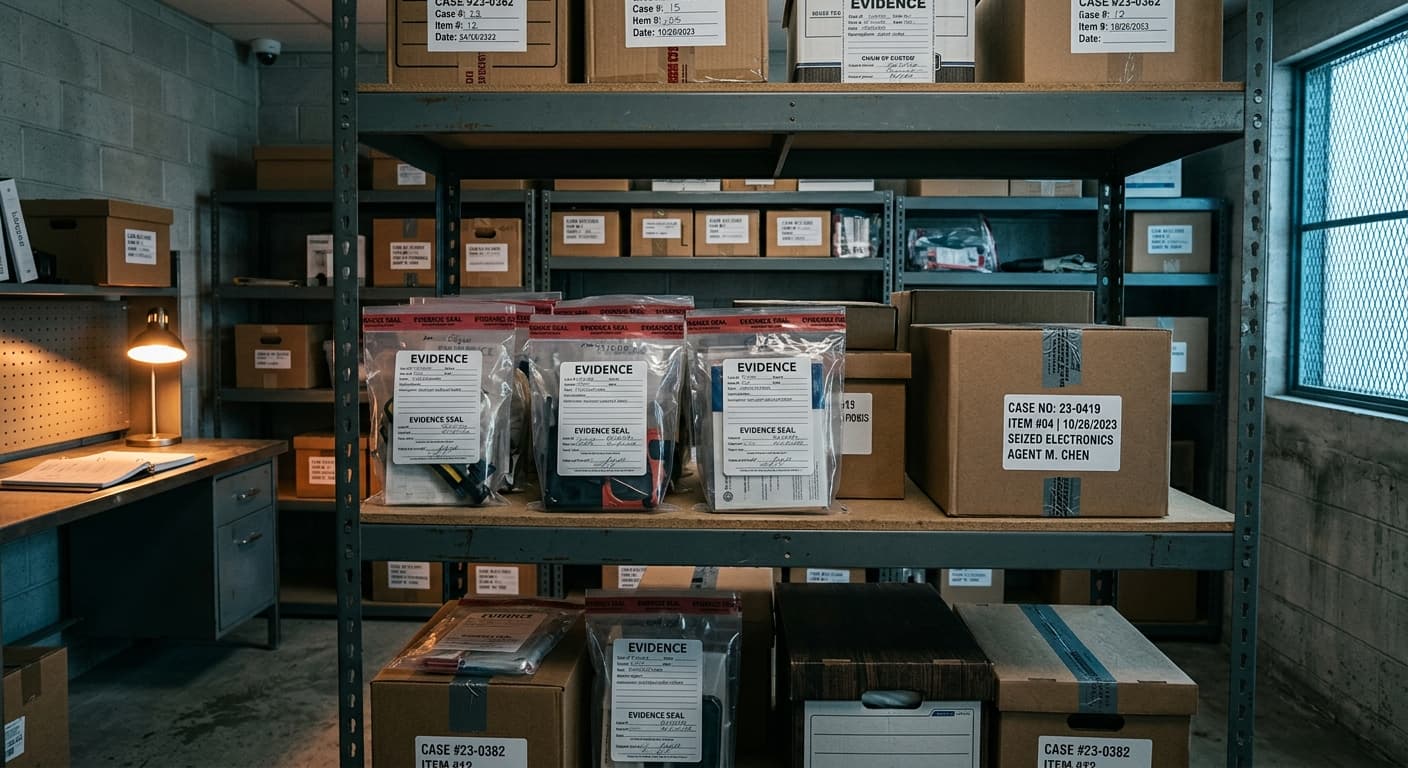
Oregon has no statute forcing every police department to use body cameras, but agencies that do must follow ORS 133.741: continuous recording once an officer has reasonable suspicion, 180 days to 30 months of retention, and an outright ban on running facial recognition against the footage.
This guide is part of our Police Bodycam Laws by State series. It covers whether Oregon departments must use bodycams, how long footage is kept, and how a member of the public can request a copy.
Jurisdiction scope: This article addresses Oregon law governing police body-worn cameras under ORS 133.741 and the Oregon Public Records Law, ORS chapter 192: mandate status, activation, retention, the facial recognition ban, and public access. It does not address a civilian's own right to record an on-duty officer, a different question covered in our guide on recording someone without their consent.
Does Oregon Require Police to Wear Body Cameras?
No statewide statute compels an Oregon law enforcement agency to buy or issue body cameras. ORS 133.741, enacted through House Bill 2571 (Oregon Laws 2015, chapter 550), instead sets mandatory operating rules for any "law enforcement agency" (an agency employing officers for the state, a municipality, a political subdivision, or a university police department) that decides to use them. Whether a given department in Oregon has bodycams at all, and when it rolled them out, is a local decision.
That local timing can matter to residents. The Portland Police Bureau, Oregon's largest municipal department, piloted body cameras on a trial basis starting in August 2023, trained officers through mid-2024, and did not have all three precincts wearing cameras until August 2, 2024. Smaller Oregon agencies have adopted bodycams on similarly uneven timelines, so a resident who wants to know whether a specific department records contacts on video should check that department's own policy rather than assume statewide coverage.

When Must an Oregon Officer's Camera Be Recording?
For any agency that has adopted bodycams, ORS 133.741 requires the camera to "record continuously," beginning when the officer develops reasonable suspicion or probable cause that a crime or violation has occurred, is occurring, or will occur, and the officer begins to make contact with the person suspected of the offense. Recording may stop no sooner than the end of the officer's involvement in that contact. Agencies may build in narrow exceptions to this continuous-recording rule for reasonable privacy concerns, exigent circumstances, or officer and bystander safety, but the statute does not allow an agency to adopt an activation policy weaker than the continuous-recording baseline.
Some departments layer their own procedural rules on top of the statute. The Portland Police Bureau's policy, for example, requires officers to activate their camera during enforcement or investigative contacts, including traffic stops and arrests, and to announce that a camera is recording at the start of an interaction unless doing so would create a safety risk or compromise an investigation.
How Long Must Oregon Departments Keep Bodycam Footage?
ORS 133.741 sets a two-tier retention rule that has become a common template nationally. A recording not related to a court proceeding or an ongoing criminal investigation must be retained for at least 180 days and no more than 30 months. A recording that is related to a court proceeding is kept for as long as the court retains other evidence in that matter in the ordinary course, which in a slow-moving case can extend well past the 30-month outer limit for ordinary footage.
Read carefully, the statute is silent about one category. Footage tied only to an ongoing criminal investigation, with no court proceeding attached, is carved out of the 180-day-to-30-month window, but no replacement period is written for it. In practice that leaves the holding period to the agency's own retention schedule, so a person hoping to obtain investigation-related footage should not assume a statutory floor is protecting it.
| Oregon bodycam fact | Rule |
|---|---|
| Statewide mandate | None; agency discretionary under ORS 133.741 |
| Activation trigger | Continuous recording from reasonable suspicion or probable cause through end of contact |
| Standard retention | 180 days minimum, 30 months maximum |
| Court-related footage | Retained as long as other case evidence |
| Investigation-only footage | Outside the 180-day to 30-month window; no period set by statute |
| Facial recognition on footage | Banned by statute |
| Bodycam records exemption | Conditionally exempt under ORS 192.345(40) unless the public interest requires disclosure |
| Faces in released video | Must be blurred before disclosure (ORS 192.345(40)(c)) |
| Public-records response | Acknowledge within 5 business days; complete or update within 10 more (ORS 192.324, 192.329) |
Can the Public Get a Copy of Bodycam Footage in Oregon?
Yes, but not on the same terms as an ordinary government record. Bodycam footage is requested through the general Oregon Public Records Law, ORS 192.311 through 192.478, and the ordinary response clocks do apply. Under ORS 192.324(2), the public body must acknowledge receipt of a written request within 5 business days. Under ORS 192.329(5), within 10 more business days after that acknowledgment deadline, the agency must either complete its response or provide a written status update with a reasonable estimated completion date.
What is different is the exemption. ORS 192.345(40) is written for body-worn camera footage specifically. It covers audio or video recordings resulting from a law enforcement officer's operation of a video camera worn upon the officer's person that records the officer's interactions with members of the public while the officer is on duty, and it places them among the records exempt from disclosure "unless the public interest requires disclosure in the particular instance." The enacted default is therefore exemption subject to a public-interest balance, not presumptive release. A requester who treats bodycam video like a routine government record is starting from the wrong baseline.
Subsection (40) also attaches three conditions that no ordinary records request carries:
- A sealed recording cannot be released at all. Under ORS 192.345(40)(a), recordings that have been sealed in a court's record of a court proceeding, or otherwise ordered by a court not to be disclosed, may not be disclosed.
- The request itself must be narrow. ORS 192.345(40)(b) requires a request to "identify the approximate date and time of an incident for which the recordings are requested and be reasonably tailored to include only that material for which a public interest requires disclosure." A broad or undated request, such as one asking for all footage from a shift or a location, does not meet that standard. Name the incident, the date, and the approximate time.
- Faces must be blurred before release. ORS 192.345(40)(c) provides that a video recording disclosed under the subsection "must, prior to disclosure, be edited in a manner as to render the faces of all persons within the recording unidentifiable." This is a statewide statutory precondition to release that binds every Oregon agency, not a local courtesy adopted by one department.
An agency may also invoke Oregon's general exemptions on top of subsection (40). The investigatory-information exemption in ORS 192.345, which covers information compiled for criminal law purposes, allows a records custodian to delay release only for as long as there is a clear, specific need tied to an active investigation, such as protecting a complaining party or a victim. Because that exemption is conditional, it generally cannot support withholding footage indefinitely once the investigative need has passed. For body-worn camera video, though, subsection (40) is the provision written for this record type and the one that governs the request.
Costs and processing time sit on top of all of this. The Portland Police Bureau's own guidance notes that public-records requests for bodycam video are subject to the city's standard records fee schedule, and the bureau has described the face-blurring work that ORS 192.345(40)(c) requires as time-consuming for the staff who process it.
What Oregon's Facial Recognition Ban Actually Covers
Oregon is one of a small number of states to write a facial recognition prohibition directly into its bodycam statute rather than leaving the issue to agency policy. ORS 133.741 requires every agency's bodycam policy to include "a prohibition on the use of facial recognition or other biometric matching technology to analyze recordings obtained through the use of the camera." The statute separately requires a prohibition on using bodycam recordings for any purpose other than a legitimate law enforcement purpose, and requires that any vendor contract for camera or storage services specify that recordings remain the property of the law enforcement agency, not the vendor. Together, these provisions are meant to prevent bodycam footage collected for one purpose, documenting a specific police contact, from being repurposed into a general surveillance or identification tool.
A Real Example: Portland's First Bodycam Release
On August 24, 2024, just weeks after the Portland Police Bureau completed its bureau-wide rollout, Officer Nicholas Morales shot and wounded 52-year-old Robert Seeger in North Portland after Seeger, who was armed with a handgun, a knife, and a hammer, did not stop when officers deployed a less-lethal round. Seeger's injuries were not life-threatening. In September 2024, the bureau released body-worn camera footage of the encounter, its first public bodycam release since the program's launch. The timing shows what actually governs the speed of release in Oregon: there is no special statutory clock unique to an officer-involved shooting, only the ordinary records-request process under ORS chapter 192, run through the conditional bodycam exemption in ORS 192.345(40) and its blurring requirement.
Recording Police Versus Police Recording You
This article addresses the opposite question from most of the recording-law content on this site. Oregon's consent rules for recording conversations govern civilians recording each other, not an officer's on-duty bodycam use, and they do not restrict a bystander's separate right to record police performing public duties. For that question, see our guide on whether it's illegal to record someone without their consent.
More Oregon Laws
Frequently Asked Questions
Are Oregon police required to wear body cameras?
No. ORS 133.741 does not require any Oregon law enforcement agency to use body cameras. It only sets mandatory operating rules, covering activation, retention, and a facial recognition ban, for agencies that choose to adopt them.
How long does an Oregon police department have to keep bodycam footage?
Under ORS 133.741, footage not related to a court proceeding or an ongoing criminal investigation must be kept for at least 180 days and no more than 30 months. Footage related to a court proceeding is kept as long as other case evidence in that matter. The statute sets no fixed period for footage tied only to an ongoing investigation.
Can Oregon police use facial recognition on bodycam footage?
No. ORS 133.741 requires every agency bodycam policy to prohibit using facial recognition or other biometric matching technology to analyze recordings obtained from the camera.
How do I request Oregon police bodycam footage?
Submit a written public-records request to the agency that holds the recording under Oregon's Public Records Law, ORS chapter 192. ORS 192.345(40)(b) requires the request to identify the approximate date and time of the incident and to be reasonably tailored to the material a public interest requires disclosing, so a broad or undated request can be rejected. The agency must acknowledge the request within 5 business days and then complete its response or provide a status update within 10 more business days.
Is Oregon bodycam footage a public record by default?
Not by default. ORS 192.345(40) makes body-worn camera recordings conditionally exempt from disclosure unless the public interest requires disclosure in the particular instance, so an agency weighs that public interest rather than releasing the video automatically.
Does Oregon law require faces to be blurred in released bodycam video?
Yes. ORS 192.345(40)(c) requires that a video recording disclosed under the bodycam subsection be edited before disclosure so that the faces of all persons in the recording are unidentifiable. It is a statewide statutory requirement that applies to every Oregon agency, not a policy choice by an individual department.
Can Oregon police withhold bodycam footage during an investigation?
Bodycam recordings are conditionally exempt under ORS 192.345(40) unless the public interest requires disclosure in the particular instance, and an agency may also delay release under the general investigatory exemption in ORS 192.345 while there is a specific, articulable need tied to an active investigation. A recording sealed by a court may not be disclosed at all.
Does every Oregon police department have body cameras?
No. Adoption is agency by agency. The Portland Police Bureau did not have officers wearing cameras bureau-wide until August 2024, and coverage among Oregon's smaller and rural departments remains uneven.
Do Oregon police need my consent to record me with a bodycam?
No. Oregon's consent rules for recording private conversations apply to civilians recording each other; they do not require an on-duty officer to obtain a subject's consent before activating a body camera during official duties.
Updates
Corrected the public-access section: Oregon does have a bodycam-specific records provision, ORS 192.345(40), which makes body-worn camera footage conditionally exempt unless the public interest requires disclosure, bars release of court-sealed recordings, requires a request to name the incident date and time, and requires faces to be blurred statewide before release; also narrowed the retention takeaway, which had applied the court-evidence retention rule to investigation-only footage.
Independently fact-checked against the cited primary sources; governing law re-checked for recent changes
Reviewed and approved by an editor
Sources and References
- ORS 133.741 (Law enforcement agency policies and procedures regarding video and audio recordings; requirements; exceptions)(oregon.public.law)
- Oregon Laws 2015, chapter 550 (HB 2571), enacting ORS 133.741(oregonlegislature.gov).gov
- ORS 192.324 (Public body's duty to assist requesters; acknowledgment deadline)(oregon.public.law)
- ORS 192.329 (Public body's response to public records request)(oregon.public.law)
- ORS 192.345 (Public records conditionally exempt from disclosure)(oregon.public.law)
- Oregon Department of Justice, "Protecting the Public's Right to Know: A Quick Reference Guide to Oregon's Public Records Law"(oregon.gov).gov
- Portland Police Bureau, Body-Worn Camera Program Frequently Asked Questions(portland.gov).gov
- "Police release first body camera footage after officer-involved shooting in N Portland," KPTV(kptv.com)
- ORS 192.345 (public records conditionally exempt from disclosure), subsection (40) on law enforcement body-worn camera recordings(oregonlegislature.gov)