
Wyoming
Wyoming Nursing Home Camera Laws: Electronic Monitoring Act
Independently fact-checked against primary sources (last audited August 14, 2026). · 5 primary sources cited on this page. How we verify our legal content
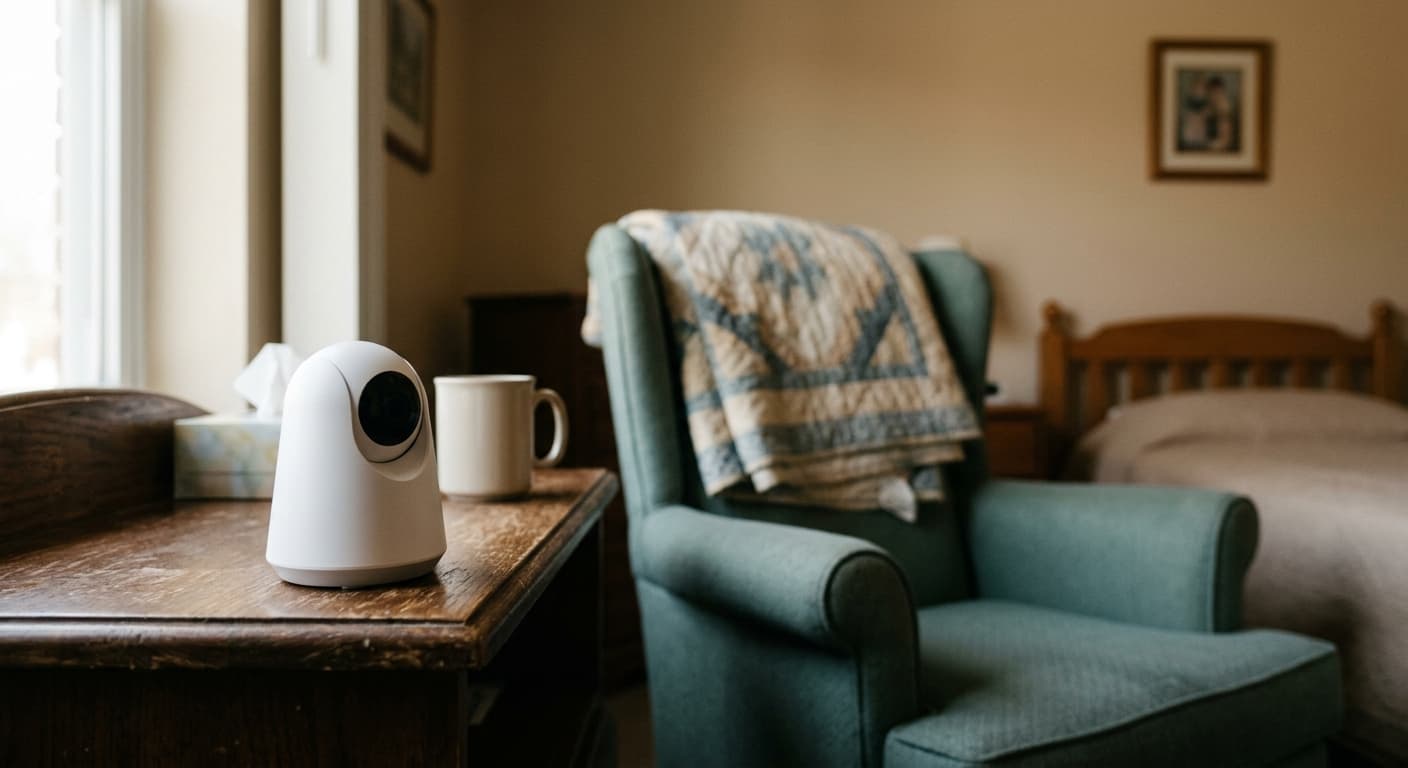
Wyoming's Long-term Care Electronic Monitoring Act, Wyo. Stat. sections 35-2-1301 through 35-2-1308, covers both assisted living and nursing care facilities, with mandatory two-tier signage and roommate consent, but no dedicated tampering penalty.
Information last verified on 2026-08-14.
This page covers Wyoming's Long-term Care Electronic Monitoring Act: what it grants, the roommate-refusal process, and two gaps worth knowing before relying on this law: no dedicated tampering penalty and a narrower evidence clause than several peer states. For Wyoming's general recording-consent law, see Wyoming Recording Laws. See the Nursing Home Camera Laws by State hub for how every state approaches this issue, and the existing 50-state statute comparison table for a side-by-side look at every enacted law.
Does Wyoming Law Allow Cameras in Nursing Home Rooms?
Yes. The Long-term Care Electronic Monitoring Act, Wyoming Statutes Title 35, Chapter 2, Article 13, has been in force since October 1, 2020. Section 35-2-1302(a)(v) defines a covered "facility" as "an assisted living facility or a nursing care facility certified, licensed or otherwise authorized or permitted by law to provide long-term care," covering both settings equally, for residents 18 or older. A resident with decision-making capacity may request in-room monitoring. If the resident lacks capacity, a legal representative may consent, provided it does not contradict the resident's known prior wishes and the resident does not object.
Roommate Consent and What Happens on Refusal
Under section 35-2-1305(c), "no resident shall install an electronic monitoring device in the resident's room without the consent of any other resident residing in the same room." Under section 35-2-1306(g), any resident living in a room with monitoring may set limits on its use, restricting it during specific times, in the presence of specific individuals, during personal care and treatment, or for any other reason, and the facility must make reasonable efforts to disable or obscure the device to accommodate those limits and must document them. Consent, once given, may be revoked at any time and for any reason, and the device must stop operating immediately on revocation.
If a roommate refuses, Wyoming's Act does not create a facility-funded accommodation mechanism the way Connecticut, North Dakota or South Dakota's laws do. Instead, "a resident requesting to use electronic monitoring may request to switch rooms or roommates, subject to availability and at the resident's expense," putting the cost of a room switch on the resident rather than automatically on the facility.
Signage: Mandatory and Two-Tier
Section 35-2-1304 requires notice or signage in a conspicuous location at or near the facility's main entrances stating that electronic monitoring devices may be in use, plus a separate notice at the entrance to each resident's room where a device is being used, matching Rhode Island's two-tier model.

Who Pays
Under section 35-2-1306(e), the resident or representative is responsible for all costs of purchasing, installing, using, maintaining, servicing and removing the device. No electricity carve-out comparable to Connecticut, Ohio, Rhode Island or South Dakota's facility-covers-electricity pattern was found in this subsection.
Facility Access Restrictions and Liability Shield
Under section 35-2-1306(h), a facility or an employee of the facility may not have access to video or audio recordings captured by an electronic monitoring device except as specified in the Act. Separately, under section 35-2-1307(e), the facility has no civil or criminal liability for a violation of a resident's privacy right arising from monitoring conducted in accordance with the Act.
Evidence Admissibility: A Limiting Clause, Not a Special Grant
Section 35-2-1307(a) states that "no court or state agency shall admit into evidence or consider during any proceeding any recording created using an electronic monitoring device in a facility unless the recording is otherwise admissible under the Wyoming Rules of Evidence." Unlike Rhode Island's or South Dakota's affirmative admissibility grants, which say a compliant recording may be admitted subject to specific conditions, Wyoming's clause simply restates that ordinary evidentiary standards govern. A reader should not treat Wyoming's law as guaranteeing that monitoring footage will be admitted; it is subject to the same rules as any other recording.
No Dedicated Tampering Penalty
Section 35-2-1308 is captioned "Electronic monitoring devices; rulemaking; compliance with rules." Subsection (a) directs the Wyoming Department of Health to promulgate the rules necessary to implement the Act, including rules for receiving and resolving resident grievances, and subsection (b) requires any resident or facility using a device before, on or after October 1, 2020 to comply with the Act. Neither subsection is a penalty provision. No criminal misdemeanor, civil fine or explicit tampering prohibition appears anywhere in sections 35-2-1301 through 1308. That is a real, distinguishing gap: North Dakota, Ohio, Rhode Island and South Dakota all criminalize device tampering, and Wyoming's Act does not.

Retaliation Ban
Under section 35-2-1306(a), a facility shall not refuse to admit, remove or retaliate against a resident who requests to use, uses, or declines to consent to use electronic monitoring, notably protecting the declining direction as well as the requesting one.
Using Camera Footage as Evidence of Abuse or Neglect
Camera footage that appears to document abuse or neglect can support a report to Wyoming's Long-Term Care Ombudsman or Adult Protective Services, and can support a civil claim. Footage alone rarely resolves a claim; it is typically weighed alongside medical, staffing and care-plan records, and, because Wyoming's admissibility clause is not a special grant, admissibility will turn on the same evidentiary rules as any other recording.
Harmed by a product or exposure? Speak with an attorney about your options
If you or a loved one may have been harmed, you can speak with an attorney about your legal options at no cost. Whether you have a claim depends on the specific facts. This is attorney advertising, not a guarantee that you qualify or of any particular outcome.
Audio Recording and Wyoming's General Consent Law
Section 35-2-1302(a)(iv) defines a covered device broadly enough to include audio, video or both: "a video camera or other surveillance instrument with a fixed position that captures, records, transmits or broadcasts audio, video or both." Section 35-2-1303(b) then clarifies that "Notwithstanding W.S. 7-3-702, nothing in this act shall be construed to authorize or permit the use of an electronic monitoring device for the nonconsensual interception or unauthorized recording, storage or disclosure of private communications or actions occurring in a resident's room." That carve-out is not limited to audio: it reaches unauthorized recording of actions occurring in the room as well as private communications. So Wyoming's general wiretap and consent rules still constrain audio capture of other people's private conversations, layered on top of this Act's device-installation authorization. See Wyoming Recording Laws for that general framework.

Getting Help
Wyoming's Long-Term Care Ombudsman and the Wyoming Department of Health, which implements the Act's regulations, are practical first stops for a resident or family navigating a monitoring request, a roommate dispute, or a suspected abuse or neglect situation.
Related Resources
- Nursing Home Camera Laws by State is the hub page for this cluster, covering every state's regime at a glance.
- The 50-State Nursing Home Camera Law Comparison covers the full 18-state comparison and how Wyoming's approach compares.
- Wyoming Recording Laws covers the state's general consent framework outside the Long-term Care Electronic Monitoring Act.
- Wyoming Power of Attorney Laws covers how a legal representative gets authority to request monitoring on a resident's behalf.
- Nursing Home Abuse & Neglect covers how an abuse or neglect claim works once evidence, including camera footage, is in hand.
- Surveillance Camera Laws by State covers the general legal framework for security cameras outside a nursing home setting.
Last updated: 2026-08-14.
Frequently Asked Questions
Can I put a camera in a Wyoming nursing home or assisted living room?
Yes. Wyoming's Long-term Care Electronic Monitoring Act covers both assisted living facilities and nursing care facilities. A resident with decision-making capacity may request in-room monitoring, and a legal representative may consent on behalf of a resident who lacks capacity, provided it doesn't contradict the resident's known wishes and the resident does not object.
What happens if my roommate refuses to consent to a camera in Wyoming?
Wyoming's Act does not require the facility to fund an accommodation. Instead, the resident may request to switch rooms or roommates, subject to availability, at the resident's own expense, a real difference from states that put the cost of accommodating a roommate's refusal on the facility.
Is it a crime to tamper with a monitoring device in a Wyoming nursing home?
No dedicated criminal or civil tampering penalty was found in the Act's text. Wyoming's statute establishes a facility liability shield and an access restriction, but, unlike several peer states, does not itself create a misdemeanor or civil fine specifically for interfering with a device.
Can Wyoming nursing home footage be used in court?
Wyoming's clause is a limiting statement rather than a special admissibility grant: no court or state agency shall admit a recording into evidence unless it is otherwise admissible under the Wyoming Rules of Evidence, the same standard that applies to any other recording, not a guarantee that monitoring footage will automatically come in.
Who pays for a monitoring device in Wyoming?
The resident or representative is responsible for all costs of purchasing, installing, using, maintaining, servicing and removing the device. No electricity carve-out for the facility was found in the Act's cost section.
Is signage required for a monitored room in Wyoming?
Yes, and it is two-tier, matching Rhode Island's model. The facility must post notice or signage in a conspicuous location at or near its main entrances stating that electronic monitoring devices may be in use, plus a separate notice at the entrance to each monitored resident's room.
Updates
Corrected the statutory section numbers cited for the electronic monitoring device definition, the facility access restriction, the roommate limits rule and the rulemaking provision, and restored the full text of the Act’s nonconsent carve-out, which also covers actions occurring in a resident’s room.
Independently fact-checked against the cited primary sources
The Law Behind This Article
This article rests on the statutory provisions below, held in our own legal record and retrieved from the official source. Tap a section to read the operative text.
Wyoming Statutes, Title 35 - Public Health and Safety - Chapter 2: Hospitals, Health Care Facilities and Health Services - Article 13: Electronic Monitoring of Long-term Care
§ 35-2-1303Authorized electronic monitoring; applicability.In force
(a) No facility or resident of a facility shall engage in electronic monitoring or use electronic monitoring devices except as provided in this act. (b) Notwithstanding W.S. 7-3-702, nothing in this act shall be construed to authorize or permit the use of an electronic monitoring device for the nonconsensual interception or unauthorized recording, storage or disclosure of private communications or actions occurring in a resident's room. (c) A facility may install and use security surveillance devices in the facility's common areas and other locations except for resident rooms as the facility deems necessary for monitoring the facility. Any recording made by security surveillance devices under this subsection shall be the property of the facility. (d) A resident or resident's representative may seek to install and use electronic monitoring devices in the resident's room pursuant to the requirements of this act. Any recording made by an electronic monitoring device under this subsection shall be the property of the resident or the resident's representative but may be used by a facility as provided by rule of the department.
Official text (excerpt) · last checked 2026-08-31 · Read the full text in our law library · Verify at wyoleg.gov
§ 35-2-1305Capacity; request; consent; records.In force
(a) A resident with capacity to consent may request and consent to electronic monitoring pursuant to the provisions of this act. For a resident who lacks capacity to consent, the resident's representative may request and consent to electronic monitoring, provided the use of electronic monitoring does not contravene any prior expressed wishes of the resident and the resident does not object to electronic monitoring. (b) A resident or the resident's representative shall request to use electronic monitoring in the resident's room using a form provided by the department and furnished to the resident or representative by the facility.
Official text (excerpt) · last checked 2026-07-30 · Read the full text in our law library · Verify at wyoleg.gov
§ 35-2-1306Facility rules; installation of electronic monitoring devices; accommodation by facility.In force
(a) A facility shall not refuse to admit, remove or retaliate against a resident who requests to use, uses or declines to consent to use electronic monitoring in his room pursuant to this act. (b) A facility may develop policies governing the placement and installation of electronic monitoring devices, subject to the provisions of this act and any rules promulgated by the department. (c) A facility shall not unnecessarily impair or impede a resident's use of electronic monitoring devices but may require installation of devices by a licensed contractor or facility personnel and may limit the placement of devices to maintain resident privacy and dignity. (d) A resident shall obtain the facility's approval before installing or using any electronic monitoring device, subject to the consent of any other resident residing in the same room as required under W.S. 35-2-1305(c). (e) A resident or the resident's representative shall be responsible for all costs associated with purchasing, installing, using, maintaining, servicing and removing electronic monitoring devices.
Official text (excerpt) · last checked 2026-07-30 · Read the full text in our law library · Verify at wyoleg.gov
§ 35-2-1304Authorized electronic monitoring; notice.In forcecited in 2 of our articles
(a) Every facility where electronic monitoring devices are in use shall post and maintain a notice or signage in a conspicuous location at or near the facility's main entrances stating that electronic monitoring devices may be in use in or throughout the facility. (b) A facility shall post and maintain notice or signage in a conspicuous location at the entrance to each resident's room where an electronic monitoring device is being used. The notice or signage shall state that the resident's room is being monitored by an electronic monitoring device. (c) When electronic monitoring or security surveillance is used at a facility, upon admission or at any other necessary time as determined by the facility, a facility shall obtain the resident's or the resident's representative's signature on a form furnished by the department and provided to the resident or representative by the facility.
Official text (excerpt) · last checked 2026-07-30 · Read the full text in our law library · Verify at wyoleg.gov
Also relied on in: Wyoming Employee Monitoring Laws: Workplace Surveillance and Social Media (2026)
§ 35-2-1307Admissibility of electronic monitoring; liability; reporting.In force
(a) No court or state agency shall admit into evidence or consider during any proceeding any recording created using an electronic monitoring device in a facility unless the recording is otherwise admissible under the Wyoming Rules of Evidence. (b) Upon request, a facility shall receive a copy of any recording that a party uses in an administrative proceeding against the facility. (c) A facility shall have no criminal or civil liability for: (i) Disclosing a recording made by an electronic monitoring device for any purpose pursuant to this act; and (ii) The disclosure of a recording for any purpose not authorized by this act by a resident, the resident's representative or any agent of the resident or the resident's representative. (d) A facility that provides internet or network access to a resident for the resident's electronic monitoring device shall not be liable for any network security breach caused by or resulting in unauthorized access to the electronic monitoring devices or any data captured, recorded, transmitted or broadcasted by the devices.
Official text (excerpt) · last checked 2026-07-30 · Read the full text in our law library · Verify at wyoleg.gov
§ 35-2-1302Definitions.In force
(a) As used in this act: (i) "Capacity to consent" means an individual's ability to: (A) Understand and appreciate the significant benefits, risks and alternatives to proposed health care; (B) Understand and appreciate the nature and consequences of making decisions concerning one's person; and (C) Make and communicate a health care decision. (ii) "Department" means the Wyoming department of health; (iii) "Electronic monitoring" means the placement and use of an electronic monitoring device by a resident in the resident's room pursuant to the requirements of this act; (iv) "Electronic monitoring device" means a video camera or other surveillance instrument with a fixed position that captures, records, transmits or broadcasts audio, video or both and that is installed in a resident's room and used for electronic monitoring of the resident and activities in the room; (v) "Facility" means an assisted living facility or a nursing care facility certified, licensed or otherwise authorized or permitted by law to provide long-term care in the facility's ordinary course of business and through its employees acting within the scope of their duties; (vi) "Resident" means a person…
Official text (excerpt) · last checked 2026-07-30 · Read the full text in our law library · Verify at wyoleg.gov
Search our full record of US law — 2.1 million sections, every state + federal →
Sources and References
- Wyo. Stat. section 35-2-1302, Definitions (facility, electronic monitoring device)(wyoleg.gov).gov
- Wyo. Stat. section 35-2-1304, Notice and signage requirements(wyoleg.gov).gov
- Wyo. Stat. section 35-2-1305, Roommate consent and revocation(wyoleg.gov).gov
- Wyo. Stat. section 35-2-1306, Costs and retaliation prohibited(wyoleg.gov).gov
- Wyo. Stat. section 35-2-1307, Facility access restriction, liability shield and evidence clause(wyoleg.gov).gov