
New Jersey
New Jersey AI Laws and Regulation (2026)
Independently fact-checked against primary sources (last audited August 20, 2026). · Reviewed by the RecordingLaw editorial team. · 11 primary sources cited on this page. How we verify our legal content

New Jersey regulates artificial intelligence through a combination of targeted statutes and existing civil rights law. A3540/S2544, signed on April 2, 2025 as P.L.2025, c.40 and codified at N.J.S.A. 2C:21-17.7 and 2C:21-17.8, imposes criminal penalties for AI-generated deepfakes used to further crimes, while the New Jersey Data Privacy Act and the Law Against Discrimination extend consumer and anti-discrimination protections to AI-driven decisions.
Overview of New Jersey AI Laws
New Jersey has taken a multi-pronged approach to artificial intelligence regulation, combining enacted legislation with executive guidance and regulatory action. Rather than pursuing a single comprehensive AI statute, the state has addressed AI risks through its deepfake criminal law, a broad data privacy act with AI-specific provisions, and attorney general guidance applying existing anti-discrimination law to algorithmic decision-making.
Governor Phil Murphy established a state AI Task Force in October 2023, which delivered its final recommendations in November 2024. Those recommendations have informed legislative proposals in the 222nd Legislature (2026 session), though comprehensive AI regulation has not yet been enacted.
New Jersey's regulatory environment reflects growing attention to how AI tools affect residents in employment, housing, healthcare, and public safety. The state's existing consumer protection and civil rights framework provides a foundation for enforcement even without AI-specific statutes.
This article covers all enacted and pending New Jersey AI legislation, executive actions, and the interplay between state and federal AI policy. This information is current as of March 2026, but you should consult a licensed attorney for advice specific to your situation.
Deepfake Law: A3540/S2544
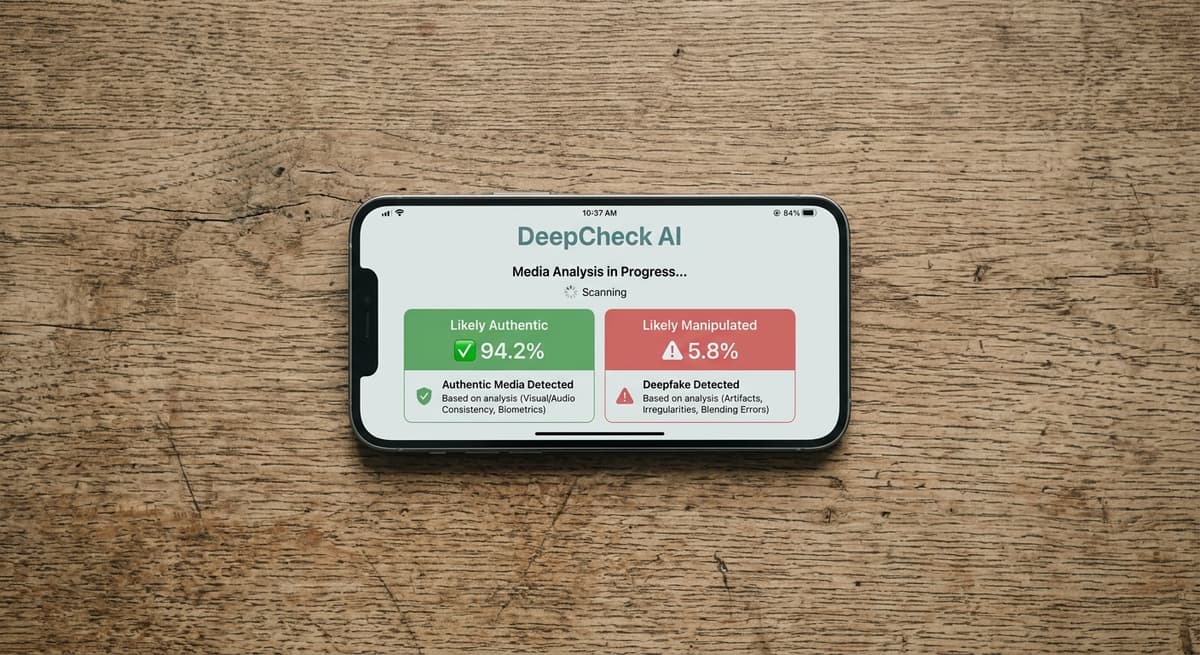
On April 2, 2025, Governor Murphy signed A3540/S2544 into law as P.L.2025, c.40, establishing both civil and criminal penalties for the creation and distribution of deceptive AI-generated audio or visual media. The act is codified at N.J.S.A. 2C:21-17.7 (legislative findings) and N.J.S.A. 2C:21-17.8 (definitions, crimes, penalties, and civil remedies). The bipartisan legislation was sponsored by Assemblyman Herb Conaway, Majority Leader Louis Greenwald, Assemblywoman Ellen Park, and Senators Paul Moriarty and Kristin Corrado.
What the Law Covers
The law defines "deceptive audio or visual media" as any media that appears to a reasonable person to realistically depict a person who did not actually engage in the speech, conduct, or writing shown, and whose production was substantially dependent on technical means rather than another person's ability to impersonate the subject. This broad definition encompasses AI-generated video, audio, and image content commonly known as deepfakes.
The statute targets deepfakes created, solicited, disclosed, or used to further any crime or offense. The enumerated list of underlying offenses is illustrative rather than exhaustive: it expressly includes crimes under chapters 14, 16, 20, 21, 28, and 29 of Title 2C, along with advertising commercial sex abuse of a minor, endangering the welfare of children, threats or improper influence in official and political matters, false public alarms, harassment, cyber-harassment, and hazing.
Criminal Penalties
| Offense | Classification | Ordinary Prison Term | Maximum Fine |
|---|---|---|---|
| Creating deceptive media to further a crime or offense, subsection (b) | Third-degree crime | 3 to 5 years | $30,000 |
| Soliciting, disclosing, or using deceptive media to further a crime or offense, subsection (c)(1) | Third-degree crime | 3 to 5 years | $30,000 |
| Knowingly or recklessly disclosing media created in violation of subsection (b), subsection (c)(2) | Fourth-degree crime | Up to 18 months | $30,000 |
A person who generates or creates a work of deceptive audio or visual media to further any crime or offense, or who solicits, discloses, or uses one for that purpose, commits a crime of the third degree. Merely disclosing a work that someone else created in violation of subsection (b), knowingly or recklessly and without any further criminal purpose, is a crime of the fourth degree under subsection (c)(2). Subsection (d) authorizes a fine of up to $30,000 for any violation of the section, above the $15,000 and $10,000 ceilings that N.J.S.A. 2C:43-3 otherwise sets for third- and fourth-degree crimes.
Third-degree crimes in New Jersey carry a presumption of non-incarceration for first-time offenders under N.J.S.A. 2C:44-1(e). A defendant with a prior conviction loses that presumption, but no mandatory prison term attaches. The presumption of imprisonment in N.J.S.A. 2C:44-1(d) reaches only first- and second-degree crimes, or a third-degree crime where the court finds aggravating factor (5), (14), or (15). Sentencing for a repeat deepfake offender remains within the court's discretion.
Consecutive Sentences and No Merger
The statute's harshest sentencing feature sits in subsection (e). A conviction under subsection (b) does not merge with a conviction under subsection (c), and a conviction under subsection (b) or (c)(1) does not merge with a conviction for the underlying offense. The court shall impose consecutive sentences on a conviction under subsection (b) or (c)(1) together with a conviction of any underlying offense.
In practice that means the deepfake sentence stacks on top of the sentence for the crime the deepfake was used to commit, rather than running at the same time. The legislative findings at N.J.S.A. 2C:21-17.7 state that punishment for committing a crime using deepfake technology should be cumulative, and subsection (e) is the mechanism that carries that intent into sentencing.
Civil Remedies
The law also creates a civil cause of action in Superior Court, allowing victims depicted in deceptive media to sue the person who created, solicited, disclosed, or used it. Under subsection (f), a court may award actual damages but not less than liquidated damages computed at $1,000 for each knowing or reckless violation, punitive damages on proof of willful disregard of the law, reasonable attorney's fees and other litigation costs reasonably incurred, and preliminary and equitable relief.
A criminal conviction is not a prerequisite for that civil action, and the claim is in addition to rather than in place of other remedies, including common law defamation, libel, slander, invasion of privacy, false light, misappropriation of identity, and public disclosure of private facts.
The $1,000 per-violation floor and the fee-shifting provision are what make these cases practical to bring, because a victim does not have to prove quantifiable out-of-pocket losses or wait for a prosecutor to act first.
Exemptions
The statute includes important protections for legitimate uses of AI-generated media. Subsection (g)(1) exempts content that a reasonable viewer or listener would understand to constitute criticism, comment, satire, parody, news reporting, teaching, scholarship, or research, along with any content a reasonable viewer or listener would not believe authentically depicts speech or conduct.
The exemption that matters most for AI companies is subsection (g)(2). The law does not apply to an interactive computer service provider, a cloud services provider, or a commercial developer or provider of artificial intelligence technology, where that developer or provider is not deemed to be a publisher, speaker, or information content provider under 47 U.S.C. 230. That carve-out is categorical rather than conditioned on inadvertence, and the statute expressly preserves existing Section 230 rights, obligations, and immunities. Liability runs to the natural person who creates, solicits, discloses, or uses the deepfake.
Subsection (g)(3) exempts broadcasting stations, cable service, radio stations, and telecommunications carriers, as well as television stations, billboards, websites, mobile applications, video streaming services, newspapers, magazines, and other advertising channels, where the channel's role in disclosing an advertisement is limited to selling advertising time or space, or where federal law prohibits it from censoring the advertisement. Subsection (g)(4) covers news outlets that publish deceptive media solely to disseminate newsworthy facts, provided that a clear disclaimer identifies the work as deceptive when its nature is known or verified. Subsection (g)(5) protects disclosures to law enforcement in connection with an investigation or prosecution, disclosures made under subpoena or court order, reports to a school administrator, attorney, family member, or other advocate, and disclosures made in furtherance of fraud, cybersecurity, identity theft, or harassment investigations.
New Jersey Data Privacy Act and AI
The New Jersey Data Privacy Act (NJDPA), signed into law on January 16, 2024, became effective on January 15, 2025. While not exclusively an AI law, the NJDPA contains significant provisions that regulate AI systems processing personal data.
Profiling and Automated Decision-Making
The NJDPA defines "profiling" as any form of automated processing performed on personal data to evaluate, analyze, or predict personal aspects related to an identified or identifiable individual. This includes assessments of a person's economic situation, health, personal preferences, interests, reliability, behavior, location, or movements.
Consumers have the right to opt out of profiling when it is used in furtherance of decisions that produce "legal or similarly significant effects." New Jersey is unique among state privacy laws in requiring controllers to recognize a universal opt-out mechanism for this type of profiling, meaning consumers can signal their preference through browser settings or privacy tools rather than contacting each company individually.
Data Protection Impact Assessments
Controllers that process personal data for profiling must conduct data protection impact assessments when the profiling presents a reasonably foreseeable risk of unfair or deceptive treatment or disparate impact on consumers. These assessments must evaluate the benefits and risks of the processing activity.
The New Jersey Division of Consumer Affairs has proposed rules requiring additional transparency for AI profiling systems. Under the proposed rules, controllers must disclose the specific decisions being made using profiling, provide a plain language explanation of how the profiling software works, and state whether the system has been evaluated for accuracy, fairness, or bias.

Enforcement
The NJDPA is enforced by the New Jersey Division of Consumer Affairs. There is no private right of action. The Division can impose civil penalties and seek injunctive relief against companies that violate the law's profiling and automated decision-making provisions.
AI and Employment Discrimination: Attorney General Guidance
On January 9, 2025, Attorney General Matthew Platkin and the New Jersey Division on Civil Rights issued guidance clarifying that the New Jersey Law Against Discrimination (NJLAD) prohibits algorithmic discrimination resulting from AI and other automated decision-making tools.
Scope of the Guidance
The guidance makes clear that the NJLAD applies to AI-powered decision-making across all areas covered by the statute, including employment, housing, lending, contracting, and places of public accommodation. Any entity that uses automated tools in these contexts is subject to NJLAD requirements.
Key Principles
The guidance establishes several foundational principles for AI use under New Jersey law.
A covered entity can violate the NJLAD even if it has no intent to discriminate. If an AI tool produces outcomes that disproportionately harm members of a protected class, the entity using that tool may face liability regardless of whether discrimination was the goal.
Employers and other covered entities cannot avoid liability by pointing to a third-party vendor. Even when a third party developed the automated decision-making tool, the entity deploying it remains responsible for ensuring it does not produce discriminatory outcomes.
The guidance recognizes both disparate treatment and disparate impact theories of discrimination. An AI system that explicitly considers protected characteristics violates the NJLAD under a disparate treatment theory. A system that appears neutral but produces discriminatory outcomes may violate the law under a disparate impact theory.
Impact on Employers
For employers using AI in hiring, screening, promotion, or termination decisions, the guidance creates practical obligations. Employers should audit their AI tools for discriminatory outcomes, document their assessment process, and be prepared to demonstrate that any disparate impact is justified by business necessity.
The Division on Civil Rights simultaneously announced the creation of the Civil Rights Innovation Lab, a new initiative focused on investigating and addressing civil rights violations stemming from technology and AI.
Disparate Impact Rules Codified
On December 15, 2025, New Jersey formally codified disparate impact liability under the NJLAD across multiple sectors. These rules clarify that facially neutral practices, including AI algorithms, with a disproportionately negative effect on protected classes violate the law unless the entity can prove the practice is necessary for a legitimate business interest.
AI Task Force and State Initiatives
Establishment and Report
Governor Murphy established the AI Task Force in October 2023 within the New Jersey Office of Innovation. The Task Force brought together experts from government, academia, industry, and civil society to study AI's potential impacts on the state.
Working groups focused on four areas: AI and Workforce Training; AI, Equity, and Literacy; Making New Jersey a Hub for AI Innovation; and Security, Safety, Technology, and Privacy Considerations.

The Task Force delivered its final report to the Governor in November 2024. Key recommendations included developing an AI Bill of Rights framework based on the White House Blueprint for an AI Bill of Rights, studying the feasibility of establishing a state department of artificial intelligence, and expanding AI education and workforce development programs.
Princeton AI Hub
As part of its AI innovation strategy, New Jersey partnered with Princeton University to create a new AI Hub intended to catalyze AI research, support startups, and develop workforce training programs. The hub represents the state's effort to position New Jersey as a leader in responsible AI development.
Next New Jersey Program
The New Jersey Economic Development Authority implemented Next New Jersey (P.L. 2024, c.49), a tax credit program for businesses engaged in artificial intelligence work. The program offers financial incentives to attract and retain AI companies in the state.
Healthcare AI Regulation
Mental Health AI Advertising Bill
In January 2026, New Jersey Assembly Bill A5603 cleared the Assembly Science, Innovation and Technology Committee. The bill would prohibit advertising AI systems as licensed mental health professionals.
The legislation addresses growing concerns about AI chatbots and platforms that market themselves as substitutes for licensed therapists, counselors, and psychologists. Under the bill, companies would be prohibited from representing AI systems as equivalent to regulated human mental health professionals.
Broader Healthcare Implications
New Jersey's existing regulatory framework affects AI in healthcare beyond specific legislation. The NJDPA's profiling provisions apply to health-related automated decisions. The NJLAD's algorithmic discrimination guidance covers healthcare providers who use AI tools in ways that could produce discriminatory outcomes.
Health insurers operating in New Jersey must also comply with the state's insurance regulations when using AI for claims processing, underwriting, or coverage determinations.
Pending AI Legislation (222nd Legislature)
Government AI Oversight: S1438
Senate Bill 1438 would regulate the use of AI and automated systems by New Jersey state government agencies. The bill defines automated systems to include any technologies using algorithms to make decisions, including financial and administrative determinations.
The bill would require state agencies to conduct impact assessments before deploying AI systems, establish transparency requirements for government use of automated decision-making, and create oversight mechanisms. The bill passed the State Senate but faces additional review requirements.
Child Safety: A2767
Assembly Bill 2767 would modify New Jersey's child endangerment statutes to address AI technology. The bill would make it a fourth-degree crime for any person to knowingly or recklessly allow a child to be subjected to sexual conduct through automated interactive computer technology capable of simulating sexual conduct.
The bill includes an exception for AI technology that incorporates safety features designed to prevent simulated sexual conduct when the system detects a minor user. The bill is currently pending technical review by legislative counsel.
Additional Proposals
The 222nd Legislature has seen multiple AI-related proposals addressing data center energy usage (S4143 and A5462), bot disclosure requirements for commercial transactions, and AI transparency in consumer-facing applications. Many of these bills are in early committee stages.
Federal AI Policy and New Jersey
Executive Order 14365
On December 11, 2025, President Trump signed Executive Order 14365, titled "Ensuring a National Policy Framework for Artificial Intelligence." The order establishes a federal initiative to "sustain and enhance the United States' global AI dominance through a minimally burdensome national policy framework."
The order creates several mechanisms to challenge state AI regulation, including a DOJ AI Litigation Task Force empowered to file legal challenges against state AI laws, FTC directives to issue policy statements on federal preemption, and potential withholding of federal funding from states with certain AI regulations.
New Jersey's Response
Governor Murphy was among the governors who publicly opposed the executive order. In a statement issued December 12, 2025, Murphy called the order an attempt to "hamper efforts" at responsible AI regulation and pledged to work with fellow governors "on both sides of the aisle" to mitigate its impact.
Murphy's response reflected the position shared by governors in California, Colorado, and New York that the executive order will not prevent states from passing or enforcing AI regulations.
Legal Reality
The executive order itself cannot overturn existing state law. Federal preemption typically requires congressional legislation or court rulings. Until Congress enacts preemptive AI legislation or courts rule on specific challenges, New Jersey's AI laws and regulatory guidance remain enforceable.
The order does include carve-outs that protect certain categories of state regulation, including child safety protections, AI data center infrastructure rules, and state government AI procurement standards. These exemptions cover significant portions of New Jersey's existing and proposed AI regulatory framework.
More New Jersey Laws
Explore other New Jersey law topics on Recording Law:
Frequently Asked Questions
Does New Jersey have a comprehensive AI law?
No. As of March 2026, New Jersey does not have a single comprehensive AI statute. The state regulates AI through a combination of the deepfake criminal law (A3540/S2544, codified at N.J.S.A. 2C:21-17.7 and 2C:21-17.8), the New Jersey Data Privacy Act (effective January 15, 2025), and attorney general guidance applying the Law Against Discrimination to algorithmic decision-making. The AI Task Force recommended an AI Bill of Rights framework, but comprehensive legislation has not yet been enacted.
Can employers in New Jersey use AI in hiring decisions?
Yes, but with significant legal constraints. Attorney General guidance issued in January 2025 confirms that the New Jersey Law Against Discrimination (NJLAD) applies to AI-powered employment decisions. Employers can be held liable for algorithmic discrimination even without intent to discriminate, and even when a third-party vendor developed the AI tool. Employers should audit AI hiring tools for disparate impact and document their compliance efforts.
What are the penalties for creating AI deepfakes in New Jersey?
Under A3540/S2544 (P.L.2025, c.40, signed April 2, 2025 and codified at N.J.S.A. 2C:21-17.8), creating a deepfake to further a crime or offense, or soliciting, disclosing, or using one for that purpose, is a crime of the third degree carrying an ordinary term of three to five years in prison. Knowingly or recklessly sharing a deepfake that someone else created in violation of the law, without any further criminal purpose, is a fourth-degree crime carrying up to 18 months. A fine of up to $30,000 may be imposed for any violation, and the court must impose the deepfake sentence consecutively to any sentence for the underlying crime. Victims may also sue for actual damages, or at least $1,000 in liquidated damages for each knowing or reckless violation, plus punitive damages, attorney's fees, and equitable relief, without waiting for a criminal conviction. The law exempts satire, parody, news reporting, education, and research, and does not apply to AI developers and providers that are not treated as publishers or speakers under Section 230.
Does New Jersey's deepfake law apply to AI companies?
Generally no. Subsection (g)(2) of N.J.S.A. 2C:21-17.8 provides that the law does not apply to an interactive computer service provider, a cloud services provider, or a commercial developer or provider of artificial intelligence technology, where that developer or provider is not deemed a publisher, speaker, or information content provider under 47 U.S.C. 230, and it preserves existing Section 230 rights and immunities. The criminal provisions reach the natural person who creates, solicits, discloses, or uses the deceptive media, not the vendor whose tool produced it.
How does the New Jersey Data Privacy Act affect AI systems?
The NJDPA (effective January 15, 2025) requires businesses using AI for profiling to allow consumers to opt out when the profiling produces legal or similarly significant effects. New Jersey uniquely requires recognition of universal opt-out mechanisms. Controllers must also conduct data protection impact assessments for AI profiling that presents risks of unfair treatment or disparate impact.
Does the federal AI executive order override New Jersey's AI regulations?
Not directly. Executive Order 14365 (December 2025) creates mechanisms to challenge state AI laws, including a DOJ litigation task force, but an executive order alone cannot preempt state legislation. Only Congress or the courts can override state law. Governor Murphy publicly opposed the order and pledged to continue New Jersey's AI regulatory efforts. The order also includes carve-outs for child safety and state government AI procurement.
Updates
Corrected the deepfake penalty section to the codified statute: added the fourth-degree disclosure offense, removed an incorrect statement that repeat offenders face mandatory prison, added the statute's non-merger and mandatory consecutive sentencing rule, the full civil remedies including the $1,000 per-violation floor and attorney's fees, and the express exemption for AI developers and providers under Section 230.
Replaced four dead nj.gov press-release citations (including the source for the A3540/S2544 deepfake-law signing and Governor Murphy's statement opposing the federal AI executive order) with archived copies of the original official releases after New Jersey's governor transition retired the old press-release URL family; no factual claims changed.
Independently fact-checked against the cited primary sources
Reviewed and approved by an editor
The Law Behind This Article
This article rests on the statutory provisions below, held in our own legal record and retrieved from the official source. Tap a section to read the operative text.
New Jersey Statutes (Unannotated)
§ 2C:21-17.8Definitions, "deepfake", deceptive audio, visual media, crimes, penalties.In forcecited in 2 of our articles
2. a. As used in P.L.2025, c.40 (C.2C:21-17.7 et seq.): "Deceptive audio or visual media" means any video recording, motion picture film, sound recording, electronic image, photograph, any technological representation of speech or conduct substantially derivative thereof, or any forgery or facsimile of a document or writing that appears to a reasonable person to realistically depict any speech, conduct, or writing of a person who did not in fact engage in the speech, conduct, or writing, and the production of which was substantially dependent upon technical means, rather than the ability of another person to physically or verbally impersonate the person. "Disclose" means to sell, give, provide, lend, trade, mail, deliver, transfer, publish, distribute, circulate, disseminate, present, exhibit, advertise, offer, share, or make externally available via the Internet or by any other means, whether or not for pecuniary gain. "Interactive computer service provider" shall have the same meaning as set forth in 47 U.S.C. s.230.
Official text (excerpt) · last checked 2026-09-03 · Read the full text in our law library · Verify at lis.njleg.state.nj.us
Also relied on in: New Jersey Deepfake Laws: AI Images, Voice Cloning & Penalties (2026)
Search our full record of US law — 2.1 million sections, every state + federal →
Sources and References
- Governor Murphy Signs Bipartisan Legislation Establishing Civil and Criminal Penalties for Deceptive AI Deepfakes (Wayback Machine archive; original nj.gov release retired)(web.archive.org).gov
- Guidance on Algorithmic Discrimination and the New Jersey Law Against Discrimination(nj.gov).gov
- New Jersey Enacts Comprehensive Data Privacy Law(cyber.nj.gov).gov
- Governor Murphy Establishes State Artificial Intelligence Task Force (Wayback Machine archive; original nj.gov release retired)(web.archive.org).gov
- Murphy Administration Releases Report from Artificial Intelligence Task Force (Wayback Machine archive; original nj.gov release retired)(web.archive.org).gov
- Statement by Governor Murphy on the Trump AI Executive Order (Wayback Machine archive; original nj.gov release retired)(web.archive.org).gov
- Ensuring a National Policy Framework for Artificial Intelligence (EO 14365)(whitehouse.gov).gov
- Artificial Intelligence Task Force - NJ Innovation(innovation.nj.gov).gov
- NJ Data Privacy Law FAQs(njconsumeraffairs.gov).gov
- NJ Assembly Bill 2767 - Child Endangerment AI(pub.njleg.state.nj.us).gov
- NJ Adopts Rules Clarifying Disparate Impact Liability(ogletree.com)
- Legislation to Ban Misleading AI Mental Health Ads Clears Committee(assemblydems.com).gov
- P.L.2025, c.40 (A3540/S2544), enacted text codified at N.J.S.A. 2C:21-17.7 and 2C:21-17.8, approved April 2, 2025 (New Jersey State Law Library)(repo.njstatelib.org)