
Missouri
Missouri Marriage and Divorce Records: The County Holds the Real Copy
Independently fact-checked against primary sources (last audited August 4, 2026). · Law checked current as of August 8, 2026. · 4 primary sources cited on this page. How we verify our legal content

Missouri is the clearest example in the country of a fully county-held records system. The state health department can confirm that a marriage or divorce happened, but it cannot sell you the document. The certified copy exists only at the county courthouse.
Information last verified on 2026-08-04. This article has not yet been reviewed by a licensed lawyer.
This page is part of our guide to marriage and divorce records by state. It explains what Missouri's two record layers actually contain, which one you need, and what each costs.
The Missouri Model: a State Statement, a County Document
Most states run a hybrid. A county clerk issues the license, the state health department registers the event, and either office can hand you something certified. Missouri splits those roles more sharply than almost anywhere else, and the split is the single fact that decides where you should send your request.
The Missouri Department of Health and Senior Services (DHSS) maintains a central registry in Jefferson City. What it issues is a Certified Statement Relating to Marriage or a Certified Statement Relating to Divorce. DHSS describes the contents precisely: the statement "will only include the names of both spouses, date of marriage, and county where the marriage was recorded," and the divorce version likewise carries only the names, the date of divorce, and the county where it was recorded.
That statement is a confirmation, not a reproduction. DHSS says so directly: "An actual certified copy of the original marriage certificate may only be obtained by contacting the [Recorder of Deeds] ... in the county where the license was obtained." The divorce sentence is the mirror image: "An actual certified copy of the original divorce decree may only be obtained by contacting the [Circuit Clerk] ... in the county where the decree was granted."
So the practical question is what the requesting agency will accept. Immigration filings, name changes at the Social Security Administration, pension and survivor benefit claims, and most court proceedings want the certified county document. A statement from Jefferson City is usually enough only where an agency simply needs confirmation that the event was registered.
Divorce Records: Decree Versus Statement
A divorce generates two entirely different papers, and confusing them is the most common reason a Missouri request comes back wrong.

The decree, formally a judgment of dissolution of marriage, is the court's own order. It contains the terms: the dissolution itself, property division, maintenance, custody, and support. It lives in the case file of the circuit court that entered it, and the Circuit Clerk in that county is the only office that can certify a copy.
The statement is a vital-records product. Under RSMo 193.205, "A record of each dissolution of marriage and annulment of marriage granted by any court in this state shall be filed by the clerk of the court with the department and shall be registered if it has been completed and filed in accordance with this section." That filing is what feeds the DHSS registry, and the statement DHSS issues from it carries three facts and nothing more.
Missouri, unlike Ohio or Mississippi, does have a state-level divorce product. It is simply a thin one. If the goal is to prove you are divorced for a remarriage license, a statement often suffices. If the goal is to enforce or interpret anything the judge ordered, only the certified decree from the Circuit Clerk will do.
For the substantive law of ending a marriage rather than documenting one, see our guide to Missouri divorce laws.
Marriage Records: the Recorder of Deeds Holds the Original
Missouri marriage licenses are issued by the Recorder of Deeds, an office most states use only for land records. The Recorder issues the license, receives the officiant's return after the ceremony, and records the result in that county's marriage books. That recorded original is what a certified county copy reproduces.
Because the books are county books, year ranges vary by county rather than by statute. The City of St. Louis is a useful illustration. Its Recorder of Deeds provides certified and uncertified copies of marriage records from 1932 to the present at $12 for each certified copy and $3 for each uncertified copy, and it directs requests for licenses issued before 1932 to the Archives Department housed in the same office. Another county's start year, fee, and archive arrangement will differ, so confirm with the specific Recorder rather than assuming St. Louis figures apply statewide.
When you do not know which county issued the license, the DHSS statement becomes genuinely useful. It names the county, which is exactly the piece of information a county-level system requires before it can search anything. Ordering the $15 statement first and the county copy second is often faster than guessing.
How Far Back the State Registry Goes
DHSS reporting of marriages began July 1, 1948, and dissolutions were folded into the same central registry. Nothing before that date was ever centralized in Jefferson City.
That cutoff is not a records gap so much as a reminder of the architecture. Pre-1948 Missouri marriages were recorded by the county Recorder of Deeds and pre-1948 divorces by the county Circuit Clerk, in the same offices that hold them today. The same fully county model simply extends backward in time, which is why Missouri genealogy work is county work: the Recorder's marriage books and the circuit court case files, plus whatever local archive a given county maintains for its oldest volumes.
Who Can Order, and What It Costs
Missouri restricts vital record copies rather than opening them to any requester. The entitlement rule DHSS applies reads: "Immediate family members shall include those family members and in-laws in the direct line of descent up to, but not including, cousins. This qualification of entitlement also applies to Statements of Marriage, Divorce, and Single Status."
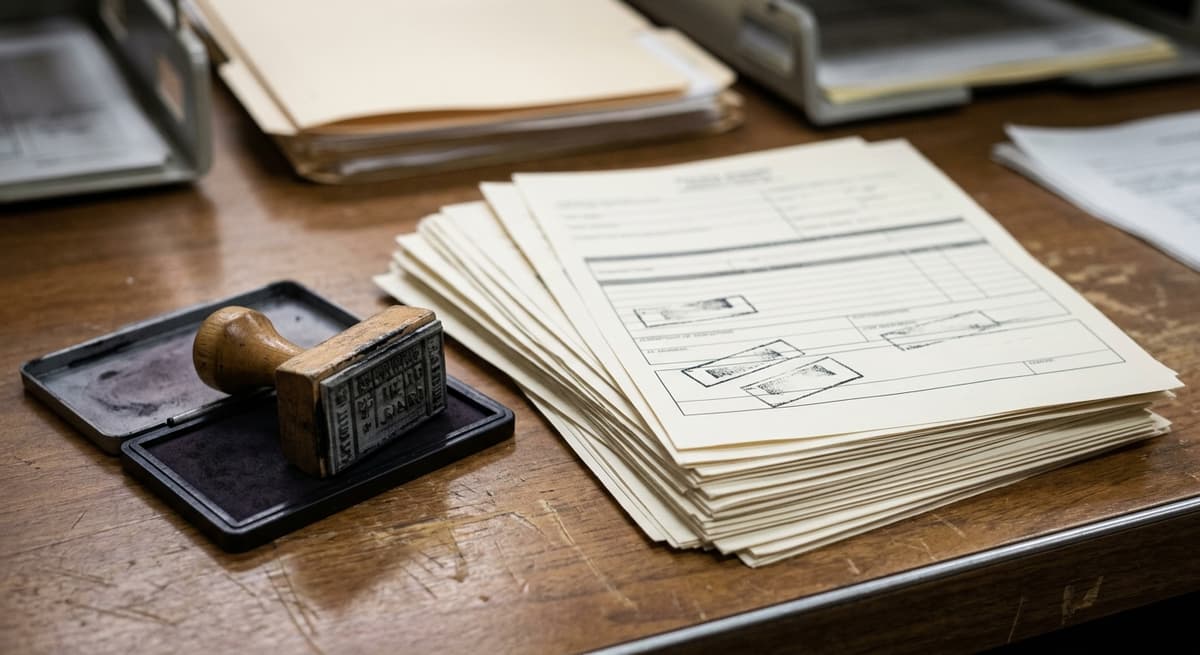
In practice that means the spouses themselves, parents, children, grandparents, grandchildren, and in-laws in that direct line, plus legal representatives. Cousins are expressly outside it.
On price, RSMo 193.265 sets one flat figure for this record class: "the applicant shall pay a fee of fifteen dollars" for a certification or copy of a birth, marriage, divorce, or fetal death record. That $15 applies per record, with no separate first-copy or additional-copy rate. The $14 first-copy/$11 additional-copy structure found elsewhere in the same statute is set for death records specifically, not for marriage or divorce records.
County copy fees are separate, but they are not purely local. RSMo 451.151 imposes a statewide fee of seven dollars for a certified copy of a marriage license, collected by the Recorder of Deeds "in addition to any other fee for a certified copy of a marriage license." What a county charges is therefore that statutory seven dollars plus whatever that office adds. The state fee buys the statement; the county fee buys the document.
RSMo 193.265 also carries fee waivers worth knowing about. No fee is collected for a certification of birth, death, or marriage requested by the children's division, the division of youth services, a guardian ad litem, or a juvenile officer on behalf of a child or a person under twenty-one "who has come under the jurisdiction of the juvenile court under section 211.031." The waiver does not reach requests made for a child or young adult outside that juvenile court jurisdiction.
How to Order
At the state level, DHSS accepts requests in person in Jefferson City, by mail, and by phone or online through VitalChek, the private vendor most states use for card payments. Missouri also maintains a network of local public health agency offices that can process walk-in vital records requests, which is often the fastest route for someone who needs a statement the same day.
At the county level, contact the office that holds what you need. For a marriage certificate, that is the Recorder of Deeds in the county that issued the license. For a divorce decree, it is the Circuit Clerk in the county where the case was heard. Have the full names of both parties, including middle names, and the date of the event; the St. Louis City Recorder, for example, requires both applicant names and the ceremony date before it will search.
Our general walkthrough of how to get a copy of your marriage certificate covers the identification and application steps common to every state.
Trying to Confirm Someone Else's Marital Status
Missouri's entitlement rule means you cannot order a certified statement about someone you are not related to in the direct line. That closes the vital-records route for most curiosity-driven searches.
The court layer is more open, because circuit court dissolution files are court records rather than health-agency records, and case indexes are searchable through the Missouri courts system. What you find there is a case, not a certified document, and the file may be partially sealed. Our page on Missouri public records law explains how the state's open-records framework applies to government files generally, and how to find out if someone is married or divorced covers the lawful ways to check.
Two cautions. Commercial background-check sites market "marriage and divorce records" searches, but because these records are county-scattered and unevenly digitized nationwide, their coverage is unreliable; treat any hit as a lead to verify at the county, not an answer. And none of this may be used to screen someone for a job, an apartment, or credit, which are regulated uses under the federal Fair Credit Reporting Act.
If the couple never obtained a license, there is no certificate anywhere to find. See Missouri common law marriage for what that means. For the sibling records franchise, see Missouri death records.
Disclaimer
This article provides general information about how Missouri marriage and divorce records are held and released. It is not legal advice. Fees, county year ranges, and processing times change, and the figures here reflect official Missouri Department of Health and Senior Services, Missouri Revisor of Statutes, and county sources as of August 2026. Anyone dealing with a sealed file, a contested record, or an active court proceeding should consult an attorney licensed in Missouri.

Last updated: 2026-08-04.
Frequently Asked Questions
Why will Missouri not send me a copy of my marriage certificate?
Because the state never held the original. The Department of Health and Senior Services registers the event and issues a Certified Statement Relating to Marriage carrying the names, date, and county. The certificate itself was recorded by the Recorder of Deeds in the county that issued the license, and only that office can certify a copy.
Which Missouri office has my divorce decree?
The Circuit Clerk in the county where the divorce was granted. The state can issue a Certified Statement Relating to Divorce confirming the names, date, and county, but the decree with the actual terms is a court record held in the circuit court case file.
How much does a Missouri marriage or divorce record cost?
At the state level, a flat $15 per record under RSMo 193.265, the same fee that applies to birth and fetal death records. County fees for the certified document add a statutory seven dollars under RSMo 451.151 to whatever the Recorder of Deeds charges locally; the City of St. Louis, for example, charges $12 per certified marriage copy.
How far back does Missouri's statewide registry go?
Reporting of marriages began July 1, 1948, and dissolutions are registered under RSMo 193.205 through filings made by the clerk of the court. Earlier records were never centralized and remain with the county Recorder of Deeds and Circuit Clerk.
Who is entitled to a Missouri marriage or divorce statement?
Immediate family in the direct line of descent, up to but not including cousins, plus in-laws in that line and legal representatives. The same entitlement rule applies to statements of marriage, divorce, and single status.
I need to prove I am single in order to marry abroad. What do I request?
Missouri issues a Statement of Single Status through the same Bureau of Vital Records channel, subject to the same entitlement rule. Confirm with the receiving country's consulate whether it also requires an apostille, which is issued by the Missouri Secretary of State rather than by the health department.
I do not know which county issued the license. What now?
Order the state statement first. It names the county where the marriage or divorce was recorded, which is the piece of information the county office needs before it can search its books. Then request the certified copy from that county.
Updates
Corrected the RSMo 193.265 fee-waiver description to include its juvenile-court jurisdiction requirement, and noted the seven dollar statutory fee RSMo 451.151 adds to every county certified copy of a marriage license.
Corrected the state-level marriage/divorce record fee to the flat $15 set by RSMo 193.265 (the $14/$11 figures previously stated are the statute's death-record tier, not the marriage/divorce tier).
Governing law re-checked for recent changes
Independently fact-checked against the cited primary sources
The Law Behind This Article
This article rests on the statutory provisions below, held in our own legal record and retrieved from the official source. Tap a section to read the operative text.
Revised Statutes of Missouri, Title XII (PUBLIC HEALTH AND WELFARE), Chapter 193
§ 193.245Inspection and copying of records, disclosure of information, unlawful unless authorized — authority.In forcecited in 4 of our articles
It shall be unlawful for any person to permit inspection of, or to disclose information contained in, vital records or to copy or issue a copy of all or part of any such record except as authorized by this law and by regulation or by order of a court of competent jurisdiction or in the following situations: (1) The department may authorize the disclosure of information contained in vital records for legitimate research purposes; (2) To a qualified applicant as provided in section 193.255; (3) Copies of death records over fifty years old may be disclosed upon request.
Official text (excerpt) · last checked 2026-09-04 · Read the full text in our law library · Verify at revisor.mo.gov
Also relied on in: Vital Records Explained: Are birth certificates public records?, Missouri Death Records: Are They Public + How to Get One, How to Find a Cause of Death in Missouri (2026)
§ 193.205Marriage dissolution or annulment record.In force
1. A record of each dissolution of marriage and annulment of marriage granted by any court in this state shall be filed by the clerk of the court with the department and shall be registered if it has been completed and filed in accordance with this section. The record shall be prepared by the petitioner or such petitioner's legal representative on a form prescribed and furnished by the state registrar and shall be presented to the clerk of the court with the petition. 2. The clerk of the court shall complete and forward to the department on or before the fifteenth day of each calendar month the records of each dissolution of marriage and annulment of marriage decree granted during the preceding calendar month.
Official text (excerpt) · last checked 2026-07-31 · Read the full text in our law library · Verify at revisor.mo.gov
§ 193.265Fees for certification and other services — distribution — services free, when.In force
1. For the issuance of a certification or copy of a death record, the applicant shall pay a fee of fourteen dollars for the first certification or copy and a fee of eleven dollars for each additional copy ordered at that time. For the issuance of a certification or copy of a birth, marriage, divorce, or fetal death record, the applicant shall pay a fee of fifteen dollars. No fee shall be required or collected for a certification of birth, death, or marriage if the request for certification is made by the children's division, the division of youth services, a guardian ad litem, or a juvenile officer on behalf of a child or person under twenty-one years of age who has come under the jurisdiction of the juvenile court under section 211.031. All fees collected under this subsection shall be deposited to the state department of revenue. Beginning August 28, 2004, for each vital records fee collected, the director of revenue shall credit four dollars to the general revenue fund, five dollars to the children's trust fund, one dollar shall be credited to the endowed care cemetery audit fund, one dollar for each certification or copy of death records to the Missouri coroners' fund…
Official text (excerpt) · last checked 2026-07-31 · Read the full text in our law library · Verify at revisor.mo.gov
Cited in 1 court opinions in our collectionLatest citing opinion in our collection: 1998
Opinions citing this section in our collection:
- Bratt v. Cohn (Missouri Court of Appeals 1998, 969 S.W.2d 277)“…sited in the endowed care cemetery audit fund as defined in section 193.265, RSMo. The fee authorized in this subsection…”
Identified automatically from the court opinions citing this section — not a ranking of which case controls.
Search our full record of US law — 2.1 million sections, every state + federal →
Sources and References
- Missouri Department of Health and Senior Services, Order a Copy of a Vital Record(health.mo.gov).gov
- Missouri Revised Statutes, RSMo Section 193.265 (fees for certifications and copies)(revisor.mo.gov).gov
- Missouri Revised Statutes, RSMo Section 193.205 (records of dissolution and annulment of marriage)(revisor.mo.gov).gov
- City of St. Louis Recorder of Deeds, Obtain a Copy of a Marriage License(stlouis-mo.gov).gov
- Missouri Revised Statutes, RSMo Section 451.151 (recorder of deeds fees; seven dollar fee for a certified copy of a marriage license)(revisor.mo.gov)