
Iowa
Iowa E-Scooter Laws: Sidewalk, Helmet & Age Rules (2026)
Independently fact-checked against primary sources (last audited July 23, 2026). · Law checked current as of August 9, 2026. · 3 primary sources cited on this page. How we verify our legal content
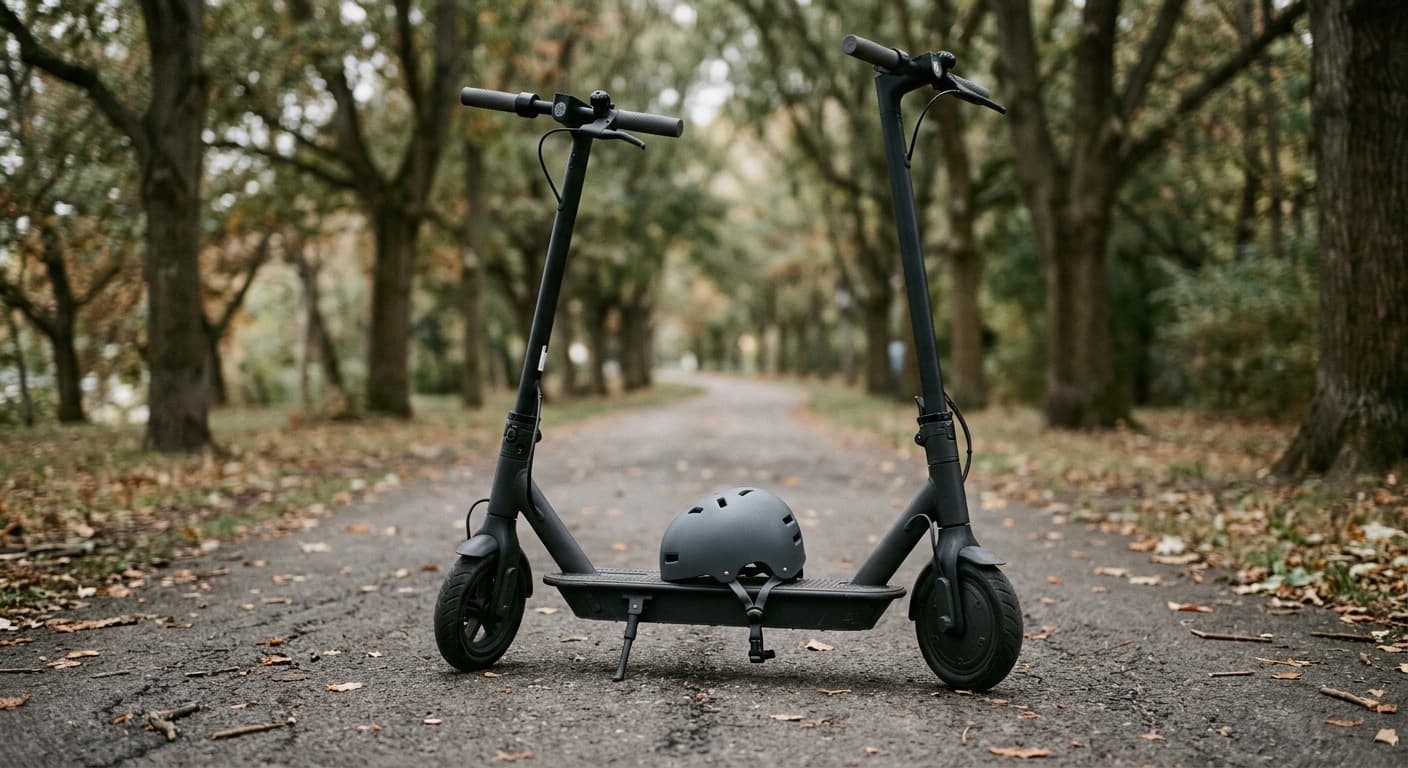
This article is general information about Iowa e-scooter laws and is not legal advice. If you were cited under a local ordinance or a rental operator's terms, check the current city code or the operator's rules directly, or consult an Iowa attorney. Information last verified on 7 September 2026 against the Iowa Code 2026.
Are e-scooters legal in Iowa?
Yes, but Iowa handles e-scooters very differently from most of its neighbors, and this is worth understanding before anything else on this page. Iowa has no dedicated "electric scooter" statute the way Illinois, Ohio, Michigan, Wisconsin, and Minnesota each do. Instead, a standing kick or throttle scooter under 750 watts falls under Iowa Code § 321.1(51A), the definition of a "pedestrian conveyance," which reads: "'Pedestrian conveyance' means any human-powered device by which a pedestrian may move other than by walking or by which a pedestrian may move another person, including but not limited to a wheelchair, stroller, skateboard, scooter, or other similar device. 'Pedestrian conveyance' also includes an electric personal assistive mobility device and any other device used to move a person sitting or standing on the device regardless of whether the device is powered by an electric motor, so long as the electric motor produces less than seven hundred fifty watts. 'Pedestrian conveyance' does not include a bicycle."
Iowa Code § 321.1(51) then completes the framework: "'Pedestrian' means a person afoot or a person using a pedestrian conveyance." In other words, a person riding a typical sub-750-watt electric scooter in Iowa is, for purposes of the vehicle code, legally a pedestrian rather than the operator of a vehicle. This is confirmed further by § 321.1(90)(a), which excludes from the definition of "vehicle" any device moved by human power, "including a low-speed electric bicycle and a pedestrian conveyance."
This is a materially different legal structure than a neighboring state's bicycle-style scooter law. It means Iowa does not have a dedicated e-scooter operating statute covering age, helmet, or road rights the way its neighbors do; instead, an Iowa rider's rights and restrictions default to whatever the state's general pedestrian rules provide, not bicycle-style road rights.
What counts as an e-scooter in Iowa
A device qualifies as a "pedestrian conveyance" under § 321.1(51A) when its electric motor produces less than 750 watts. Above that wattage threshold, a device would fall outside this pedestrian-conveyance framing and into a different vehicle category, though Iowa's vehicle code was not researched for what that heavier category would be for this page.

A related but different device, the electric personal assistive mobility device (EPAMD), is separately defined at § 321.1(20B) as "a self-balancing, nontandem two-wheeled device powered by an electric propulsion system that averages seven hundred fifty watts and is designed to transport one person, with a maximum speed on a paved level surface of less than twenty miles per hour." This is the Segway-type category, not a stand-up kick or throttle scooter, and it is also swept into the "pedestrian conveyance" definition above. Some search results and secondary sources cite "Iowa Code § 321.235A" as though it were an electric-scooter definition with a specific mph cap; that section is confirmed to actually govern electric personal assistive mobility devices, not electric scooters, and no such standalone scooter mph figure was found anywhere in Iowa's vehicle code.
Where you can ride
Because an Iowa e-scooter rider is classified as a pedestrian rather than a vehicle operator or a cyclist, the rules for where and how you can ride come from Iowa's pedestrian provisions rather than from any bicycle or scooter statute. Iowa Code § 321.325 sets the frame: pedestrians are subject to traffic-control signals at intersections, and at all other places they are subject to the restrictions in §§ 321.327 through 321.331.
Those restrictions are short and specific:
- Keep to the left along a highway. Section 321.326 provides that pedestrians "shall at all times when walking on or along a highway, walk on the left side of such highway." That is the opposite of the ride-with-traffic rule riders carry over from bicycle law. Note the wording: the section speaks of walking, and no Iowa decision was found applying it to a person riding a pedestrian conveyance, so treat facing traffic as the safe default rather than assuming the section cannot reach a scooter.
- Crossing outside a crosswalk. Under § 321.328, a pedestrian crossing a roadway at any point other than a marked crosswalk, or an unmarked crosswalk at an intersection, must yield the right-of-way to all vehicles on the roadway, and cities may restrict such crossings by ordinance. The same duty to yield applies where a pedestrian tunnel or overhead crossing has been provided, and where signals operate at a location that is not an intersection, crossing is limited to a marked crosswalk.
- Right half of a crosswalk. Section 321.330 directs pedestrians to move on the right half of crosswalks whenever practicable.
- No soliciting rides from the roadway. Section 321.331 bars standing in a roadway to solicit a ride from a private vehicle.
- Never on a freeway. Section 321.366(1)(g) makes it unlawful to "Ride a bicycle or use a pedestrian conveyance, or be a pedestrian, anywhere on a fully controlled-access facility," which § 321.366(2) defines as a highway that gives preference to through traffic by providing access only at interchanges with selected public roads. This is the one operative Iowa statute that names pedestrian conveyances by name, so an interstate or comparable controlled-access highway is off limits to an e-scooter as a matter of state law.
The driver-side counterpart, § 321.327, requires a driver to yield to a pedestrian crossing in a marked or unmarked crosswalk where traffic-control signals are not in place or in operation, so an Iowa rider crossing in a crosswalk holds the pedestrian right-of-way rather than a cyclist's.
A city that runs a shared or dockless scooter program can still layer its own bicycle-style operating rules on top of this state default through the operator's rental agreement or a local ordinance, even though the state's own baseline treats the rider as a pedestrian. Riders using a rental scooter in an Iowa city should check the operator's app and any posted local rules rather than assuming the state pedestrian default is the only rule in play.
Rider rules
- Age: No electric-scooter-specific minimum age was found in Iowa's vehicle code, consistent with the pedestrian-conveyance classification rather than a licensed vehicle category.
- Helmet: No electric-scooter-specific helmet requirement was found in Iowa's vehicle code.
- License, registration, insurance: None of these apply to a pedestrian conveyance under Iowa's vehicle code framework, since the device and its rider are not classified as a vehicle or vehicle operator in the first place.
The absence of an age, helmet, or license rule in the state statute is a real feature of Iowa's pedestrian-conveyance framing, not a research gap, but a specific city or a rental operator's own terms could still impose age or safety requirements as a condition of using a shared program.
Penalties
Iowa has no scooter-specific penalty schedule, which fits the pedestrian-conveyance classification. That does not mean no state fine can reach a rider. Because the rider is a pedestrian using a pedestrian conveyance, the scheduled violations in Iowa Code § 805.8A apply:
- Fully controlled-access facility, § 321.366: $135, set at § 805.8A(6)(y). Section 321.366(3) states that violations of that section are punishable as a scheduled violation under § 805.8A, subsection 6. This is the fine that squarely covers taking a scooter onto an interstate.
- Pedestrian violations, § 805.8A(9): $35 each for § 321.325 (signals), § 321.326 (keeping to the left along a highway), § 321.328 (crossing outside a crosswalk), and § 321.331 (soliciting a ride from a roadway).
A city ordinance can add its own penalty on top of these, so check the municipal code for the city where a citation was issued.

Enforcement in practice
No statewide enforcement data specific to electric scooters was located for this research. Enforcement patterns, wherever they exist locally, do not change the underlying legal classification described above, and this page does not present unverified figures as confirmed fact.
Des Moines e-scooter rules
Des Moines is Iowa's largest city. Available research surfaced only park-and-recreation restrictions, specifically a ban on skateboards and scooters in Des Moines parks and skate parks under the city's municipal code, rather than a citywide street-operation ordinance specific to electric scooters. Riders in Des Moines should check the current Des Moines Municipal Code directly for any street-level scooter rule beyond the state's pedestrian-conveyance default, since a citywide operating ordinance was not confirmed in this research.
If a scooter-related incident happens on an Iowa roadway, general Iowa OWI and negligence rules can still apply; see RecordingLaw's Iowa DUI Laws and Iowa Car Accident Laws pages, and RecordingLaw's E-Scooter Laws by State hub to compare Iowa's rules to other states.
Frequently Asked Questions
Are e-scooters legal in Iowa?
Yes, but Iowa has no dedicated e-scooter statute. A sub-750-watt standing scooter is classified as a "pedestrian conveyance" under Iowa Code § 321.1(51A), which makes the rider legally a pedestrian rather than a vehicle operator.
Can I ride an e-scooter on the sidewalk in Iowa?
No statewide sidewalk ban on pedestrian conveyances was found in Iowa's vehicle code. Because the rider is classified as a pedestrian, sidewalk and crosswalk use follows Iowa's pedestrian rules in §§ 321.325 through 321.331 rather than a bicycle-style road-riding framework. One state limit is absolute: § 321.366(1)(g) prohibits using a pedestrian conveyance anywhere on a fully controlled-access facility. Check local ordinances for any city-specific restriction.
Which side of the road should an e-scooter rider use in Iowa?
Iowa Code § 321.326 requires a pedestrian on or along a highway to keep to the left side, meaning facing oncoming traffic, which is the opposite of the bicycle rule. The section is written in terms of walking and no Iowa decision was found applying it to a person riding a pedestrian conveyance, so facing traffic is the safe default rather than a settled certainty. The scheduled fine under § 805.8A(9)(f) is $35.
Can I ride an e-scooter on an Iowa interstate or freeway?
No. Iowa Code § 321.366(1)(g) makes it unlawful to use a pedestrian conveyance, or to be a pedestrian, anywhere on a fully controlled-access facility, and § 805.8A(6)(y) sets the scheduled fine at $135.
Is there a minimum age to ride an e-scooter in Iowa?
No electric-scooter-specific minimum age was found in Iowa's vehicle code. A rental operator's program could still set its own age requirement as a condition of use.
Do I need a helmet to ride an e-scooter in Iowa?
No electric-scooter-specific helmet requirement was found in Iowa's vehicle code.
Is Iowa Code 321.235A the e-scooter law?
No. That section defines electric personal assistive mobility devices, the Segway-type category, not standing kick or throttle e-scooters. This is a common mix-up in secondary sources.
Do I need a license or insurance for an e-scooter in Iowa?
No. A pedestrian conveyance is not classified as a vehicle under Iowa law, so licensing, registration, and insurance requirements that apply to vehicles do not apply.
Injured in Iowa? Get a free case review from a personal-injury attorney
If someone else's negligence caused your injury, you may be owed compensation for medical bills, lost wages, and pain and suffering. Get a free, no-obligation review from a Iowa personal-injury attorney. Most work on contingency, so there is no upfront cost.
Updates
Added Iowa's operative pedestrian riding rules (Iowa Code §§ 321.325 through 321.331, including the requirement to keep to the left along a highway) and the § 321.366(1)(g) ban on using a pedestrian conveyance on a fully controlled-access facility with its $135 scheduled fine, replacing a passage that told readers the pedestrian subchapter had not been reviewed.
Restored a sentence the article's verbatim quote of Iowa Code section 321.1(51A) had dropped: the statute's final sentence, "'Pedestrian conveyance' does not include a bicycle," which the live legis.iowa.gov text confirms is part of the same subsection quoted.
Governing law re-checked for recent changes
Governing law re-checked for recent changes
Independently fact-checked against the cited primary sources
The Law Behind This Article
This article rests on the statutory provisions below, held in our own legal record and retrieved from the official source. Tap a section to read the operative text.
Iowa Code, Chapter 321: MOTOR VEHICLES AND LAW OF THE ROAD
§ 321.1Definitions of words and phrases.In forcecited in 2 of our articles
The following words and phrases when used in this chapter shall, for the purpose of this chapter, have the meanings respectively ascribed to them. 1. a. “Agricultural hazardous material” means a hazardous material, other than hazardous waste, whose end use directly supports the production of an agricultural commodity, including but not limited to a fertilizer, pesticide, beneficial substance, or fuel. b. “Agricultural hazardous material” is limited to material in class 3, 8, or 9, division 2.1, 2.2, 5.1, or 6.1, or an ORM-D material as defined in 49 C.F.R. §171.8. 1A. “Air bag” means a motor vehicle inflatable occupant restraint system that operates in the event of a crash and is designed in accordance with federal motor vehicle safety standards for the specific make, model, and year of the motor vehicle in which it is or will be installed. “Air bag” includes all component parts to a motor vehicle inflatable occupant restraint system, including but not limited to the cover, sensors, controllers, inflators, wiring, and seat belt systems. 1B. “Alcohol concentration” means the number of grams of alcohol per any of the following: a. One hundred milliliters of blood. b.
Official text (excerpt) · last checked 2026-07-29 · Read the full text in our law library · Verify at legis.iowa.gov
Cited in 70 court opinions in our collectionLatest citing opinion in our collection: 2026
Opinions citing this section in our collection:
- Lee v. Grinnell Mutual Reinsurance Co. (Supreme Court of Iowa 2002, 646 N.W.2d 403)“…red, a category that includes passengers. See Iowa Code §§ 321.1 (24A), .20B (Supp.1997). Lee reasons th…”
- State v. Peters (Supreme Court of Iowa 1994, 525 N.W.2d 854)“…eters was operating met the definitional parameters of both Iowa Code section 321.1(2)(a) 1 (defining motor ve…”
- Zimmer v. Vander Waal (Supreme Court of Iowa 2010, 780 N.W.2d 730)“…roperty is or may be transported or drawn upon a highway.” Iowa Code § 321.1 (90). The parties agree the trailer in…”
Identified automatically from the court opinions citing this section — not a ranking of which case controls.
Also relied on in: E-Scooter Laws by State: Sidewalk, Helmet & Age Rules (2026)
§ 321.235AElectric personal assistive mobility devices.In force
An electric personal assistive mobility device, which is a two-wheeled device as defined in section 321.1, subsection 20B, may be operated by a person at least sixteen years of age on sidewalks and bikeways in accordance with this section. 1. None of the following are required for operation of an electric personal assistive mobility device: a. Licensure or registration of the electric personal assistive mobility device under this chapter. b. Possession of a driver’s license or permit by the operator of the electric personal assistive mobility device. c. Proof of financial responsibility. 2. A person operating an electric personal assistive mobility device on a sidewalk or bikeway shall do all of the following: a. Yield the right-of-way to other pedestrians. b. Give an audible signal before overtaking and passing a pedestrian. 3.
Official text (excerpt) · last checked 2026-07-29 · Read the full text in our law library · Verify at legis.iowa.gov
Search our full record of US law — 2.1 million sections, every state + federal →
Sources and References
- Iowa Code § 321.1 (Definitions), 2026 Code, including subsections (51A) "Pedestrian conveyance," (51) "Pedestrian," (20B) "Electric personal assistive mobility device," and (90)(a) "Vehicle"(legis.iowa.gov).gov
- Iowa Code § 321.235A, Electric personal assistive mobility devices(legis.iowa.gov).gov
- Iowa Legislature, Iowa Code Chapter 321, Motor Vehicles and Law of the Road(legis.iowa.gov).gov
- RecordingLaw.com, Iowa DUI Laws(recordinglaw.com)
- RecordingLaw.com, Iowa Car Accident Laws(recordinglaw.com)
- Iowa Code § 321.366 (Acts prohibited on fully controlled-access facilities), 2026 Code, subsection (1)(g) barring use of a pedestrian conveyance and subsection (3) scheduling the penalty(legis.iowa.gov)
- Iowa Code § 321.325 (Pedestrians subject to signals), 2026 Code(legis.iowa.gov)
- Iowa Code § 321.326 (Pedestrians on left), 2026 Code(legis.iowa.gov)
- Iowa Code § 321.328 (Crossing at other than crosswalk), 2026 Code(legis.iowa.gov)
- Iowa Code § 321.330 (Use of crosswalks), 2026 Code(legis.iowa.gov)
- Iowa Code § 321.331 (Pedestrians soliciting rides), 2026 Code(legis.iowa.gov)
- Iowa Code § 321.327 (Pedestrians' and bicyclists' right-of-way), 2026 Code(legis.iowa.gov)
- Iowa Code § 805.8A (Motor vehicle and transportation scheduled violations), 2026 Code, subsection 6(y) ($135 for § 321.366) and subsection 9 ($35 pedestrian violations)(legis.iowa.gov)