
Connecticut
Connecticut E-Scooter Laws: Sidewalk, Helmet & Age Rules (2026)
Independently fact-checked against primary sources (last audited July 23, 2026). · Law checked current as of August 8, 2026. · 3 primary sources cited on this page. How we verify our legal content
This article is general information about Connecticut e-scooter law and is not legal advice. If you were cited or injured, a Connecticut-licensed attorney or the Connecticut General Assembly's own statute text at cga.ct.gov can give you a current, situation-specific answer. Information last verified on 23 July 2026.
Are e-scooters legal in Connecticut?
Yes. Connecticut has one of the clearest e-scooter statutes in New England. The Connecticut General Statutes create a specific device category, "electric foot scooter," defined in section 14-1, and set out its operating rules in Chapter 248, primarily section 14-286b. This category was added by Public Act 19-162 in 2019. Compared to Massachusetts and Maine, Connecticut imposes no license requirement to operate one. For how Connecticut compares to its neighbors, see the e-scooter laws hub.
What counts as an e-scooter in Connecticut
Section 14-1 defines an electric foot scooter as a device that: weighs no more than 75 pounds; has two or three wheels, handlebars, and a floorboard that can be stood on while riding; is powered by an electric motor and human power; and has a maximum speed, with or without pedaling assistance, of no more than 20 mph on a paved level surface. A device outside these limits, heavier, faster, or built differently, would not qualify for this category and could fall under a different vehicle classification instead.

Where you can ride
Section 14-286b permits electric foot scooters on roadways and on any portion of a roadway set aside for the exclusive use of bicycles, electric bicycles, or electric foot scooters, such as bike lanes, contra-flow lanes, and cycle tracks. A rider travelling on a roadway at less than the normal speed of traffic must ride as close to the right side of the roadway as is safe, as judged by that rider. A rider keeping pace with traffic is not bound by that keep-right rule at all, and even a slower rider may leave the right side to pass, to prepare for a left turn, to avoid hazards or a lane too narrow to share, to approach a dedicated right-turn lane, to ride near the left curb on a one-way street, or to use a lane set aside for scooters and bicycles.
Riders must also keep at least one hand on the handlebars whenever the scooter is in motion, and must not carry any package, bundle, or other article that prevents them from using both hands to operate it.
State law does address sidewalks. Section 14-286 lets a rider use a sidewalk, or cross a roadway along a crosswalk, by default, but requires yielding the right-of-way to any pedestrian and giving an audible signal within a reasonable distance before overtaking and passing one. That default gives way to local control: sidewalk and crosswalk riding is prohibited wherever an ordinance of a city, town, or borough, or a regulation of the Office of the State Traffic Administration, bans it, so check the rules of the municipality you are riding in. Section 14-286 also sets a statewide default for parking, allowing a scooter to be left on a sidewalk as long as it does not impede the reasonable movement of pedestrians and other traffic and no such local ordinance or state traffic regulation forbids it.
Rider rules
License: none required. Section 14-286b contains no license or registration requirement for operating an electric foot scooter.
Age: no statutory minimum age was found for simply operating an electric foot scooter under section 14-286b.
Helmet: required for "any child fifteen years of age or under" riding a bicycle, electric bicycle, nonmotorized scooter, skateboard, or electric foot scooter, or wearing roller skates or in-line skates, on the traveled portion of a highway, at a skate park, or in any park, under section 14-286d. Notably, the statute does not make it a violation for the child or a parent if the child rides without one; instead, a rental business that fails to supply compliant headgear to a customer commits the infraction.
Penalties
A violation of section 14-286b's operating rules, which cover roadway position, riding two abreast, carrying passengers, and keeping a hand on the handlebars, is classified as an infraction, Connecticut's lowest tier of traffic violation, rather than a misdemeanor or felony.
Section 14-286 carries the same penalty on its own terms. A violation of any provision of that section, including the sidewalk and crosswalk rules, the bridge provisions, and the sidewalk-parking rule described above, is also an infraction. So a rider can pick up an infraction under either section depending on which rule was broken.
Connecticut General Statutes section 14-1(60) expressly excludes an electric foot scooter from the definition of 'motor vehicle,' so Connecticut's motor-vehicle-specific impaired-operation rules do not clearly extend to a scooter rider on that basis alone; for the broader framework of how the state treats impaired driving, see Connecticut DUI laws.
Enforcement in practice
No Connecticut-specific enforcement statistics, such as statewide citation counts, were documented in the research behind this article. Enforcement patterns do not change what the statute requires, and inconsistent local enforcement is not a form of permission to ignore the roadway, sidewalk, or helmet rules described above.
Hartford e-scooter rules
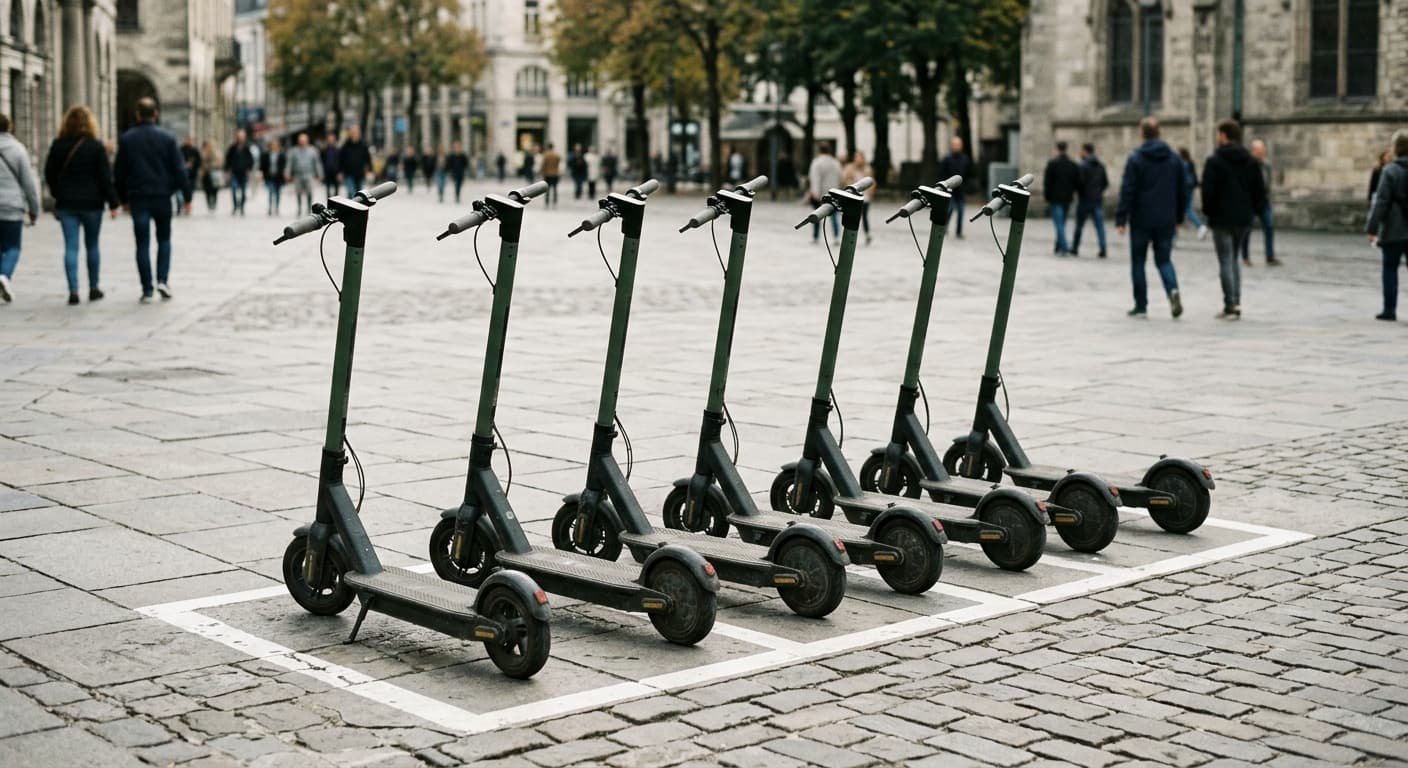
Hartford currently runs its shared e-scooter program with Veo, after earlier partnerships with Lime and then Superpedestrian, which ceased operations at the end of 2023. The city layers designated parking zones and fleet caps onto the state's roadway and bike-lane framework through its municipal permit process, on top of the section 14-286b rules that apply to every rider in the state.

If you are hit by a car or another vehicle while riding an electric foot scooter, or if a scooter rider is involved in a collision with you, the general framework in Connecticut car accident laws covers fault and insurance questions that generally extend to scooter riders as road users, and an attorney can explain how that applies to your specific situation.
Frequently Asked Questions
Can I ride an e-scooter on the sidewalk in Connecticut?
Yes by default, unless your municipality bans it. Section 14-286 permits riding an electric foot scooter along a sidewalk or across a roadway on a crosswalk, but you must yield the right-of-way to any pedestrian and give an audible signal within a reasonable distance before overtaking and passing one. Sidewalk and crosswalk riding is prohibited only where a city, town, or borough ordinance, or an Office of the State Traffic Administration regulation, prohibits it, so check your city's rules.
Do I need a license to ride an e-scooter in Connecticut?
No. Connecticut's electric foot scooter statute, section 14-286b, does not require a driver's license or registration to operate one.
Do I have to wear a helmet on an e-scooter in Connecticut?
Only if you are 15 or younger. Section 14-286d requires a helmet for children age 15 and under riding an electric foot scooter, but does not impose a helmet mandate on adult riders.
Can a child ride an e-scooter in Connecticut?
The statute does not set a minimum age to operate an electric foot scooter, but any child 15 or under must wear a helmet, and the rental-business helmet-supply obligation in section 14-286d applies if the scooter is rented.
What counts as an electric foot scooter under Connecticut law?
Section 14-1 defines it as weighing no more than 75 pounds, having two or three wheels with a stand-on floorboard, and a maximum speed of 20 mph.
What's the penalty for an e-scooter violation in Connecticut?
A violation of the operating rules in section 14-286b is classified as an infraction, the lowest tier of Connecticut traffic violation. A violation of section 14-286, which covers sidewalk and crosswalk use, bridges, and sidewalk parking, is also an infraction.
Is there a shared e-scooter program in Hartford?
Yes. Hartford currently partners with Veo, following earlier programs with Lime and Superpedestrian.
Is Connecticut's e-scooter law different from Massachusetts or Rhode Island?
Yes. Connecticut has a clearly defined device category and no license requirement, unlike Massachusetts, which requires a driver's license, and Rhode Island, which has no statutory category for a stand-up e-scooter at all.
Injured in Connecticut? Get a free case review from a personal-injury attorney
If someone else's negligence caused your injury, you may be owed compensation for medical bills, lost wages, and pain and suffering. Get a free, no-obligation review from a Connecticut personal-injury attorney. Most work on contingency, so there is no upfront cost.
Updates
Corrected the sidewalk section to reflect that Connecticut law affirmatively permits and regulates e-scooter sidewalk riding by default subject to local bans, restated the keep-right and hand-on-handlebars rules to match the statutory text, and noted that violations of section 14-286 are infractions alongside those of section 14-286b.
Corrected the article's claim that an electric foot scooter counts as a 'motor vehicle' for DUI purposes; Connecticut law (CGS 14-1(60)) expressly excludes electric foot scooters from that definition.
Governing law re-checked for recent changes
Independently fact-checked against the cited primary sources
The Law Behind This Article
This article rests on the statutory provisions below, held in our own legal record and retrieved from the official source. Tap a section to read the operative text.
Connecticut General Statutes, Title 14 (Motor Vehicles. Use of the Highway By Vehicles. Gasoline), Chapter 248
§ 14-286bOperation of bicycles, electric bicycles and electric foot scooters on roadways. Prohibitions re attaching to moving vehicle. Penalty.In force
(a) Any person operating a bicycle, an electric bicycle or an electric foot scooter upon a roadway at less than the normal speed of traffic shall ride as close to the right side of the roadway as is safe, as judged by such person, except when: (1) Overtaking or passing another vehicle proceeding in the same direction; (2) Preparing for a left turn at an intersection or into a private road or driveway; (3) Reasonably necessary to avoid conditions, including, but not limited to, fixed or moving objects, parked or moving vehicles, bicycles, pedestrians, animals, surface hazards or lanes that are too narrow for a bicycle, an electric bicycle or an electric foot scooter and a motor vehicle to travel safely side by side within such lanes; (4) Approaching an intersection where right turns are permitted and there is a dedicated right turn lane, in which case a person operating a bicycle, an electric bicycle or an electric foot scooter may ride on the left-hand side of such dedicated lane, even if such person does not intend to turn right; (5) Riding on a roadway designated for one-way traffic, when the person operating a bicycle, an electric bicycle or an electric foot scooter may…
Official text (excerpt) · last checked 2026-09-07 · Read the full text in our law library · Verify at cga.ct.gov
Connecticut General Statutes, Title 14 (Motor Vehicles. Use of the Highway By Vehicles. Gasoline), Chapter 246
§ 14-1Definitions.In force
Terms used in this chapter shall be construed as follows, unless another construction is clearly apparent from the language or context in which the term is used or unless the construction is inconsistent with the manifest intention of the General Assembly: (1) “Activity vehicle” means a student transportation vehicle that is used to transport students in connection with school-sponsored events and activities, but is not used to transport students to and from school; (2) “Agricultural tractor” means a tractor or other form of nonmuscular motive power used for transporting, hauling, plowing, cultivating, planting, harvesting, reaping or other agricultural purposes on any farm or other private property, or used for the purpose of transporting, from one farm to another, agricultural implements and farm products, provided the agricultural tractor is not used on any highway for transporting a pay load or for some other commercial purpose; (3) “Antique, rare or special interest motor vehicle” means a motor vehicle twenty years old or older which is being preserved because of historic interest and which is not altered or modified from the original manufacturer's specifications; (4)…
Official text (excerpt) · last checked 2026-07-29 · Read the full text in our law library · Verify at cga.ct.gov
Cited in 102 court opinions in our collectionLatest citing opinion in our collection: 2025
Opinions citing this section in our collection:
- Beloff v. Progressive Casualty Insurance (Supreme Court of Connecticut 1987, 203 Conn. 45)“…38-175a itself would appear to resolve the issue before us. General Statutes § 14-1 (7), 7 however, defines only “commerci…”
- State v. Kluttz (Connecticut Appellate Court 1987, 9 Conn. App. 686)“…for purposes of General Statutes § 14-222a, by reference to General Statutes § 14-1 (41). That statute, in turn, defines “p…”
- Dias v. Adams (Supreme Court of Connecticut 1983, 189 Conn. 354)“…not a “motor vehicle” as *357 delineated in General Statutes § 14-1 (26), 2 to which § 31-293a…”
Identified automatically from the court opinions citing this section — not a ranking of which case controls.
Search our full record of US law — 2.1 million sections, every state + federal →
Sources and References
- CGS section 14-1, definitions (electric foot scooter)(cga.ct.gov).gov
- CGS Chapter 248, sections 14-286, 14-286a, 14-286b, 14-286d(cga.ct.gov).gov
- Connecticut General Assembly, Public Act 19-162 (2019, created the electric foot scooter category)(cga.ct.gov).gov
- Hartford Business Journal, Hartford's Veo scooter partnership(hartfordbusiness.com)