
Australia
Public Liability Claims in Tasmania: The Civil Liability Act, Injury Thresholds and Time Limits
Independently fact-checked against primary sources (last audited August 20, 2026). · 4 primary sources cited on this page. How we verify our legal content

In Tasmania, a public liability claim runs under the Civil Liability Act 2002 without a dedicated occupiers' liability law, but gives occupiers a no-duty-to-warn rule and a dangerous recreational activity defence that Victoria's equivalent Act does not have.
Tasmania is one of eight jurisdictions covered in our Australia Public Liability hub, which explains what a public liability claim is and how it differs from a workplace injury, a motor accident, or a wrongful death claim. This page covers how Tasmania's own Act, defences, thresholds and time limits work.
Who You Claim Against and Under Which Act
A public liability claim in Tasmania is an ordinary negligence claim against whoever controlled the premises or activity where the injury happened, a shop, a venue, a landlord, an event organiser, or a council or other public authority. The Civil Liability Act 2002 governs the claim once it is brought: it sets the general standard of care and breach test in Part 6, the obvious-risk and recreational-activity defences in the same Part, the public-authority and roads protections in Part 9, and the damages assessment rules in Part 7. As with other states, the claim in practice is answered by whichever public liability insurer covers the occupier or authority, though the legal claim itself runs against the occupier or authority.
The Occupier's Duty: No Dedicated Occupiers' Act
Tasmania has no codified occupiers' liability law equivalent to Victoria's Wrongs Act Part IIA. The Civil Liability Act 2002's own Part list, checked heading by heading across its 18 Parts, including Preliminary, Intoxication, Recovery by Criminals, Apologies, Structured Settlements, Provisional Damages, Breach of Duty, Assessment of Damages, Mental Harm, Good Samaritans, Food Donors, Liability of Public and Other Authorities, Proportionate Liability, Volunteers, Accommodation Provider, Rights Between Employer and Employee, and Child Abuse Liability of Organisations, contains no occupiers' liability Part. An occupier's duty appears to rest on the general negligence standard set by Part 6, Division 2, section 11: a person does not breach a duty to take reasonable care unless the risk was foreseeable, not insignificant, and a reasonable person would have taken precautions against it. This is the weakest-confidence finding in Tasmania's public liability framework: the absence of an occupiers' Part within the Civil Liability Act itself is directly confirmed, but a title and full-text search of every current and repealed Tasmanian Act and statutory rule found no standalone occupiers' statute under any name. Tasmania's occupiers' liability genuinely rests on the common law applied through this Act's negligence framework.
The Defences: No Duty to Warn and Dangerous Recreational Activities
Part 6, Division 4 covers obvious risk. Section 15 defines an obvious risk in the same broad terms as Victoria, a risk that would have been obvious to a reasonable person in the injured person's position, which can include a risk of low probability, but adds a subsection Victoria's equivalent does not have: a risk is not an obvious risk merely because a warning about it was given. Section 16 presumes an injured person was aware of an obvious risk once a voluntary-assumption-of-risk defence is raised, with no carve-out for professional, health-service or work-risk claims, unlike Victoria's equivalent, which excludes those categories.
Two provisions give Tasmanian occupiers meaningfully stronger protection than Victoria's Wrongs Act. Section 17 removes any proactive duty to warn another person of an obvious risk, subject to three exceptions: the injured person requested advice about the risk, a written law requires the warning, or the defendant is a non-medical professional and the risk is death or personal injury arising from a professional service. And Division 5, sections 18 to 20, adds a dangerous recreational activity defence: a person is not liable for harm from the materialisation of an obvious risk of a dangerous recreational activity the injured person themselves engaged in, whether or not they were actually aware of the risk, where a dangerous recreational activity is one involving a significant degree of risk of physical harm. Victoria has neither of these provisions. A separate, narrower defence in Part 9, section 39, applies only to public authorities: an authority owes no duty of care for a risk that was the subject of a risk warning given to a person engaging in a recreational activity, a defence lost if the harm resulted from breach of a safety-specific written law, a contradictory representation, compulsion by the authority, or the authority's reckless disregard.
Claims Over Footpaths and Roads
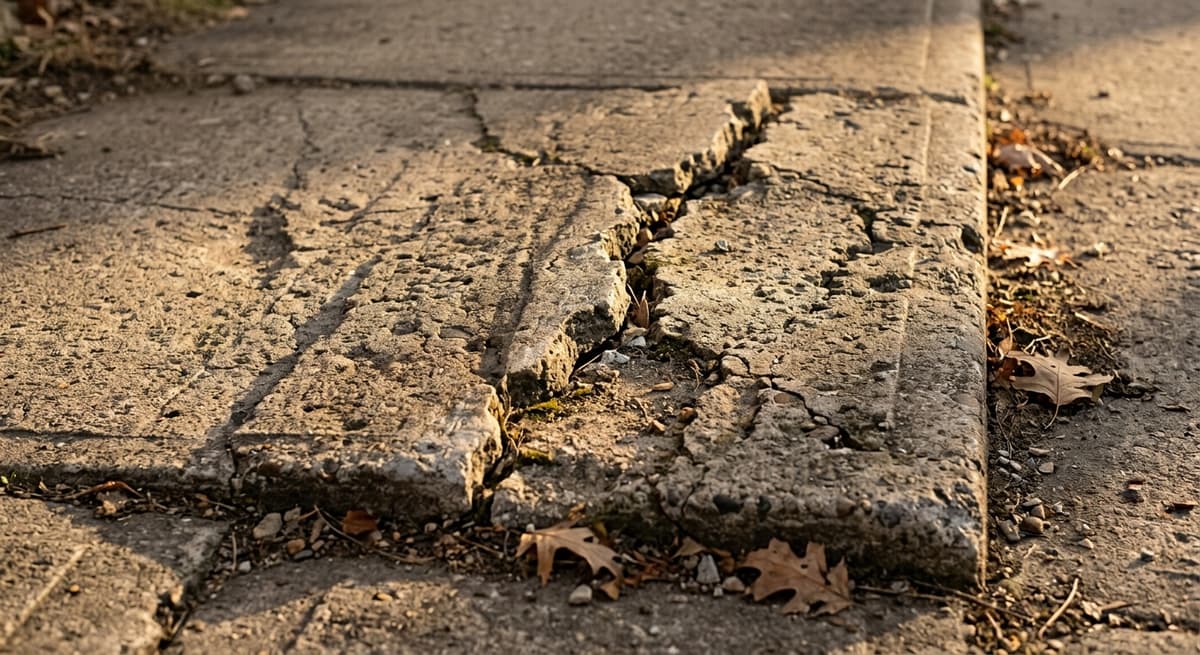
Unlike Victoria, where the roads protection sits in a wholly separate Act, Tasmania's roads protection sits inside the Civil Liability Act itself, in Part 9 alongside the general public-authority provisions. Section 42 protects a public or other authority responsible for road work from liability for a failure to carry out that work, or to consider carrying it out, unless the authority had actual knowledge of the facts creating the particular risk at the time of the alleged failure. Section 42(3) defines "road" broadly to expressly include a footpath, bridge, or other place open to or used by the public, directly covering a footpath trip-and-fall claim. The general public-authority provisions in the same Part apply alongside this protection: section 38 requires a court to weigh the authority's limited resources and broad range of functions, and expressly states the reasonableness of the authority's allocation of those resources is not open to challenge, a stronger ouster of judicial second-guessing than Victoria's equivalent provision. Section 40 sets the same high bar for a breach-of-statutory-duty claim as Victoria, conduct so unreasonable no authority in that position could properly consider it a reasonable exercise of its functions.
Intoxication and Illegal Conduct
Tasmania treats intoxication and illegal conduct more directly than a state that only asks a court to weigh them as factors. Part 2, section 5, creates a rebuttable presumption: if the injured person was intoxicated to the extent their capacity to exercise due care was impaired, they are presumed to have been contributorily negligent, unless the court is satisfied the intoxication did not contribute to the harm. Once the presumption applies, section 5(2) sets a statutory default reduction of 25 percent, or a greater or lesser percentage the court considers appropriate, with the injured person bearing the onus of showing a lower figure is warranted.
Part 3 goes further, providing a full bar rather than a reduction. Section 6 states a court is not to award damages where the injured person was, on the balance of probabilities, engaged in conduct constituting a serious offence at the time, and that conduct materially contributed to the risk of the harm suffered. Section 6(3) defines a "serious offence" as one punishable by imprisonment for a term greater than 6 months, a comparatively low threshold that can capture many indictable and some summary offences, not only serious violent crime. This finding applies whether or not the injured person has actually been charged with or convicted of the offence; the civil court makes its own finding independent of any criminal proceeding.
What Compensation Covers: An Indexed Threshold, Not a Single Cap
Tasmania structures its non-economic loss damages, pain, suffering and loss of the amenities of life, as an indexed deductible threshold rather than a single dollar cap. Section 27(1) provides that if the assessed non-economic loss is not more than "Amount A," no damages for non-economic loss are awarded at all. Section 27(3) provides that if the assessed amount is more than "Amount B," the full assessed amount is awarded, with the threshold no longer suppressing anything. Between the two figures, section 27(2) applies a sliding-scale formula. Amount A starts from a 2003 base of $4,000 and is recalculated each financial year by a CPI-Hobart formula; Amount B is fixed at five times Amount A. The Tasmanian Department of Justice's own published indexed-amounts page confirms the current FY2026-27 figures: Amount A is $7,500 and Amount B is $37,500. A separate cap in section 26(1) limits earning-capacity damages to three times the adult average weekly earnings published by the Australian Bureau of Statistics, a formula-pegged limit rather than a fixed dollar figure.
Contributory Negligence and Time Limits
Tasmania's contributory negligence rule for an ordinary personal injury claim sits in a separate, older Act, the Wrongs Act 1954, not the Civil Liability Act 2002. Section 23 of the Civil Liability Act sets the standard, an ordinary reasonable-person test judged on the injured person's actual or constructive knowledge, "for the purpose of apportioning liability under section 4 of the Wrongs Act 1954." Section 4(1) of that 1954 Act then allows a reduction of up to 100 percent, defeating the claim entirely, to the extent the court thinks just and equitable.
The general limitation period is 3 years from when the injury and its cause were reasonably discoverable, under the Limitation Act 1974, section 5A(3), governing negligence, nuisance and breach-of-duty actions. Section 5A(5) allows a court to extend this to 6 years from discoverability if it is just and reasonable to do so, though that extension is discretionary, not automatic. No express 12-year long-stop provision, of the kind Victoria's limitation law has, was found in the sections reviewed, an absence that has not been confirmed with the same certainty as the other findings on this page and should be treated as an open question rather than a settled negative. Section 26A separately suspends time running for a minor or person under a disability for each period without a capable representative.
What This Claim Is Not
A public liability claim is separate from a workplace injury claim, which runs through WorkSafe Tasmania's scheme; see Workers Compensation in Tasmania. It is also separate from a motor-vehicle injury claim, which runs through the Motor Accidents Insurance Board's no-fault scheme rather than the Civil Liability Act's general negligence provisions; see Motor Accident Compensation in Tasmania. Where the injury results in death, the claim becomes a wrongful death claim brought under the Fatal Accidents Act 1934 by the deceased's family or estate rather than the injured person; see Wrongful Death in Tasmania. And an injury on rented residential premises can also raise separate obligations a landlord owes under Tasmania's tenancy law; see Tenant Rights in Australia for how that framework works.

Frequently Asked Questions
Is there a codified occupiers' liability law in Tasmania?
No dedicated occupiers' liability Part exists in the Civil Liability Act 2002, and a search of every current and repealed Tasmanian Act found no standalone occupiers' statute either. An occupier's duty rests on the general negligence framework in Part 6.
Does a Tasmanian occupier have to warn me of an obvious danger?
Generally no. Section 17 of the Civil Liability Act removes any proactive duty to warn of an obvious risk, subject to exceptions where the injured person asked for the information, a written law requires the warning, or the defendant is a non-medical professional and the risk arises from a professional service.
Is there a dangerous recreational activity defence in Tasmania?
Yes. Sections 18 to 20 provide that a person is not liable for harm from the materialisation of an obvious risk of a dangerous recreational activity the injured person engaged in, whether or not they were actually aware of the risk.
Who do I claim against if I trip on a Tasmanian footpath?
The relevant council or other public authority. Section 42 of the Civil Liability Act protects an authority responsible for road work from liability unless it had actual knowledge of the particular risk, and the section's own definition of road expressly includes footpaths.
How much can I recover for pain and suffering in Tasmania?
It depends on where the assessed non-economic loss falls against two indexed figures set under section 27. Below Amount A, currently $7,500 for FY2026-27, no non-economic loss damages are awarded at all. Above Amount B, currently $37,500, the full assessed amount is awarded. Between the two figures, a sliding scale set out in the Act applies.
Does being intoxicated affect my compensation in Tasmania?
Yes, more directly than in some other states. Section 5 creates a rebuttable presumption that an intoxicated injured person was contributorily negligent, with a statutory default reduction of 25 percent, unless they show the intoxication did not contribute to the harm.
Can I lose my claim entirely because of my own conduct?
Yes, two separate ways. Section 6 bars damages altogether if the injured person was engaged in conduct constituting a serious offence, one punishable by more than 6 months imprisonment, that materially contributed to the risk. Separately, ordinary contributory negligence under the Wrongs Act 1954 can reduce damages by up to 100 percent.
How long do I have to bring a public liability claim in Tasmania?
Generally 3 years from when the injury and its cause were reasonably discoverable, under the Limitation Act 1974, section 5A, extendable to 6 years at a court's discretion if just and reasonable. No express 12-year long-stop provision was found in the sections reviewed.
Updates
Independently fact-checked against the cited primary sources
Sources and References
- Civil Liability Act 2002 (Tas): Part 6 (Breach of Duty, including ss15-20 obvious risk and dangerous recreational activity), Part 7 (Assessment of Damages, s26-s27 earning capacity and non-economic loss threshold), Part 9 (Liability of Public and Other Authorities, s36-s43 including s42 roads protection), Part 2 (Intoxication, s4A-s5), Part 3 (Recovery by Criminals, s5A-s6)(legislation.tas.gov.au).gov
- Tasmanian Department of Justice: current indexed Civil Liability Act amounts, confirming Amount A $7,500 and Amount B $37,500 for FY2026-27(justice.tas.gov.au).gov
- Wrongs Act 1954 (Tas): section 4, contributory negligence apportionment up to a 100 percent reduction(legislation.tas.gov.au).gov
- Limitation Act 1974 (Tas): section 5A, three year discoverability period for personal injury actions and discretionary six year extension(legislation.tas.gov.au).gov