Minnesota Child Support Laws: Guidelines and Calculations

How Child Support Works in Minnesota
Minnesota law requires both parents to contribute financially to raising their children, even after separation or divorce. The state's child support program is governed by Minnesota Statutes Chapter 518A, which establishes guidelines for calculating, modifying, and enforcing support obligations.
As of July 2025, the Minnesota Department of Children, Youth, and Families (DCYF) oversees child support services statewide. DCYF took over this responsibility from the Department of Human Services (DHS) as part of a broader state agency restructuring that began on July 1, 2024. County agencies continue to administer cases, provide services, and work directly with parents on a local level.
Child support in Minnesota is divided into three separate components, each addressed individually in a court order:
- Basic support covers everyday expenses like housing, food, clothing, and transportation for the child
- Medical support covers health and dental insurance premiums and unreimbursed medical expenses
- Childcare support covers work-related or education-related daycare and childcare costs
How Child Support Is Calculated in Minnesota
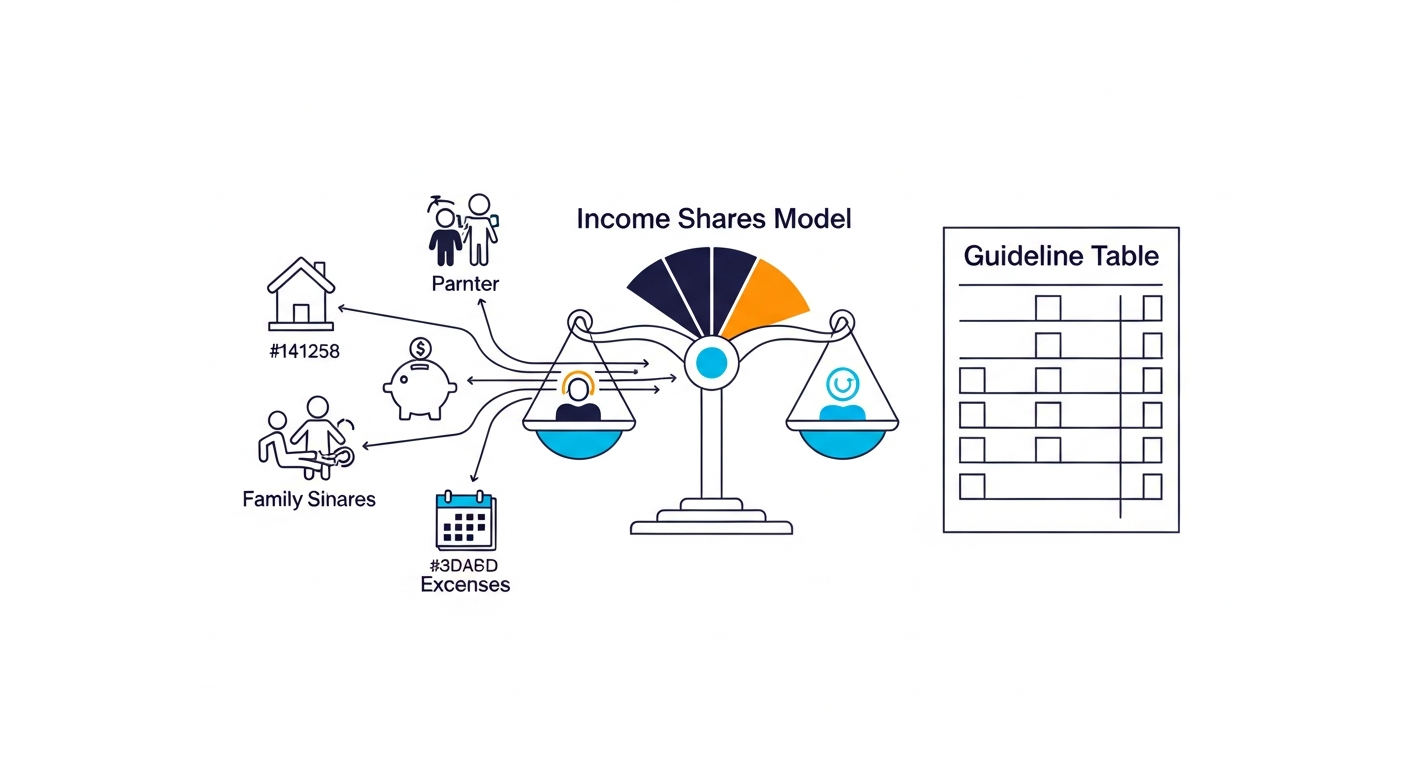
Minnesota uses the Income Shares Model to calculate child support under Minnesota Statutes section 518A.35. This model considers the combined gross income of both parents and assigns each parent a proportionate share of the total support obligation.
The idea behind the Income Shares Model is straightforward: children should receive the same proportion of parental income they would have received if both parents lived together. Both parents' incomes are combined, and each parent's share of the obligation is based on their percentage of that combined total.
What Counts as Gross Income
Under Minnesota Statutes section 518A.29, gross income includes nearly all forms of periodic payment, such as:
- Salaries, wages, and commissions
- Self-employment income
- Workers' compensation and unemployment benefits
- Pension, annuity, and retirement payments
- Social Security and veterans benefits provided for a joint child
- Spousal maintenance received under a previous or current order
- Potential income (imputed income if a parent is voluntarily underemployed or unemployed)
Gross income does not include child support received from another case, adoption assistance payments, foster care subsidies, public assistance benefits based on need, or the income of a new spouse.
Basic Calculation Steps
The court follows a specific process under section 518A.34 to determine each parent's obligation:
- Calculate each parent's gross monthly income from all sources
- Subtract any credits for nonjoint children (children from other relationships) to arrive at the Parental Income for Child Support (PICS)
- Combine both parents' PICS to get the total combined monthly PICS
- Determine each parent's percentage share of the combined PICS
- Look up the basic support obligation in the statutory guideline table based on the combined PICS and number of children
- Multiply the guideline amount by each parent's percentage share
- Apply the parenting expense adjustment based on each parent's court-ordered parenting time
The Minnesota Department of Children, Youth, and Families provides an online child support calculator (Version 4.2, updated February 2026) to estimate support amounts. This calculator is helpful for planning but provides estimates only.
To use the calculator, you will need:
- Each parent's gross monthly income from all sources
- Information about existing child support orders
- The number of joint children and any nonjoint children
- Spousal maintenance order amounts
- Cost of medical and dental insurance for the children
- Parenting time percentage from the court order
- Work-related or education-related childcare costs
- Social Security or veterans benefits paid to the child on behalf of a parent
Minnesota Basic Support Guideline Table
Under section 518A.35, the basic support obligation depends on the parents' combined monthly PICS and the number of children. Here are selected amounts from the guideline:
| Combined Monthly PICS | 1 Child | 2 Children | 3 Children | 4 Children |
|---|---|---|---|---|
| $0 to $1,399 | $50 | $60 | $70 | $80 |
| $2,000 to $2,099 | $170 | $200 | $235 | $270 |
| $3,000 to $3,099 | $415 | $525 | $598 | $665 |
| $4,000 to $4,099 | $625 | $845 | $954 | $1,041 |
| $5,000 to $5,099 | $818 | $1,132 | $1,281 | $1,387 |
| $6,000 to $6,099 | $988 | $1,383 | $1,577 | $1,703 |
| $8,000 to $8,099 | $1,106 | $1,548 | $1,765 | $1,907 |
| $10,000 to $10,099 | $1,230 | $1,722 | $1,963 | $2,121 |
| $15,000 to $15,099 | $1,539 | $2,155 | $2,457 | $2,654 |
| $20,000 and over | $1,839 | $2,575 | $2,935 | $3,170 |
For combined incomes exceeding $20,000 per month, the presumed basic obligation matches the $20,000 level. The court may order a higher amount if the child has demonstrated needs that exceed the guideline, such as a disability, special education requirements, or other substantial needs under section 518A.43.
Parenting Expense Adjustment
The parenting expense adjustment (PEA) under section 518A.36 recognizes that a parent with significant parenting time incurs real costs for housing, food, transportation, and daily child-related expenses during that time. The PEA reduces the basic support obligation for the obligor based on how much parenting time they have.
2025 change: Minnesota shifted from a stepped (categorical) adjustment system to a continuous formula. Under the old rules, a parent needed at least 45.1% parenting time to receive the most substantial reduction. Under the 2025 rules, the threshold dropped to 40%, and the credit is calculated on a smooth, continuous scale rather than in discrete brackets. This change provides a fairer outcome for shared-custody families where small differences in overnight parenting time previously caused large jumps in the support amount.
If both parents have equal parenting time (50/50) and equal incomes, the court generally will not order basic support unless one parent carries a disproportionate share of expenses like insurance or childcare.

Medical Support and Childcare Support
Beyond basic support, Minnesota courts must separately address medical support and childcare support in every order.
Medical Support
Under section 518A.41, the court orders both parents to share the cost of health and dental insurance premiums and all unreimbursed medical expenses. These costs are divided based on each parent's proportionate share of the combined monthly PICS, just like basic support.
Medical support is considered child support for enforcement purposes but is not subject to cost-of-living adjustments.
Childcare Support
Under section 518A.40, childcare support covers work-related or education-related childcare expenses. The amount is based on actual childcare costs and is divided between the parents in proportion to their PICS. Childcare support obligations typically end when the child enters school full-time or no longer needs daycare.
How to Apply for Child Support in Minnesota
The Minnesota DCYF Child Support Division oversees the statewide child support system. To apply:
- Download and complete the application forms
- Contact DCYF online or call 800-657-3890
- Visit your county's Human or Social Services Department in person
Key points to keep in mind:
- If the parents are not married, paternity must be established before the court can order support. Minnesota allows paternity to be established through a Recognition of Parentage form signed by both parents, genetic testing, or a court order.
- A $25 application fee applies, though it may be waived for low-income applicants.
- District judges, district court referees, and child support magistrates all have authority to set support amounts.
How to Modify Child Support in Minnesota
Minnesota provides two main paths for adjusting an existing child support order: the biennial cost-of-living adjustment (COLA) and a formal modification.
Cost-of-Living Adjustments (COLA)
Under section 518A.75, most child support orders include a provision for automatic biennial (every two years) cost-of-living adjustments. The adjustment is based on a cost-of-living index, typically the Consumer Price Index for all urban consumers (CPI-U) for the Minneapolis-St. Paul area.
For cases receiving full child support enforcement services, the child support office notifies both parents and automatically applies the adjustment on May 1 of the applicable year. COLA increases are compounded over time.
Important 2025 legislative update: The Minnesota Legislature passed a bill that will phase out COLA adjustments for maintenance and child support orders effective January 1, 2027. Existing orders with COLA provisions will be affected by this change. Parents should consult an attorney or their county child support office for guidance on how this may affect their case.
Formal Modification
Either parent may petition for a modification based on a "substantial change in circumstances" under section 518A.39. The law creates a rebuttable presumption that modification is warranted when:
- The current guideline calculation differs from the existing order by at least 20% and at least $75 per month (or 20% if the current order is less than $75)
- A parent's gross income has decreased by at least 20% through no fault or choice of their own
- There is a substantial increase or decrease in a parent's earnings or income
- There is a significant change in the cost or availability of health care coverage
- Work-related or education-related childcare expenses have changed substantially
- A child has been emancipated
- The medical provisions in the existing order are no longer enforceable
To request a modification, use the ezDocs system or call 651-531-5655. Filing fees may be waived for those who cannot afford them.

Enforcement and Penalties for Non-Payment
The Child Support Division within DCYF enforces child support orders throughout Minnesota. County agencies handle day-to-day enforcement, with the state providing oversight, technology systems, and disbursement services.
Administrative Enforcement Tools
Minnesota uses a wide range of enforcement methods to collect unpaid support:
- Automatic income withholding: Every child support order includes an income withholding provision. Employers must withhold support from the obligor's wages and report all new hires to the state.
- Bank account garnishment: The Financial Institution Data Match (FIDM) program allows the state to identify and levy bank accounts held by parents who owe past-due support.
- Federal and state tax refund intercepts: Overdue support can be collected by intercepting federal and state income tax refunds.
- Credit bureau reporting: Arrears are reported to the major credit bureaus, which can affect the obligor's credit score, ability to obtain loans, and employment prospects.
- License sanctions: The state can suspend or restrict driver's licenses, recreational licenses, and occupational or professional licenses for parents with overdue support.
- Passport denial: Under federal law, if arrears exceed $2,500, the U.S. State Department will deny, restrict, or revoke the obligor's passport.
- Property liens: Unpaid support becomes a judgment by operation of law on the date it is due and can be enforced as a lien against real property and motor vehicle titles.
- Student financial aid holds: Financial aid disbursements may be withheld.
- Interest on arrears: Interest may be charged on unpaid support balances.
Payment Agreements
An obligor who cannot pay the full amount may enter a written payment agreement with the child support agency. The court or child support magistrate must consider the obligor's financial circumstances and approve a reasonable payment plan. Compliance with the agreement may suspend active enforcement actions.
Criminal Penalties
Under Minnesota Statutes section 609.375, willful failure to pay court-ordered child support is a crime:
- Gross misdemeanor: Punishable by up to 1 year in jail and/or a fine of up to $3,000
- Felony: Punishable by up to 2 years in prison and/or a fine of up to $5,000 for more serious or repeated violations
Statute of Limitations on Arrears
There is no statute of limitations on collecting child support arrears in Minnesota. Unpaid support remains enforceable indefinitely. However, the statute of limitations on enforcing a money judgment is 10 years, so periodic renewal of the judgment may be necessary for long-outstanding arrears.
When Does Child Support End in Minnesota?
Under section 518A.26, child support in Minnesota ends when the child reaches age 18 or graduates from high school, whichever occurs later, but no later than age 20.
Specifically, a "child" for support purposes is defined as:
- A person under 18 years of age
- A person under age 20 who is still attending secondary school (high school)
- A person of any age who is incapable of self-support due to a physical or mental condition
This means if a child turns 18 during their senior year of high school, support continues until graduation, but the obligation cannot extend past the child's 20th birthday regardless of school enrollment.
Support may continue indefinitely if the child has a physical or mental disability that prevents self-sufficiency. The court determines this on a case-by-case basis.
Support does not automatically terminate just because a child moves out of the custodial parent's home, as long as the child has not otherwise emancipated.
Emancipation in Minnesota
Minnesota does not have a specific statutory procedure for the emancipation of minors. Courts determine emancipation on a case-by-case basis, considering:
- The best interests of the child
- The minor's living situation and ability to support themselves
- Whether the parents have given express or implied consent to emancipation
Events that may support a finding of emancipation include lawful marriage, active military service, express parental consent, or a court order.
Termination of Parental Rights
A parent may voluntarily terminate parental rights to allow adoption by a stepparent or other adoptive parent. The court must determine that termination serves the child's best interests. Involuntary termination may occur when a parent has abandoned the child, failed to provide required support, engaged in egregious harm, or is otherwise unfit. Termination of parental rights ends the support obligation going forward, but does not erase arrears already owed.
2025 Legislative Changes at a Glance
Several important changes to Minnesota child support law took effect in 2025:
- Parenting expense adjustment: The threshold for the largest PEA credit dropped from 45.1% to 40% parenting time, and the adjustment formula changed from a stepped system to a continuous calculation.
- Social Security and veterans benefits: Effective January 1, 2025, any regular or lump-sum payment of Social Security or apportioned veterans' benefits received by the obligee for the benefit of a joint child based on the obligor's disability may be credited against arrears upon a motion to modify.
- Self-support reserve increase: The self-support reserve increased from 120% to 130% of the federal poverty guideline for one person, protecting more of a low-income obligor's earnings.
- COLA phase-out: The legislature voted to eliminate biennial cost-of-living adjustments for child support and spousal maintenance orders, effective January 1, 2027.
- Calculator update: The official Minnesota Child Support Calculator was updated to version 4.2 (February 2026) to reflect all 2025 legislative changes.
More Minnesota Laws
Sources and References
- Minnesota Statutes Chapter 518A - Child Support(revisor.mn.gov).gov
- Section 518A.35 - Guideline Used in Child Support Determinations(revisor.mn.gov).gov
- Section 518A.34 - Computation of Child Support Obligations(revisor.mn.gov).gov
- Section 518A.29 - Calculation of Gross Income(revisor.mn.gov).gov
- Section 518A.36 - Parenting Expense Adjustment(revisor.mn.gov).gov
- Section 518A.39 - Modification of Orders or Decrees(revisor.mn.gov).gov
- Section 518A.41 - Medical Support(revisor.mn.gov).gov
- Section 518A.40 - Child Care Support(revisor.mn.gov).gov
- Section 518A.75 - Cost-of-Living Adjustments(revisor.mn.gov).gov
- Section 518A.43 - Deviation from Guidelines(revisor.mn.gov).gov
- Section 518A.26 - Definitions(revisor.mn.gov).gov
- Section 609.375 - Nonsupport of Spouse or Child(revisor.mn.gov).gov
- Minnesota DCYF - Child Support Services(dcyf.mn.gov).gov
- Minnesota Child Support Guidelines Calculator(dhs.state.mn.us).gov
- DCYF - Cost of Living Adjustments for Child Support(dcyf.mn.gov).gov
- DCYF - Changing a Child Support Order(dcyf.mn.gov).gov
- Minnesota DHS - Enforcing Child Support Orders(mn.gov).gov