Michigan's Child Support Laws: Guidelines, Calculations, and Enforcement

How Child Support Works in Michigan
Michigan uses the Income Shares Model to calculate child support. This approach considers the combined income of both parents and assigns each parent a share of the support obligation based on their proportionate contribution to that combined income.
The goal of the Income Shares Model is straightforward. Children should receive the same proportion of parental income they would have received if both parents lived together. Rather than placing the full burden on one parent, the formula distributes the obligation fairly based on what each parent earns.
The Michigan Child Support Formula (MCSF) is maintained by the State Court Administrative Office (SCAO) and updated periodically to reflect economic changes. The most recent version took effect on January 1, 2025.
Michigan law requires all child support orders to follow the MCSF unless the court finds that applying the formula would produce an unjust or inappropriate result under MCL 552.605.
How Child Support Is Calculated in Michigan
The basic calculation process involves several steps. Courts work through each step methodically to arrive at a support amount that reflects each family's unique financial situation.
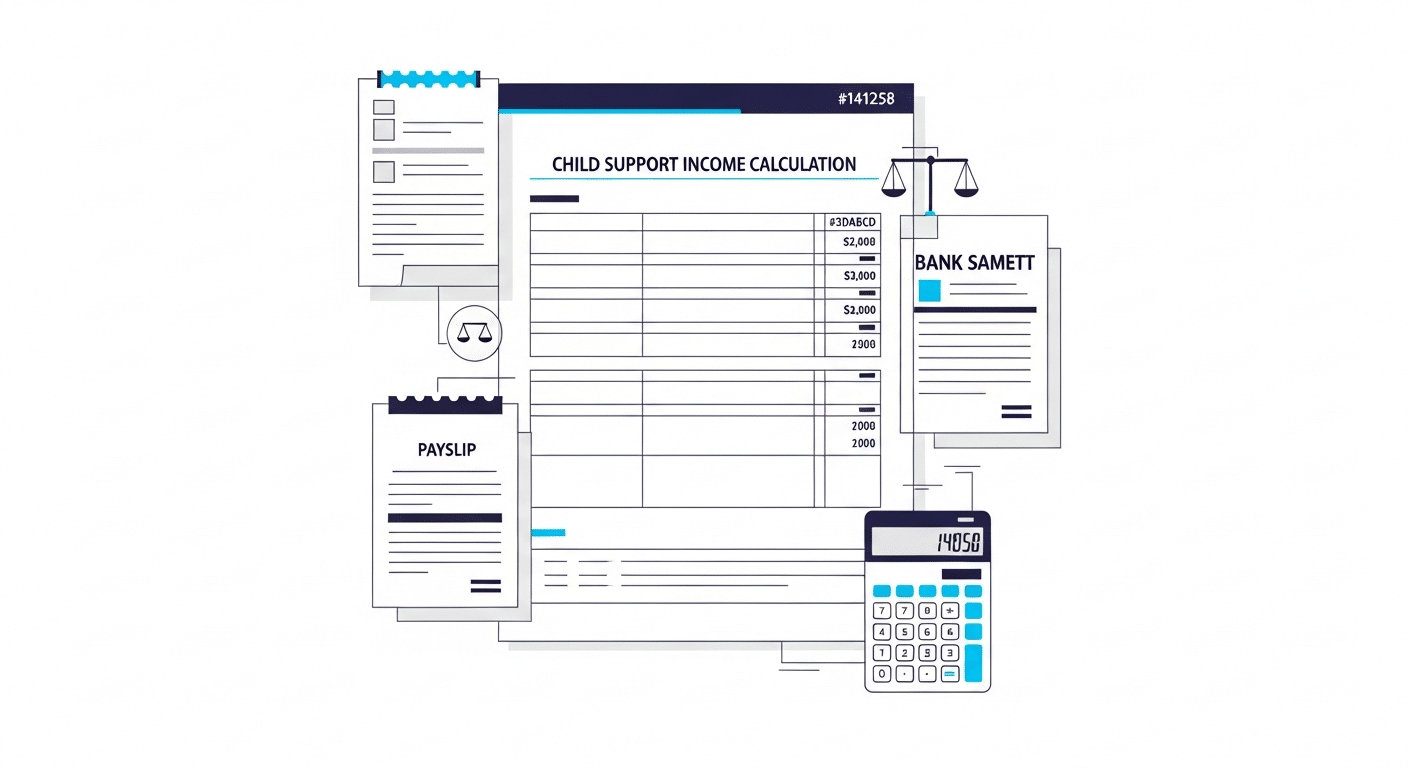
Step 1: Determine Each Parent's Net Income
The court first calculates each parent's net income from all sources. This includes wages, salaries, bonuses, overtime pay, commissions, self-employment income, rental income, investment returns, Social Security benefits, unemployment compensation, workers' compensation, and pension or retirement income.
Certain deductions are subtracted from gross income to arrive at net income. These include federal and state income taxes, FICA contributions, mandatory retirement contributions, existing child support obligations for other children, and union dues.
Step 2: Combine Both Parents' Incomes
The court adds both parents' net incomes together to determine the combined family income. This total is the baseline for calculating the support obligation.
Step 3: Calculate Each Parent's Percentage Share
Each parent's net income is divided by the combined total to determine their percentage share. For example, if one parent earns $4,000 per month and the other earns $2,000, the first parent's share is 66.7% and the second parent's share is 33.3%.
Step 4: Apply the Base Support Obligation
Using the MCSF guidelines tables, the court determines the base support obligation for the combined income level and number of children. Each parent is responsible for their percentage share of that obligation.
Step 5: Adjust for Parenting Time (Overnights)
The number of overnights each child spends with each parent directly affects the support amount. More overnights with the paying parent reduces the support obligation, since that parent covers more direct costs during those overnights.
Step 6: Add Healthcare and Childcare Costs
The court factors in health insurance premiums, ordinary medical expenses, and work-related childcare costs. These expenses are divided between parents based on their income shares.
You can estimate your support obligation using the Michigan Child Support Calculator (MiCase), the state's official online tool.
2025 Michigan Child Support Formula Changes
The Michigan Supreme Court approved significant updates to the child support formula effective January 1, 2025. These changes affect how income is determined, how expenses are divided, and how deviations are handled.
Income Determination Changes
The 2025 formula includes several important updates to how income is calculated.
Reduced or deferred income. The formula now clarifies when to count income when a business does not distribute profits (Rule 2.01(E)(4)(d)(i)). This prevents parents from hiding income inside a business entity.
Accelerated depreciation. Accelerated depreciation must be added back to a parent's income. However, with proof, the court may use the lesser of actual expenses or straight-line depreciation (Rule 2.01(E)(4)(e)(iii)).
Imputing income. Courts may now consider additional costs associated with employment for the children when imputing income to an unemployed or underemployed parent (Rule 2.01(G)(3)).
Incarceration costs. A new deduction from income is allowed for costs related to a parent's conviction or incarceration (Rule 2.07(H)).
Calculation and Expense Changes
Expense apportionment. The formula now uses each parent's actual share of income for apportioning all expenses. The previous 10% minimum and 90% maximum caps have been eliminated (Rule 3.01(B)). This means a parent with very low income may have their percentage reduced to zero at the court's discretion.
Ordinary medical expenses. The annual amount for ordinary medical expenses has been reduced from $454 per child to $200 per child (Rule 3.04(A)). The Formula Committee reviewed consumer expenditure data and determined the lower amount better reflects actual out-of-pocket medical costs for most families. The support recipient must cover the first $200 in medical expenses per child per year, with costs above that threshold shared between parents as extraordinary medical expenses.
Childcare age. The presumed age for childcare eligibility changed to the last day of the month the child turns 13, up from the previous cutoff of age 12 (Rule 3.06(D)). This aligns with how dependent care credits are treated under federal tax law.
Deviation Clarifications
The 2025 formula also clarifies deviation rules. The existence of a deviation factor does not require the court to deviate from the formula amount (Rule 1.04(E)). The list of deviation factors is explicitly stated to be non-exhaustive. Several factors that are now directly addressed in the formula have been removed from the deviation list.
Factors That Determine Child Support in Michigan
Under MCL 552.605, the court considers several factors when calculating support obligations.
- Net income of both parents. All income sources are evaluated, including wages, self-employment earnings, investment returns, and government benefits.
- Number of overnights. The parenting time schedule directly affects the support calculation, with more overnights reducing the paying parent's obligation.
- Healthcare costs. Health insurance premiums, ordinary medical expenses (first $200 per child annually), and extraordinary medical costs are all factored into the calculation.
- Childcare expenses. Work-related or education-related childcare costs for children under age 13 are included in the formula.
- Number of children. The base support obligation increases with the number of children requiring support.
- Existing support obligations. Support orders for children from other relationships are deducted from income before calculating the new obligation.
- Special needs. A child with extraordinary medical, educational, or developmental needs may require a deviation from the standard formula amount.

Deviations from the Child Support Formula
While courts must follow the Michigan Child Support Formula, they may deviate from the calculated amount when strict application would be unjust or inappropriate. Per MCL 552.605(2), the court must set forth in writing or on the record the reasons for any deviation.
Common reasons for deviation include:
- A child with special educational, medical, or developmental needs that create extraordinary expenses
- Extraordinary educational expenses beyond typical schooling costs
- A minor parent with limited income capacity
- An incarcerated parent with minimal or no income or assets
- Overnights spent with a non-parent recipient or caregiver
- Significant disparity in the parents' living situations that affects the child
- Any other factor the court deems relevant to the child's best interests
The 2025 formula emphasizes that a deviation is not automatic just because a deviation factor exists. The court retains discretion to determine whether the factor warrants departing from the formula in each specific case.
How to Modify Child Support in Michigan
Michigan law allows either parent to request a modification of a child support order when there has been a significant change in circumstances. You can petition the court yourself or retain an attorney to file on your behalf.
Automatic Reviews
If either parent receives public assistance, the Friend of the Court automatically reviews the child support order every 36 months. Parents who do not receive public assistance may still request a review every 36 months.
What Qualifies as a Substantial Change
The Friend of the Court will only recommend a modification if the difference between the current support amount and the recalculated amount is at least 10% of the current order (or at least $50, whichever is greater). Common changes that may justify a modification include:
- Job loss, layoff, or significant reduction in income
- A substantial increase in either parent's income
- Changes in the parenting time schedule
- Changes in childcare or healthcare costs
- A child aging out of the support order
- A new support obligation for another child
Documents Needed for Modification
To request a modification, you will typically need:
- Recent pay stubs or a statement of wages from your employer
- State and federal income tax returns with all schedules, 1099s, and W-2s
- FOC39e (Child care verification form) if requesting childcare reimbursement
- Documentation of the changed circumstances (medical records, layoff notice, new custody order, etc.)
Contact the Friend of the Court at 1-877-543-2660 for assistance with the modification process.

How to Pay Child Support in Michigan
All child support payments in Michigan are processed through the Michigan State Disbursement Unit (MiSDU). Payments should never be made directly to the other parent, as direct payments may not be credited toward the support obligation.
Payment Methods
Michigan offers several ways to pay child support.
Income withholding. Michigan law requires all support orders to include an income withholding order. The employer deducts child support directly from the paying parent's paycheck, similar to tax withholding. This is the most common and reliable method.
Online payment. Parents can submit credit card payments through MiSDU.com.
Phone payment. Payments can be made by calling the Friend of the Court Interactive Voice Response System at 1-877-543-2660.
Mail. Checks or money orders can be mailed to: Michigan State Disbursement Unit, P.O. Box 30351, Lansing, Michigan 48909-7851.
Retail locations. MiSDU partners with PayNearMe to allow cash payments at CVS Pharmacy, 7-Eleven, and Family Dollar stores nationwide.
Enforcement and Penalties for Non-Payment
The Friend of the Court enforces child support orders in Michigan using a range of administrative and legal tools. Enforcement actions escalate based on the amount and duration of the arrearage.
Administrative Enforcement Methods
- Income withholding orders. Sent to employers, Social Security, unemployment, or workers' compensation to collect support directly from income sources.
- Tax refund intercepts. If back support exceeds $150, state and federal tax refunds may be intercepted to pay the arrearage.
- Credit bureau reporting. Delinquent child support is reported to all three major credit bureaus, affecting credit scores and loan eligibility.
- Property liens. A lien may be placed against real or personal property if payments are more than two months behind.
- Passport denial. The U.S. State Department will deny, revoke, or limit passports when past-due support reaches $2,500 under federal law.
- License suspension. Driver's licenses, professional licenses, and recreational licenses may be suspended for non-payment.
- Financial account seizure. Bank accounts, investment accounts, and other financial assets may be seized to satisfy a child support arrearage.
Criminal Penalties Under MCL 750.165
Willful failure to pay court-ordered child support is a felony in Michigan under MCL 750.165. Penalties include:
- Up to 4 years in prison
- A fine of up to $2,000
- Or both imprisonment and a fine
Upon arrest, the individual must post a cash bond of at least $500 or 25% of the arrearage (whichever is greater) or remain in custody until arraignment. The court may suspend the sentence if the individual files a bond and commits to a payment plan.
Statute of Limitations on Back Support
The statute of limitations for collecting back child support in Michigan is 10 years from the date the last payment was due. This typically means 10 years after the child turns 18 (or 19 and a half if the high school extension applies).
Michigan does not have a formal arrearage forgiveness program. However, the court may allow parents with significant debt to negotiate a reasonable payment plan for the outstanding balance.
When Does Child Support End in Michigan?
Child support in Michigan typically terminates when the child:
- Turns 18 years old
- Turns 19 years and 6 months old if still attending high school full time (under MCL 552.605b)
- Gets married
- Joins the military on active duty
- Becomes legally emancipated
- Dies
Support does not end automatically in Michigan. The paying parent must file a motion to terminate the support order, even after the child reaches the qualifying age. Failing to file could result in continued accrual of the support obligation.
Support may continue indefinitely if the child has a mental or physical incapacity that prevents them from supporting themselves.
High School Extension Rule
Under MCL 552.605b, child support continues past age 18 if the child is regularly attending high school full time with a reasonable expectation of graduating. The child must reside full time with the support recipient or at an institution. Support under this provision cannot extend beyond age 19 and a half under any circumstances.
A parent seeking this extension must file a complaint or motion before the child reaches age 19 and a half.
Emancipation in Michigan
A minor in Michigan may petition the court for emancipation if they are at least 16 years old and can demonstrate:
- Michigan residency
- The ability to manage personal, social, and financial affairs
- A legal source of income and financial independence from parents
Emancipation terminates the child support obligation. Download SCAO-approved emancipation forms here.
More Michigan Laws
Sources and References
- MCL 552.605 - Child Support Guidelines(legislature.mi.gov).gov
- MCL 552.605b - Child Support After Age 18(legislature.mi.gov).gov
- MCL 750.165 - Criminal Non-Payment of Child Support(legislature.mi.gov).gov
- 2025 Michigan Child Support Formula Manual(courts.michigan.gov).gov
- Michigan Child Support Formula - SCAO(courts.michigan.gov).gov
- Michigan Child Support Calculator (MiCase)(state.mi.us).gov
- Modify a Child Support Order - Michigan MDHHS(michigan.gov).gov
- Make a Child Support Payment - Michigan MDHHS(michigan.gov).gov
- Michigan State Disbursement Unit (MiSDU)(misdu.com)
- FOC39e Child Care Verification Form(courts.michigan.gov).gov
- SCAO Emancipation Forms(courts.michigan.gov).gov